

98
6 Applications of Carbon Nanostructures Produced in Molten Salts
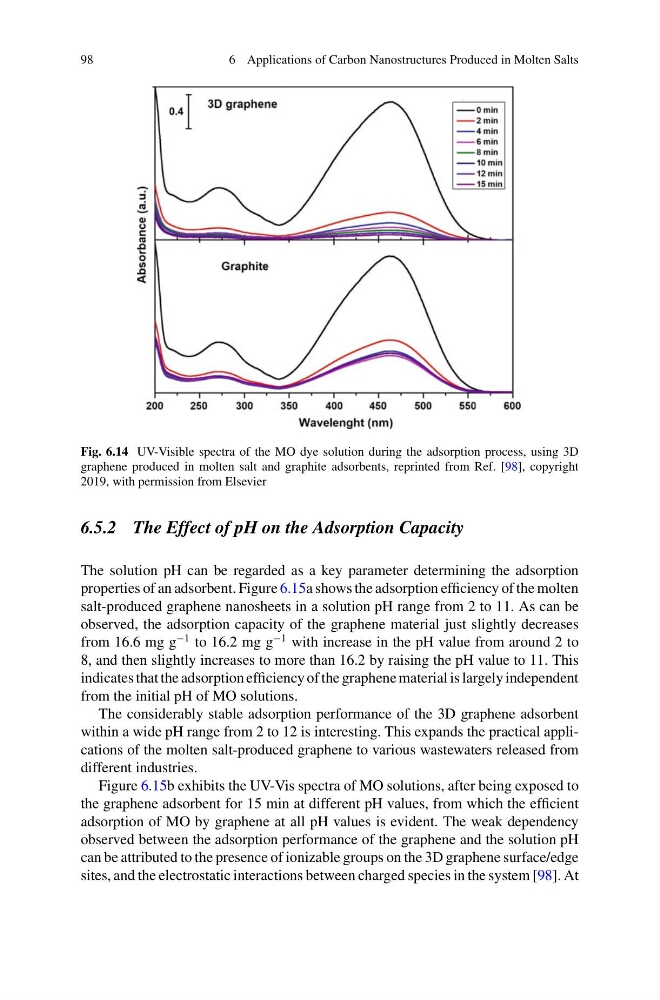
Fig. 6.14 UV-Visible spectra of the MO dye solution during the adsorption process, using 3D
graphene produced in molten salt and graphite adsorbents, reprinted from Ref. [98], copyright
2019, with permission from Elsevier
6.5.2 The Effect of pH on the Adsorption Capacity
The solution pH can be regarded as a key parameter determining the adsorption
properties of an adsorbent. Figure 6.15a shows the adsorption efficiency of the molten
salt-produced graphene nanosheets in a solution pH range from 2 to 11. As can be
observed, the adsorption capacity of the graphene material just slightly decreases
from 16.6 mg g
−1 to 16.2 mg g
−1 with increase in the pH value from around 2 to
8, and then slightly increases to more than 16.2 by raising the pH value to 11. This
indicates that the adsorption efficiency of the graphene material is largely independent
from the initial pH of MO solutions.
The considerably stable adsorption performance of the 3D graphene adsorbent
within a wide pH range from 2 to 12 is interesting. This expands the practical applications of the molten salt-produced graphene to various wastewaters released from
different industries.
Figure 6.15b exhibits the UV-Vis spectra of MO solutions, after being exposed to
the graphene adsorbent for 15 min at different pH values, from which the efficient
adsorption of MO by graphene at all pH values is evident. The weak dependency
observed between the adsorption performance of the graphene and the solution pH
can be attributed to the presence of ionizable groups on the 3D graphene surface/edge
sites, and the electrostatic interactions between charged species in the system [98]. At
6 Applications of Carbon Nanostructures Produced in Molten Salts
Fig. 6.14 UV-Visible spectra of the MO dye solution during the adsorption process, using 3D
graphene produced in molten salt and graphite adsorbents, reprinted from Ref. [98], copyright
2019, with permission from Elsevier
6.5.2 The Effect of pH on the Adsorption Capacity
The solution pH can be regarded as a key parameter determining the adsorption
properties of an adsorbent. Figure 6.15a shows the adsorption efficiency of the molten
salt-produced graphene nanosheets in a solution pH range from 2 to 11. As can be
observed, the adsorption capacity of the graphene material just slightly decreases
from 16.6 mg g
−1 to 16.2 mg g
−1 with increase in the pH value from around 2 to
8, and then slightly increases to more than 16.2 by raising the pH value to 11. This
indicates that the adsorption efficiency of the graphene material is largely independent
from the initial pH of MO solutions.
The considerably stable adsorption performance of the 3D graphene adsorbent
within a wide pH range from 2 to 12 is interesting. This expands the practical applications of the molten salt-produced graphene to various wastewaters released from
different industries.
Figure 6.15b exhibits the UV-Vis spectra of MO solutions, after being exposed to
the graphene adsorbent for 15 min at different pH values, from which the efficient
adsorption of MO by graphene at all pH values is evident. The weak dependency
observed between the adsorption performance of the graphene and the solution pH
can be attributed to the presence of ionizable groups on the 3D graphene surface/edge
sites, and the electrostatic interactions between charged species in the system [98]. At