

94
6 Applications of Carbon Nanostructures Produced in Molten Salts
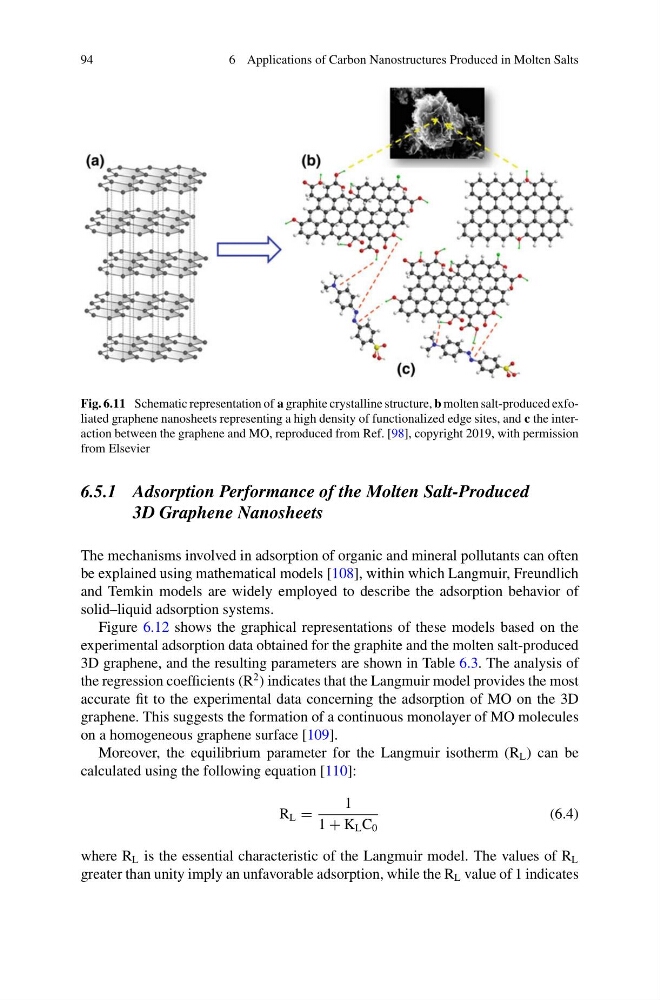
Fig. 6.11 Schematic representation of a graphite crystalline structure, b molten salt-produced exfoliated graphene nanosheets representing a high density of functionalized edge sites, and c the interaction between the graphene and MO, reproduced from Ref. [98], copyright 2019, with permission
from Elsevier
6.5.1 Adsorption Performance of the Molten Salt-Produced
3D Graphene Nanosheets
The mechanisms involved in adsorption of organic and mineral pollutants can often
be explained using mathematical models [108], within which Langmuir, Freundlich
and Temkin models are widely employed to describe the adsorption behavior of
solid–liquid adsorption systems.
Figure 6.12 shows the graphical representations of these models based on the
experimental adsorption data obtained for the graphite and the molten salt-produced
3D graphene, and the resulting parameters are shown in Table 6.3. The analysis of
the regression coefficients (R
2 ) indicates that the Langmuir model provides the most
accurate fit to the experimental data concerning the adsorption of MO on the 3D
graphene. This suggests the formation of a continuous monolayer of MO molecules
on a homogeneous graphene surface [109].
Moreover, the equilibrium parameter for the Langmuir isotherm (R L ) can be
calculated using the following equation [110]:
R L =
1
1 + K L C 0
(6.4)
where R L is the essential characteristic of the Langmuir model. The values of R L
greater than unity imply an unfavorable adsorption, while the R L value of 1 indicates
6 Applications of Carbon Nanostructures Produced in Molten Salts
Fig. 6.11 Schematic representation of a graphite crystalline structure, b molten salt-produced exfoliated graphene nanosheets representing a high density of functionalized edge sites, and c the interaction between the graphene and MO, reproduced from Ref. [98], copyright 2019, with permission
from Elsevier
6.5.1 Adsorption Performance of the Molten Salt-Produced
3D Graphene Nanosheets
The mechanisms involved in adsorption of organic and mineral pollutants can often
be explained using mathematical models [108], within which Langmuir, Freundlich
and Temkin models are widely employed to describe the adsorption behavior of
solid–liquid adsorption systems.
Figure 6.12 shows the graphical representations of these models based on the
experimental adsorption data obtained for the graphite and the molten salt-produced
3D graphene, and the resulting parameters are shown in Table 6.3. The analysis of
the regression coefficients (R
2 ) indicates that the Langmuir model provides the most
accurate fit to the experimental data concerning the adsorption of MO on the 3D
graphene. This suggests the formation of a continuous monolayer of MO molecules
on a homogeneous graphene surface [109].
Moreover, the equilibrium parameter for the Langmuir isotherm (R L ) can be
calculated using the following equation [110]:
R L =
1
1 + K L C 0
(6.4)
where R L is the essential characteristic of the Langmuir model. The values of R L
greater than unity imply an unfavorable adsorption, while the R L value of 1 indicates