

Congestion flag to north neighbor
Addr decoder
Port controller
North input FIFO
East input FIFO
Addr decoder
Addr decoder
Addr decoder
Addr decoder
Port controller
Port controller
Port controller
Port controller
Congestion flag to east neighbor
Congestion flag to south neighbor
Congestion flag to west neighbor
South input FIFO
West input FIFO
Local input FIFO
Mode controller
Crossbar arbiter
Crossbar
switch
North out port
South out port
West out port
Local out port
East out port
Congestion flag of east neighbor
Congestion flag of west neighbor
Congestion flag of south neighbor
Congestion flag of west neighbor
71
Architecture Design of Network-on-Chip
When the network is not congested, a DyAD router works in a deterministic
mode and hence enjoying low routing latency. On the contrary, when the
network becomes congested, the DyAD router switches back to the adaptive
routing mode and thus avoids the congested links by exploiting other routing paths; this leads to higher network throughput.
This section presents the actual router design, DyAD–OE, which implements the concept of DyAD for odd–even routing. Combining odd–even
and XY to form a DyAD router may lead to deadlock. Thus, a new routing scheme has been developed, called oe-fixed, as the deterministic routing
mode in DyAD–OE. The oe-fixed is indeed a deterministic version of odd–even
based on removing the odd–even’s adaptiveness. For instance, in the odd–
even mode, if a packet with a given source and destination can be routed to
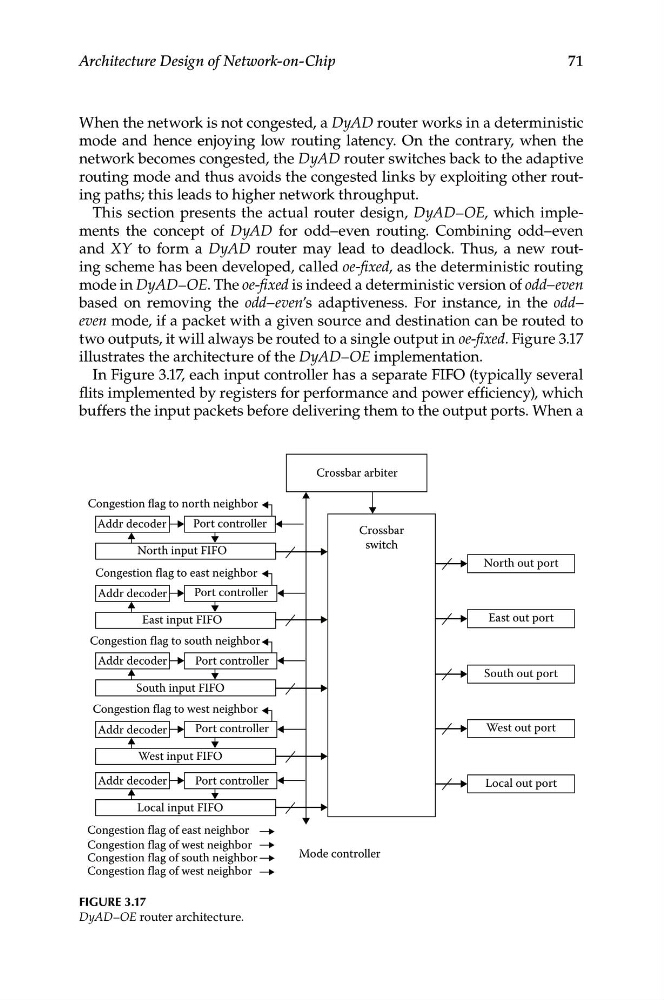
two outputs, it will always be routed to a single output in oe-fixed. Figure 3.17
illustrates the architecture of the DyAD–OE implementation.
In Figure 3.17, each input controller has a separate FIFO (typically several
flits implemented by registers for performance and power efficiency), which
buffers the input packets before delivering them to the output ports. When a
Figure 3.17
DyAD–OE router architecture.
Addr decoder
Port controller
North input FIFO
East input FIFO
Addr decoder
Addr decoder
Addr decoder
Addr decoder
Port controller
Port controller
Port controller
Port controller
Congestion flag to east neighbor
Congestion flag to south neighbor
Congestion flag to west neighbor
South input FIFO
West input FIFO
Local input FIFO
Mode controller
Crossbar arbiter
Crossbar
switch
North out port
South out port
West out port
Local out port
East out port
Congestion flag of east neighbor
Congestion flag of west neighbor
Congestion flag of south neighbor
Congestion flag of west neighbor
71
Architecture Design of Network-on-Chip
When the network is not congested, a DyAD router works in a deterministic
mode and hence enjoying low routing latency. On the contrary, when the
network becomes congested, the DyAD router switches back to the adaptive
routing mode and thus avoids the congested links by exploiting other routing paths; this leads to higher network throughput.
This section presents the actual router design, DyAD–OE, which implements the concept of DyAD for odd–even routing. Combining odd–even
and XY to form a DyAD router may lead to deadlock. Thus, a new routing scheme has been developed, called oe-fixed, as the deterministic routing
mode in DyAD–OE. The oe-fixed is indeed a deterministic version of odd–even
based on removing the odd–even’s adaptiveness. For instance, in the odd–
even mode, if a packet with a given source and destination can be routed to
two outputs, it will always be routed to a single output in oe-fixed. Figure 3.17
illustrates the architecture of the DyAD–OE implementation.
In Figure 3.17, each input controller has a separate FIFO (typically several
flits implemented by registers for performance and power efficiency), which
buffers the input packets before delivering them to the output ports. When a
Figure 3.17
DyAD–OE router architecture.