

24
Network-on-Chip
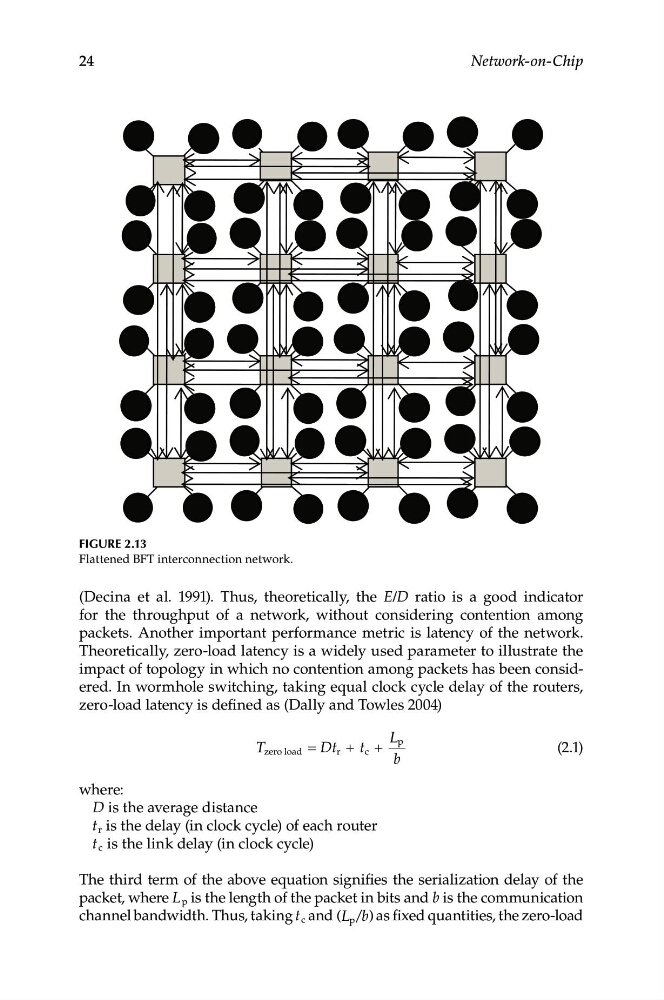
Figure 2.13
Flattened BFT interconnection network.
(Decina et al. 1991). Thus, theoretically, the E/D ratio is a good indicator
for the throughput of a network, without considering contention among
packets. Another important performance metric is latency of the network.
Theoretically, zero-load latency is a widely used parameter to illustrate the
impact of topology in which no contention among packets has been considered. In wormhole switching, taking equal clock cycle delay of the routers,
zero-load latency is defined as (Dally and Towles 2004)
L p
T zero load = Dt r + t c +
(2.1)
b
where:
D is the average distance
t r is the delay (in clock cycle) of each router
t c is the link delay (in clock cycle)
The third term of the above equation signifies the serialization delay of the
packet, where L p is the length of the packet in bits and b is the communication
channel bandwidth. Thus, taking t c and ( p b
L / ) as fixed quantities, the zero-load
Network-on-Chip
Figure 2.13
Flattened BFT interconnection network.
(Decina et al. 1991). Thus, theoretically, the E/D ratio is a good indicator
for the throughput of a network, without considering contention among
packets. Another important performance metric is latency of the network.
Theoretically, zero-load latency is a widely used parameter to illustrate the
impact of topology in which no contention among packets has been considered. In wormhole switching, taking equal clock cycle delay of the routers,
zero-load latency is defined as (Dally and Towles 2004)
L p
T zero load = Dt r + t c +
(2.1)
b
where:
D is the average distance
t r is the delay (in clock cycle) of each router
t c is the link delay (in clock cycle)
The third term of the above equation signifies the serialization delay of the
packet, where L p is the length of the packet in bits and b is the communication
channel bandwidth. Thus, taking t c and ( p b
L / ) as fixed quantities, the zero-load