

356
Network-on-Chip
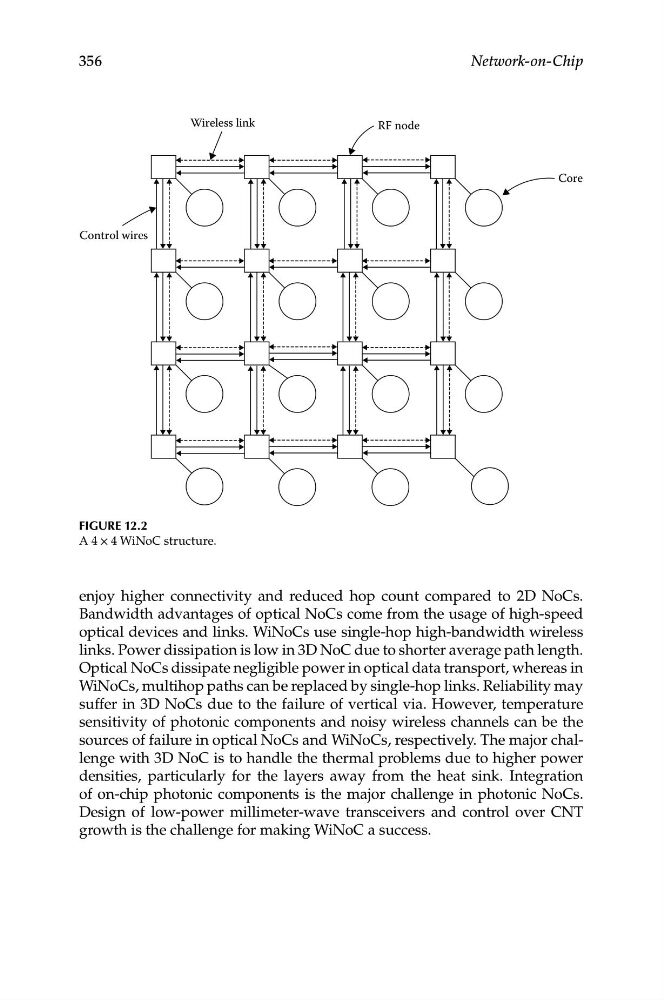
Wireless link
Control wires
RF node
Core
Figure 12.2
A 4 × 4 WiNoC structure.
enjoy higher connectivity and reduced hop count compared to 2D NoCs.
Bandwidth advantages of optical NoCs come from the usage of high-speed
optical devices and links. WiNoCs use single-hop high-bandwidth wireless
links. Power dissipation is low in 3D NoC due to shorter average path length.
Optical NoCs dissipate negligible power in optical data transport, whereas in
WiNoCs, multihop paths can be replaced by single-hop links. Reliability may
suffer in 3D NoCs due to the failure of vertical via. However, temperature
sensitivity of photonic components and noisy wireless channels can be the
sources of failure in optical NoCs and WiNoCs, respectively. The major challenge with 3D NoC is to handle the thermal problems due to higher power
densities, particularly for the layers away from the heat sink. Integration
of on-chip photonic components is the major challenge in photonic NoCs.
Design of low-power millimeter-wave transceivers and control over CNT
growth is the challenge for making WiNoC a success.
Network-on-Chip
Wireless link
Control wires
RF node
Core
Figure 12.2
A 4 × 4 WiNoC structure.
enjoy higher connectivity and reduced hop count compared to 2D NoCs.
Bandwidth advantages of optical NoCs come from the usage of high-speed
optical devices and links. WiNoCs use single-hop high-bandwidth wireless
links. Power dissipation is low in 3D NoC due to shorter average path length.
Optical NoCs dissipate negligible power in optical data transport, whereas in
WiNoCs, multihop paths can be replaced by single-hop links. Reliability may
suffer in 3D NoCs due to the failure of vertical via. However, temperature
sensitivity of photonic components and noisy wireless channels can be the
sources of failure in optical NoCs and WiNoCs, respectively. The major challenge with 3D NoC is to handle the thermal problems due to higher power
densities, particularly for the layers away from the heat sink. Integration
of on-chip photonic components is the major challenge in photonic NoCs.
Design of low-power millimeter-wave transceivers and control over CNT
growth is the challenge for making WiNoC a success.