

355
Conclusions and Future Trends
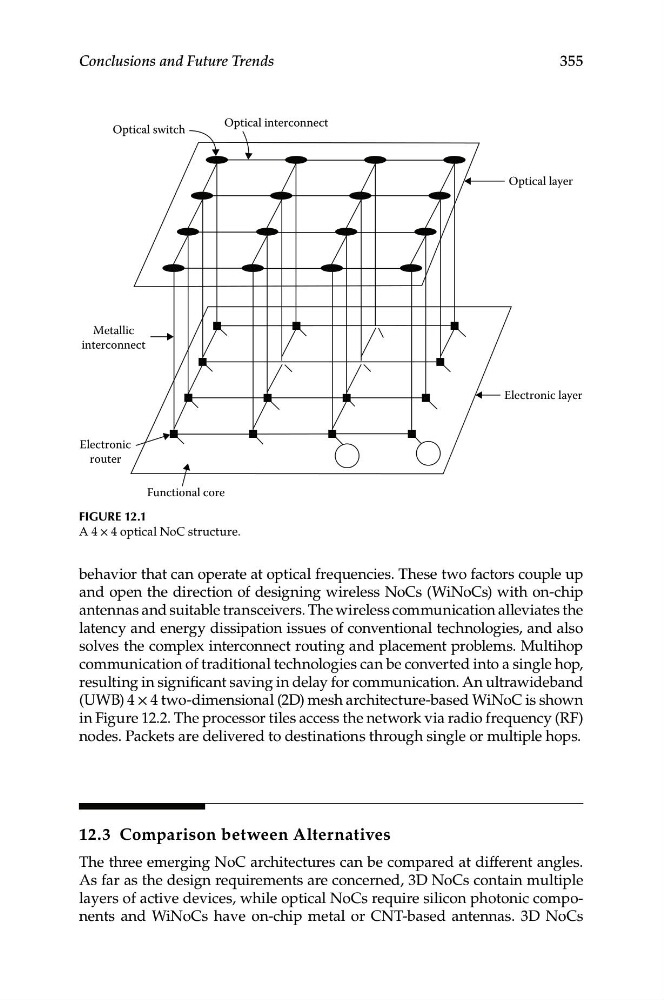
Optical switch
Metallic
interconnect
Electronic
router
Functional core
Optical layer
Electronic layer
Optical interconnect
Figure 12.1
A 4 × 4 optical NoC structure.
behavior that can operate at optical frequencies. These two factors couple up
and open the direction of designing wireless NoCs (WiNoCs) with on-chip
antennas and suitable transceivers. The wireless communication alleviates the
latency and energy dissipation issues of conventional technologies, and also
solves the complex interconnect routing and placement problems. Multihop
communication of traditional technologies can be converted into a single hop,
resulting in significant saving in delay for communication. An ultrawideband
(UWB) 4 × 4 two-dimensional (2D) mesh architecture-based WiNoC is shown
in Figure 12.2. The processor tiles access the network via radio frequency (RF)
nodes. Packets are delivered to destinations through single or multiple hops.
12.3 Comparison between Alternatives
The three emerging NoC architectures can be compared at different angles.
As far as the design requirements are concerned, 3D NoCs contain multiple
layers of active devices, while optical NoCs require silicon photonic components and WiNoCs have on-chip metal or CNT-based antennas. 3D NoCs