

log2 Z
(log2 Z)−1
S M (M × N × 2
) = S M (M × N × 2
)
(log2 Z)−1
0
⎡2
× S M (M × N × 2 ) + ⎤
(11.8)
+ ⎢
⎥
⎢ lo og2 Z
log2 Z ⎥
2
× M × N ×(2 log 2 2
)
⎣
⎦
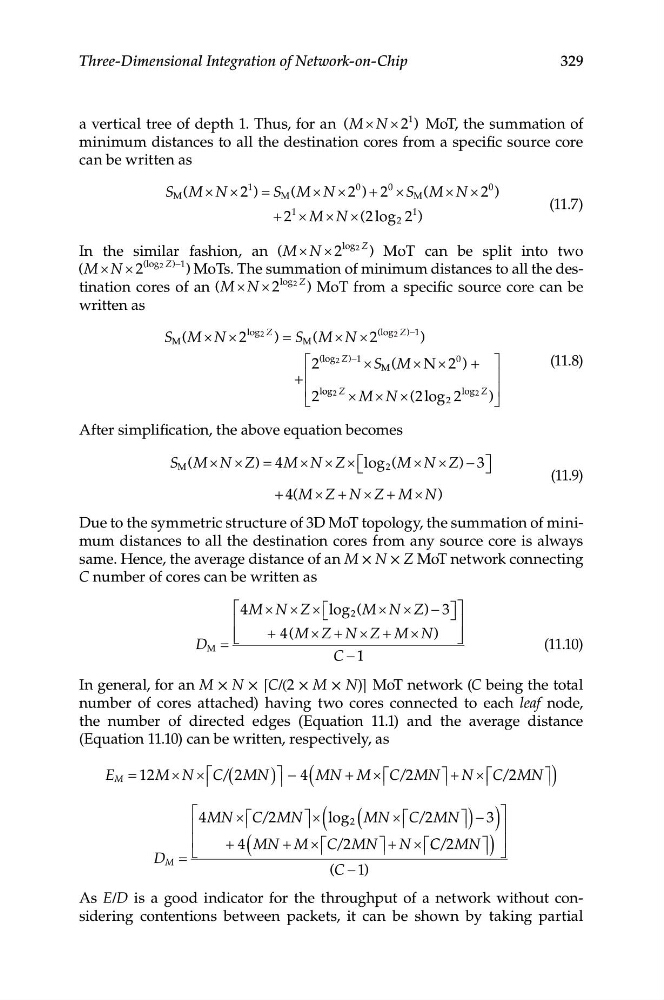
After simplification, the above equation becomes
M (
Z
) − 3⎤ ⎦
S M × N × Z) = 4M × N × × ⎡ ⎣ log 2 (M × N × Z
(11.9)
+ 4(M × Z + N × Z + M × N)
E M = 12M × N × ⎡ ⎢ C/(2MN ) ⎤ ⎥ − 4 ( MN + M × ⎡ ⎢ C/2MN ⎤ ⎥ + N × ⎡ ⎢ C/2MN ⎤ ⎥ )
⎡
⎤
4MN × ⎡ ⎢ C/2MN ⎤ ⎥ × ( log 2 ( MN × ⎡ ⎢ C/2MN ⎤ ⎥ ) − 3 )
⎢
⎥
⎢
+ 4 ( MN + M × ⎡ ⎢ C/2MN ⎤ ⎥ + N × ⎡ ⎢ C C/2MN ⎤ ⎥ ) ⎥
⎣
⎦
D M =
(C − 1)
329
Three-Dimensional Integration of Network-on-Chip
a vertical tree of depth 1. Thus, for an (M × N × 2
1 ) MoT, the summation of
minimum distances to all the destination cores from a specific source core
can be written as
1
0
0
0
S M (M × N × 2 ) = S M (M × N × 2 ) + 2 × S M (M × N × 2 )
(11.7)
+ 2
1
× M × N ×(2 log 2 2
1 )
log2 Z
In the similar fashion, an (M × N × 2
) MoT can be split into two
(log2 Z)−1
(M × N × 2
) MoTs. The summation of minimum distances to all the deslog2 Z
tination cores of an (M × N × 2
) MoT from a specific source core can be
written as
Due to the symmetric structure of 3D MoT topology, the summation of minimum distances to all the destination cores from any source core is always
same. Hence, the average distance of an M × N × Z MoT network connecting
C number of cores can be written as
⎡4M × N × ×
Z log (M × N × Z) − 3 ⎤
⎢
⎥
⎡ ⎣ 2
⎤ ⎦
⎢
+ 4(M × Z + N × Z + M × N) ⎥
⎣
⎦
D M =
(11.10)
C − 1
In general, for an M × N × ⌈C/(2 × M × N)⌉ MoT network (C being the total
number of cores attached) having two cores connected to each leaf node,
the number of directed edges (Equation 11.1) and the average distance
(Equation 11.10) can be written, respectively, as
As E/D is a good indicator for the throughput of a network without considering contentions between packets, it can be shown by taking partial
(log2 Z)−1
S M (M × N × 2
) = S M (M × N × 2
)
(log2 Z)−1
0
⎡2
× S M (M × N × 2 ) + ⎤
(11.8)
+ ⎢
⎥
⎢ lo og2 Z
log2 Z ⎥
2
× M × N ×(2 log 2 2
)
⎣
⎦
After simplification, the above equation becomes
M (
Z
) − 3⎤ ⎦
S M × N × Z) = 4M × N × × ⎡ ⎣ log 2 (M × N × Z
(11.9)
+ 4(M × Z + N × Z + M × N)
E M = 12M × N × ⎡ ⎢ C/(2MN ) ⎤ ⎥ − 4 ( MN + M × ⎡ ⎢ C/2MN ⎤ ⎥ + N × ⎡ ⎢ C/2MN ⎤ ⎥ )
⎡
⎤
4MN × ⎡ ⎢ C/2MN ⎤ ⎥ × ( log 2 ( MN × ⎡ ⎢ C/2MN ⎤ ⎥ ) − 3 )
⎢
⎥
⎢
+ 4 ( MN + M × ⎡ ⎢ C/2MN ⎤ ⎥ + N × ⎡ ⎢ C C/2MN ⎤ ⎥ ) ⎥
⎣
⎦
D M =
(C − 1)
329
Three-Dimensional Integration of Network-on-Chip
a vertical tree of depth 1. Thus, for an (M × N × 2
1 ) MoT, the summation of
minimum distances to all the destination cores from a specific source core
can be written as
1
0
0
0
S M (M × N × 2 ) = S M (M × N × 2 ) + 2 × S M (M × N × 2 )
(11.7)
+ 2
1
× M × N ×(2 log 2 2
1 )
log2 Z
In the similar fashion, an (M × N × 2
) MoT can be split into two
(log2 Z)−1
(M × N × 2
) MoTs. The summation of minimum distances to all the deslog2 Z
tination cores of an (M × N × 2
) MoT from a specific source core can be
written as
Due to the symmetric structure of 3D MoT topology, the summation of minimum distances to all the destination cores from any source core is always
same. Hence, the average distance of an M × N × Z MoT network connecting
C number of cores can be written as
⎡4M × N × ×
Z log (M × N × Z) − 3 ⎤
⎢
⎥
⎡ ⎣ 2
⎤ ⎦
⎢
+ 4(M × Z + N × Z + M × N) ⎥
⎣
⎦
D M =
(11.10)
C − 1
In general, for an M × N × ⌈C/(2 × M × N)⌉ MoT network (C being the total
number of cores attached) having two cores connected to each leaf node,
the number of directed edges (Equation 11.1) and the average distance
(Equation 11.10) can be written, respectively, as
As E/D is a good indicator for the throughput of a network without considering contentions between packets, it can be shown by taking partial