

311
Reconfigurable Network-on-Chip Design
discarded. The completed paths between a pair of nodes can also be
used to reject more costly partial paths. Moreover, if the current path
configures switches in such a way that all possible paths between
the source and destination nodes for at least one unmapped edge are
blocked, the partial path gets bounded.
10.5 Link Reconfiguration
In traditional NoC architectures, neighboring routers are connected via a
pair of unidirectional links. Each link is hardwired to carry traffic in one
direction only. However, depending upon the network traffic, it may be possible that one channel is overflowed with heavy traffic, whereas the traffic in
the other direction is almost zero. This results in inappropriate resource utilization, leading to performance loss. A strategy has been presented in Lan
et al. (2011) that supports dynamic self-reconfiguration of links, resulting in
a bidirectional NoC architecture, aptly named as BiNoC. Adjacent routers
negotiate the flow directions of connecting links using a channel direction
control (CDC) protocol.
10.5.1 estimating Channel Bandwidth utilization
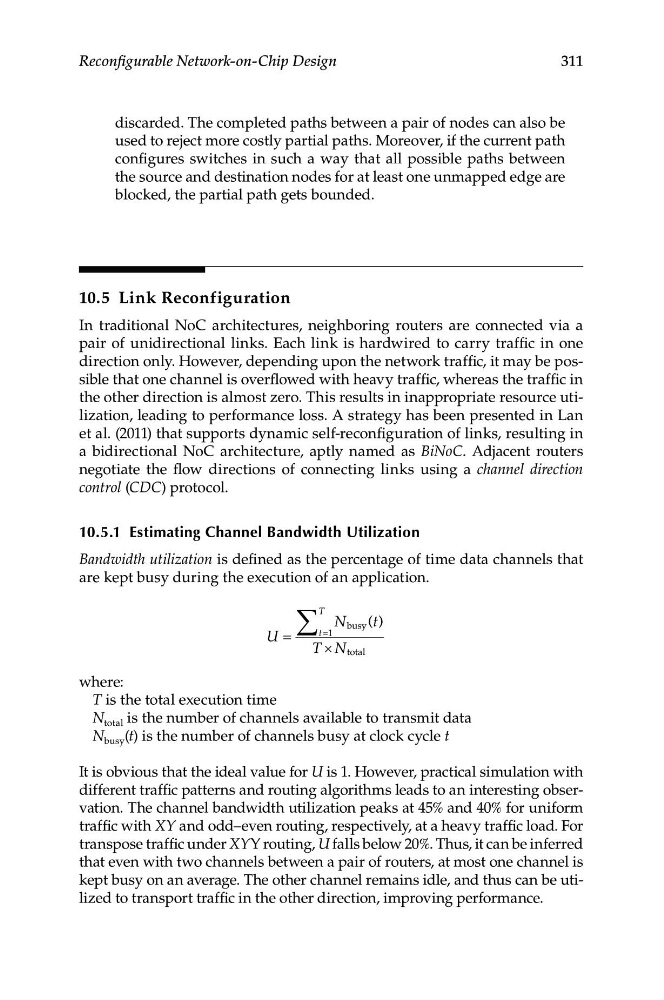
Bandwidth utilization is defined as the percentage of time data channels that
are kept busy during the execution of an application.
∑
T N busy ( )
t
t=1
U = T × N total
where:
T is the total execution time
N total is the number of channels available to transmit data
N busy (t) is the number of channels busy at clock cycle t
It is obvious that the ideal value for U is 1. However, practical simulation with
different traffic patterns and routing algorithms leads to an interesting observation. The channel bandwidth utilization peaks at 45% and 40% for uniform
traffic with XY and odd–even routing, respectively, at a heavy traffic load. For
transpose traffic under XYY routing, U falls below 20%. Thus, it can be inferred
that even with two channels between a pair of routers, at most one channel is
kept busy on an average. The other channel remains idle, and thus can be utilized to transport traffic in the other direction, improving performance.
Reconfigurable Network-on-Chip Design
discarded. The completed paths between a pair of nodes can also be
used to reject more costly partial paths. Moreover, if the current path
configures switches in such a way that all possible paths between
the source and destination nodes for at least one unmapped edge are
blocked, the partial path gets bounded.
10.5 Link Reconfiguration
In traditional NoC architectures, neighboring routers are connected via a
pair of unidirectional links. Each link is hardwired to carry traffic in one
direction only. However, depending upon the network traffic, it may be possible that one channel is overflowed with heavy traffic, whereas the traffic in
the other direction is almost zero. This results in inappropriate resource utilization, leading to performance loss. A strategy has been presented in Lan
et al. (2011) that supports dynamic self-reconfiguration of links, resulting in
a bidirectional NoC architecture, aptly named as BiNoC. Adjacent routers
negotiate the flow directions of connecting links using a channel direction
control (CDC) protocol.
10.5.1 estimating Channel Bandwidth utilization
Bandwidth utilization is defined as the percentage of time data channels that
are kept busy during the execution of an application.
∑
T N busy ( )
t
t=1
U = T × N total
where:
T is the total execution time
N total is the number of channels available to transmit data
N busy (t) is the number of channels busy at clock cycle t
It is obvious that the ideal value for U is 1. However, practical simulation with
different traffic patterns and routing algorithms leads to an interesting observation. The channel bandwidth utilization peaks at 45% and 40% for uniform
traffic with XY and odd–even routing, respectively, at a heavy traffic load. For
transpose traffic under XYY routing, U falls below 20%. Thus, it can be inferred
that even with two channels between a pair of routers, at most one channel is
kept busy on an average. The other channel remains idle, and thus can be utilized to transport traffic in the other direction, improving performance.