

305
Reconfigurable Network-on-Chip Design
et al. 2008) adds some topology switches around the individual routers.
The second one (Modarressi et al. 2011) introduces similar switches into the
topology, though not exclusively earmarked for a particular router.
10.4.1 Modification around routers
The strategy ReNoC (Stensgaard et al. 2008) combines the flexibilities of packet
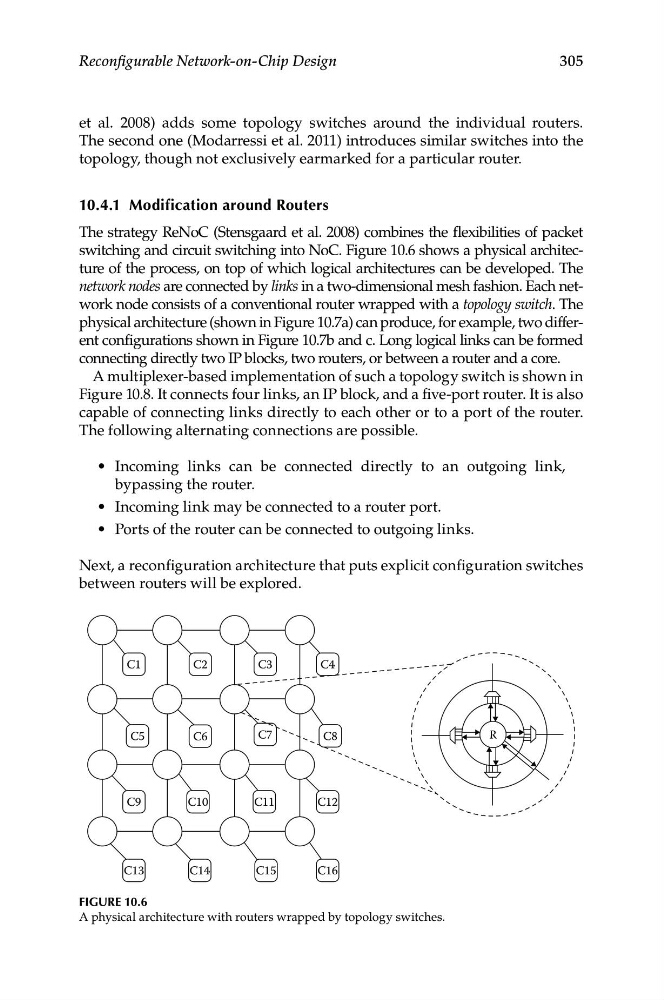
switching and circuit switching into NoC. Figure 10.6 shows a physical architecture of the process, on top of which logical architectures can be developed. The
network nodes are connected by links in a two-dimensional mesh fashion. Each network node consists of a conventional router wrapped with a topology switch. The
physical architecture (shown in Figure 10.7a) can produce, for example, two different configurations shown in Figure 10.7b and c. Long logical links can be formed
connecting directly two IP blocks, two routers, or between a router and a core.
A multiplexer-based implementation of such a topology switch is shown in
Figure 10.8. It connects four links, an IP block, and a five-port router. It is also
capable of connecting links directly to each other or to a port of the router.
The following alternating connections are possible.
• Incoming links can be connected directly to an outgoing link,
bypassing the router.
• Incoming link may be connected to a router port.
• Ports of the router can be connected to outgoing links.
Next, a reconfiguration architecture that puts explicit configuration switches
between routers will be explored.
C7
C1
C2
C3
C4
C5
C6
C8
C9
C13
C10
C14
C11
C15
C12
R
C16
Figure 10.6
A physical architecture with routers wrapped by topology switches.