

284
Network-on-Chip
r3 r7 r8 r4 r1 r5 r2 r6
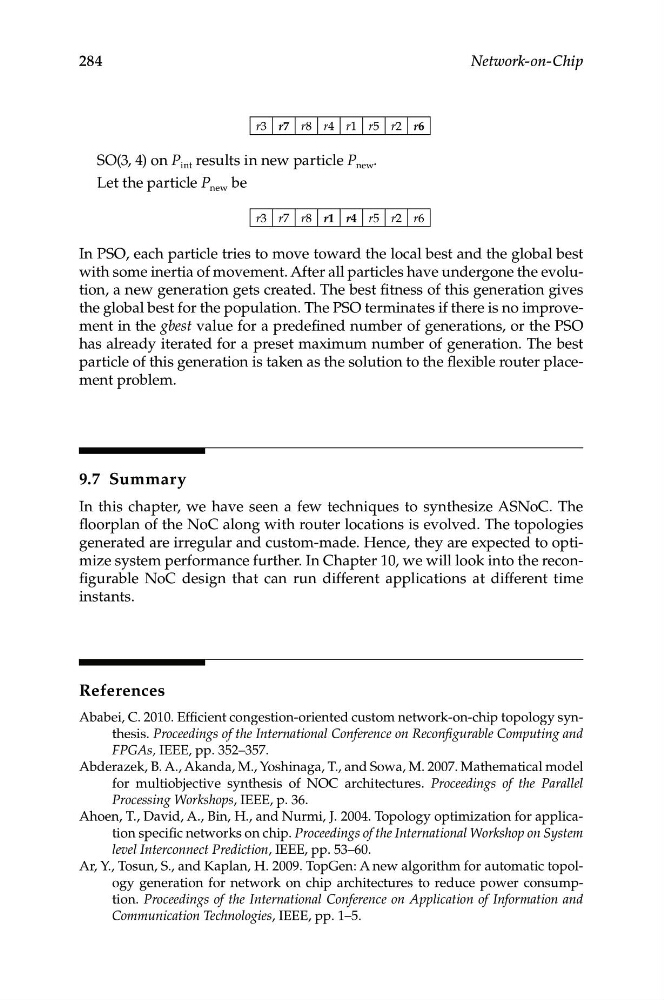
SO(3, 4) on P int results in new particle P new .
Let the particle P new be
r3 r7 r8 r1 r4 r5 r2 r6
In PSO, each particle tries to move toward the local best and the global best
with some inertia of movement. After all particles have undergone the evolution, a new generation gets created. The best fitness of this generation gives
the global best for the population. The PSO terminates if there is no improvement in the gbest value for a predefined number of generations, or the PSO
has already iterated for a preset maximum number of generation. The best
particle of this generation is taken as the solution to the flexible router placement problem.
9.7 Summary
In this chapter, we have seen a few techniques to synthesize ASNoC. The
floorplan of the NoC along with router locations is evolved. The topologies
generated are irregular and custom-made. Hence, they are expected to optimize system performance further. In Chapter 10, we will look into the reconfigurable NoC design that can run different applications at different time
instants.
References
Ababei, C. 2010. Efficient congestion-oriented custom network-on-chip topology synthesis. Proceedings of the International Conference on Reconfigurable Computing and
FPGAs, IEEE, pp. 352–357.
Abderazek, B. A., Akanda, M., Yoshinaga, T., and Sowa, M. 2007. Mathematical model
for multiobjective synthesis of NOC architectures. Proceedings of the Parallel
Processing Workshops, IEEE, p. 36.
Ahoen, T., David, A., Bin, H., and Nurmi, J. 2004. Topology optimization for application specific networks on chip. Proceedings of the International Workshop on System
level Interconnect Prediction, IEEE, pp. 53–60.
Ar, Y., Tosun, S., and Kaplan, H. 2009. TopGen: A new algorithm for automatic topology generation for network on chip architectures to reduce power consumption. Proceedings of the International Conference on Application of Information and
Communication Technologies, IEEE, pp. 1–5.
Network-on-Chip
r3 r7 r8 r4 r1 r5 r2 r6
SO(3, 4) on P int results in new particle P new .
Let the particle P new be
r3 r7 r8 r1 r4 r5 r2 r6
In PSO, each particle tries to move toward the local best and the global best
with some inertia of movement. After all particles have undergone the evolution, a new generation gets created. The best fitness of this generation gives
the global best for the population. The PSO terminates if there is no improvement in the gbest value for a predefined number of generations, or the PSO
has already iterated for a preset maximum number of generation. The best
particle of this generation is taken as the solution to the flexible router placement problem.
9.7 Summary
In this chapter, we have seen a few techniques to synthesize ASNoC. The
floorplan of the NoC along with router locations is evolved. The topologies
generated are irregular and custom-made. Hence, they are expected to optimize system performance further. In Chapter 10, we will look into the reconfigurable NoC design that can run different applications at different time
instants.
References
Ababei, C. 2010. Efficient congestion-oriented custom network-on-chip topology synthesis. Proceedings of the International Conference on Reconfigurable Computing and
FPGAs, IEEE, pp. 352–357.
Abderazek, B. A., Akanda, M., Yoshinaga, T., and Sowa, M. 2007. Mathematical model
for multiobjective synthesis of NOC architectures. Proceedings of the Parallel
Processing Workshops, IEEE, p. 36.
Ahoen, T., David, A., Bin, H., and Nurmi, J. 2004. Topology optimization for application specific networks on chip. Proceedings of the International Workshop on System
level Interconnect Prediction, IEEE, pp. 53–60.
Ar, Y., Tosun, S., and Kaplan, H. 2009. TopGen: A new algorithm for automatic topology generation for network on chip architectures to reduce power consumption. Proceedings of the International Conference on Application of Information and
Communication Technologies, IEEE, pp. 1–5.