

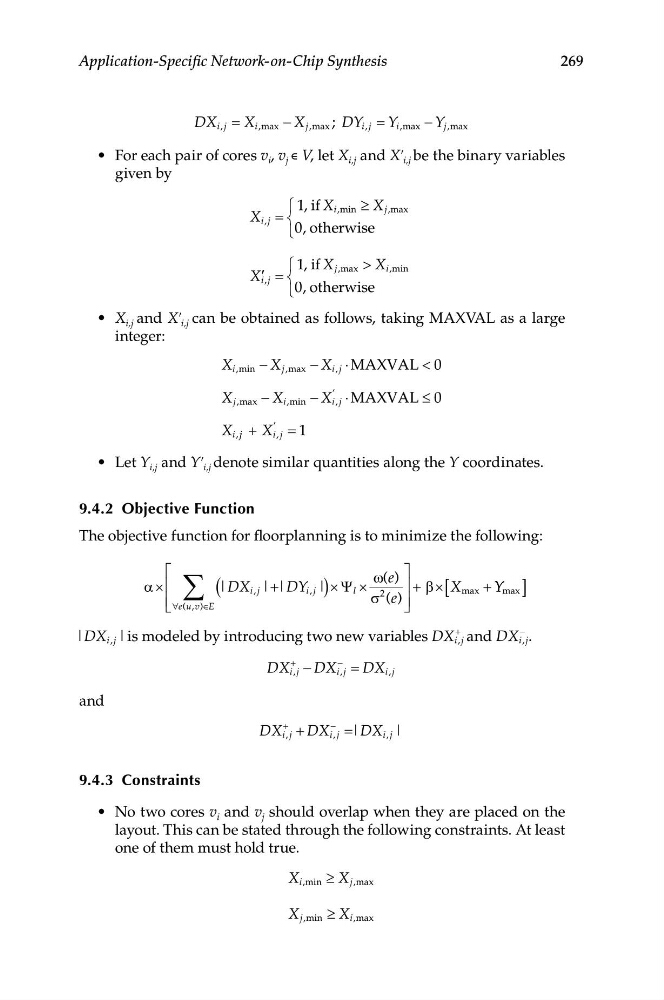
DX i , j = X i,max − X j,max ; DY i , j = Y i,max − Y j,max
• For each pair of cores v i , v j ∊ V, let X i,j and X′ i,j be the binary variables
given by
⎧ 1, if X i,min ≥ X
X
j,max
i , j = ⎨
⎩ 0, otherwise
⎧ 1, if X
>
X
X
i ′ , j =
j,max
i,min
⎨
⎩
0, otherwise
• X i,j and X′ i,j can be obtained as follows, taking MAXVAL as a large
integer:
X i,min − X j,max − X i , j ⋅ MAXVAL < 0
X j,m − X
’
ax
i,min − X i , j ⋅ MAXVAL ≤ 0
X
’
i, j j + X i , j = 1
• Let Y i,j and Y′ i,j denote similar quantities along the Y coordinates.
9.4.2 Objective Function
The objective function for floorplanning is to minimize the following:
⎡
⎤
⎢ ∑ (
ω(e)
α ×
|D X i , j | + |D Y i , j | ) × Ψ l × 2 ⎥ + β× [X + Y
σ
max
max
Y ]
⎢ ⎣ ∀
)
e
(
(
)
e
u,v ∈ E
⎥
⎦
|DX |is modeled by introducing two new variables DX
+ and DX
−
i , j
i , j
i , j .
DX
+
DX
−
i, j −
i, j = DX i, j
and
DX
+
−
i , j + DX i , j =|DX i , j |
9.4.3 Constraints
• No two cores v i and v j should overlap when they are placed on the
layout. This can be stated through the following constraints. At least
one of them must hold true.
X i,min ≥ X j,max
X j,min ≥ X i,max
269
Application-Specific Network-on-Chip Synthesis
• For each pair of cores v i , v j ∊ V, let X i,j and X′ i,j be the binary variables
given by
⎧ 1, if X i,min ≥ X
X
j,max
i , j = ⎨
⎩ 0, otherwise
⎧ 1, if X
>
X
X
i ′ , j =
j,max
i,min
⎨
⎩
0, otherwise
• X i,j and X′ i,j can be obtained as follows, taking MAXVAL as a large
integer:
X i,min − X j,max − X i , j ⋅ MAXVAL < 0
X j,m − X
’
ax
i,min − X i , j ⋅ MAXVAL ≤ 0
X
’
i, j j + X i , j = 1
• Let Y i,j and Y′ i,j denote similar quantities along the Y coordinates.
9.4.2 Objective Function
The objective function for floorplanning is to minimize the following:
⎡
⎤
⎢ ∑ (
ω(e)
α ×
|D X i , j | + |D Y i , j | ) × Ψ l × 2 ⎥ + β× [X + Y
σ
max
max
Y ]
⎢ ⎣ ∀
)
e
(
(
)
e
u,v ∈ E
⎥
⎦
|DX |is modeled by introducing two new variables DX
+ and DX
−
i , j
i , j
i , j .
DX
+
DX
−
i, j −
i, j = DX i, j
and
DX
+
−
i , j + DX i , j =|DX i , j |
9.4.3 Constraints
• No two cores v i and v j should overlap when they are placed on the
layout. This can be stated through the following constraints. At least
one of them must hold true.
X i,min ≥ X j,max
X j,min ≥ X i,max
269
Application-Specific Network-on-Chip Synthesis