

I 2
Test packets
I 2 ′
I 1 ′
I 5 ′
I 3 ′
I 3
I 5
I 4
I 4 ′
I 1
S 2
S 1
S 3
S 4
244
Network-on-Chip
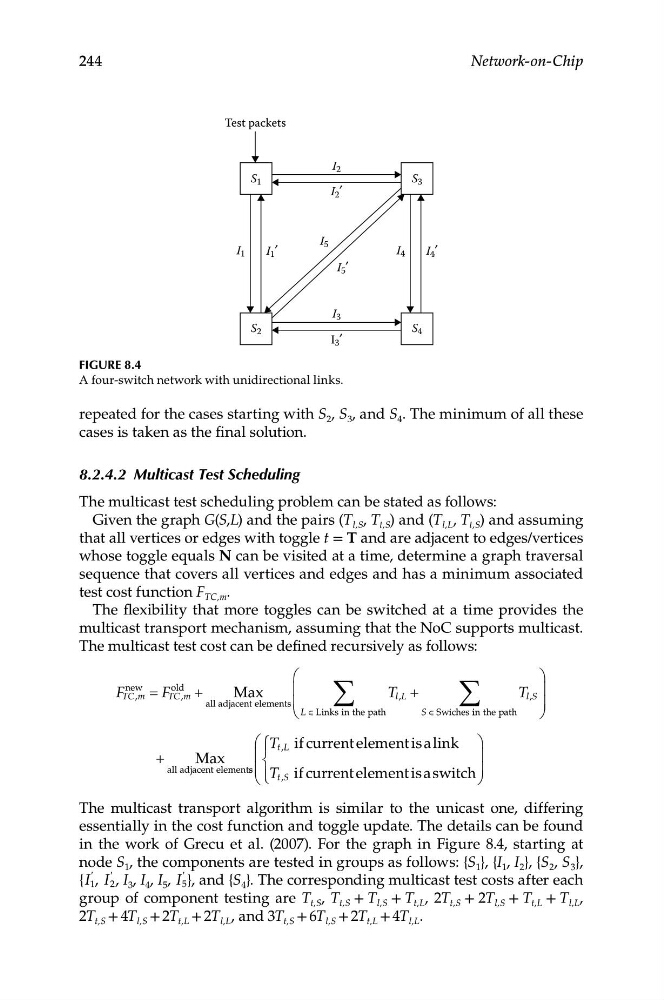
Figure 8.4
A four-switch network with unidirectional links.
repeated for the cases starting with S 2 , S 3 , and S 4 . The minimum of all these
cases is taken as the final solution.
8.2.4.2 Multicast Test Scheduling
The multicast test scheduling problem can be stated as follows:
Given the graph G(S,L) and the pairs (T l,S , T t,S ) and (T l,L , T t,S ) and assuming
that all vertices or edges with toggle t = T and are adjacent to edges/vertices
whose toggle equals N can be visited at a time, determine a graph traversal
sequence that covers all vertices and edges and has a minimum associated
test cost function F TC,m .
The flexibility that more toggles can be switched at a time provides the
multicast transport mechanism, assuming that the NoC supports multicast.
The multicast test cost can be defined recursively as follows:
⎛
⎞
F
new
=
F
old
TC , m
TC , m +
Max
⎜
∑
T l ,L +
⎜
∑
T l , S ⎟
all adjacent elements
⎟
⎝
L ∈ Links in the path
S ∈ Swiches i in the path
⎠
⎛
⎧ ⎧Tt ,L if current element is a link ⎞
⎪
+
Max
⎜
⎟
⎨
all adjacent elements s ⎜ ⎩
⎪ T t , S if current element is a switch ⎟
⎝
⎠
The multicast transport algorithm is similar to the unicast one, differing
essentially in the cost function and toggle update. The details can be found
in the work of Grecu et al. (2007). For the graph in Figure 8.4, starting at
node S 1 , the components are tested in groups as follows: {S 1 }, {I 1 , I 2 }, {S 2 , S 3 },
{I
′
1 , I
′
2 , I 3 , I 4 , I 5 , I
′
5 }, and {S 4 }. The corresponding multicast test costs after each
group of component testing are T t,S , T t,S + T l,S + T t,L , 2T t,S + 2T l,S + T t,L + T l,L ,
2T t,S + 4T l,S + 2T t,L + 2T l,L , and 3T t,S + 6T l,S + 2T t,L + 4T l,L .
Test packets
I 2 ′
I 1 ′
I 5 ′
I 3 ′
I 3
I 5
I 4
I 4 ′
I 1
S 2
S 1
S 3
S 4
244
Network-on-Chip
Figure 8.4
A four-switch network with unidirectional links.
repeated for the cases starting with S 2 , S 3 , and S 4 . The minimum of all these
cases is taken as the final solution.
8.2.4.2 Multicast Test Scheduling
The multicast test scheduling problem can be stated as follows:
Given the graph G(S,L) and the pairs (T l,S , T t,S ) and (T l,L , T t,S ) and assuming
that all vertices or edges with toggle t = T and are adjacent to edges/vertices
whose toggle equals N can be visited at a time, determine a graph traversal
sequence that covers all vertices and edges and has a minimum associated
test cost function F TC,m .
The flexibility that more toggles can be switched at a time provides the
multicast transport mechanism, assuming that the NoC supports multicast.
The multicast test cost can be defined recursively as follows:
⎛
⎞
F
new
=
F
old
TC , m
TC , m +
Max
⎜
∑
T l ,L +
⎜
∑
T l , S ⎟
all adjacent elements
⎟
⎝
L ∈ Links in the path
S ∈ Swiches i in the path
⎠
⎛
⎧ ⎧Tt ,L if current element is a link ⎞
⎪
+
Max
⎜
⎟
⎨
all adjacent elements s ⎜ ⎩
⎪ T t , S if current element is a switch ⎟
⎝
⎠
The multicast transport algorithm is similar to the unicast one, differing
essentially in the cost function and toggle update. The details can be found
in the work of Grecu et al. (2007). For the graph in Figure 8.4, starting at
node S 1 , the components are tested in groups as follows: {S 1 }, {I 1 , I 2 }, {S 2 , S 3 },
{I
′
1 , I
′
2 , I 3 , I 4 , I 5 , I
′
5 }, and {S 4 }. The corresponding multicast test costs after each
group of component testing are T t,S , T t,S + T l,S + T t,L , 2T t,S + 2T l,S + T t,L + T l,L ,
2T t,S + 4T l,S + 2T t,L + 2T l,L , and 3T t,S + 6T l,S + 2T t,L + 4T l,L .