

216
Network-on-Chip
FPC_1
(4–5 coding)
FPC_2
(4–5 coding)
FPC_8
(4–5 coding)
32 bits
54 bits
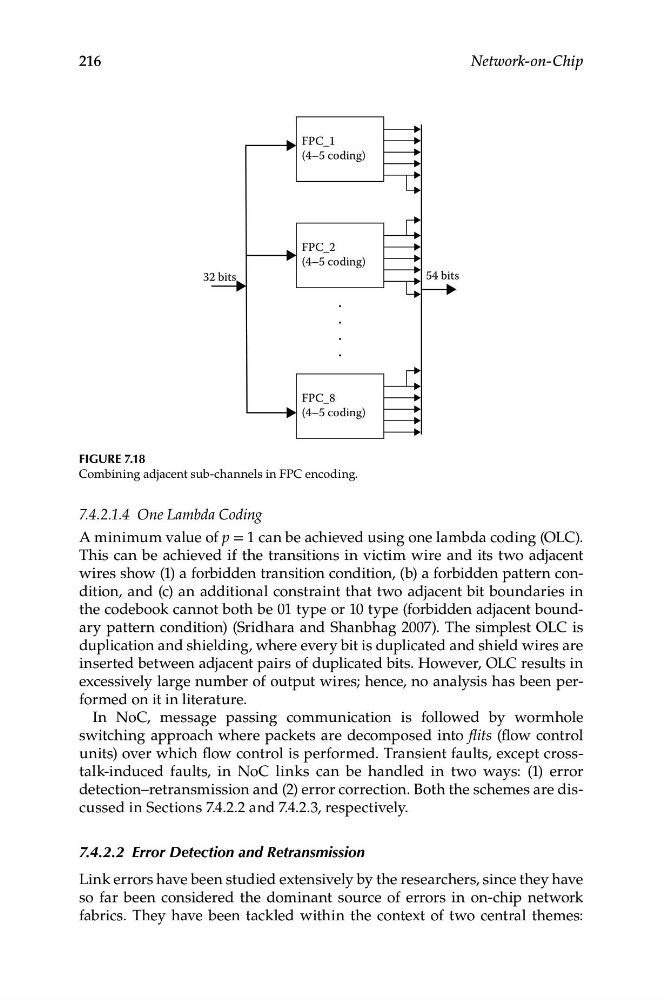
Figure 7.18
Combining adjacent sub-channels in FPC encoding.
7.4.2.1.4 One Lambda Coding
A minimum value of p = 1 can be achieved using one lambda coding (OLC).
This can be achieved if the transitions in victim wire and its two adjacent
wires show (1) a forbidden transition condition, (b) a forbidden pattern condition, and (c) an additional constraint that two adjacent bit boundaries in
the codebook cannot both be 01 type or 10 type (forbidden adjacent boundary pattern condition) (Sridhara and Shanbhag 2007). The simplest OLC is
duplication and shielding, where every bit is duplicated and shield wires are
inserted between adjacent pairs of duplicated bits. However, OLC results in
excessively large number of output wires; hence, no analysis has been performed on it in literature.
In NoC, message passing communication is followed by wormhole
switching approach where packets are decomposed into flits (flow control
units) over which flow control is performed. Transient faults, except crosstalk-induced faults, in NoC links can be handled in two ways: (1) error
detection–retransmission and (2) error correction. Both the schemes are discussed in Sections 7.4.2.2 and 7.4.2.3, respectively.
7.4.2.2 Error Detection and Retransmission
Link errors have been studied extensively by the researchers, since they have
so far been considered the dominant source of errors in on-chip network
fabrics. They have been tackled within the context of two central themes: