

198
Network-on-Chip
n2 (aggressor)
n3 (victim)
n1
n1
n2 (aggressor)
Aggressor transition
Voltage bump
at input of u2
Double switch at
output of u2
n3 (victim)
n4
n4
u1
u2
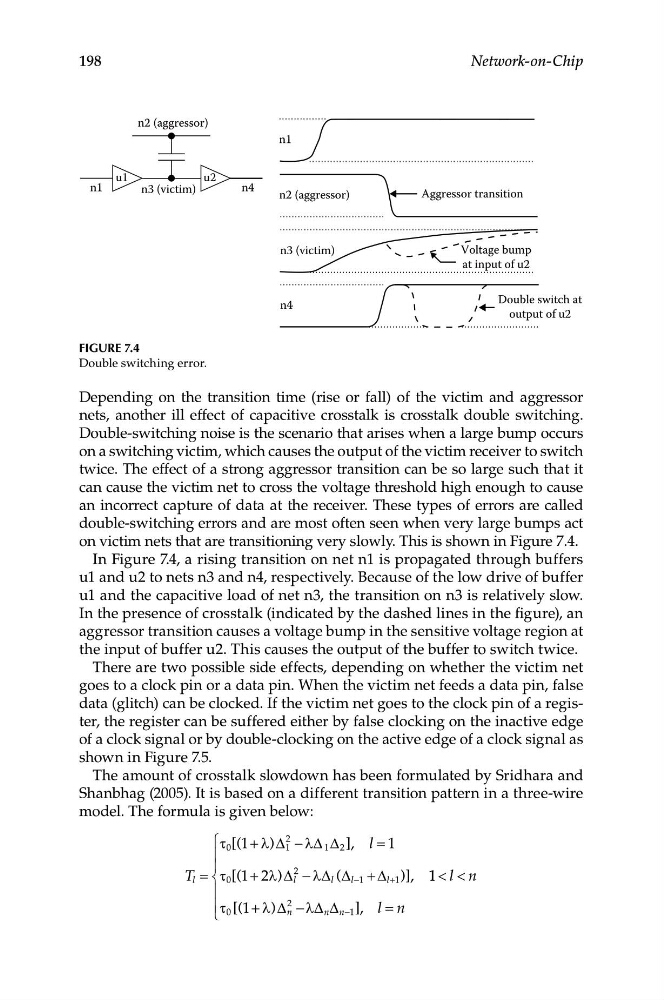
Figure 7.4
Double switching error.
Depending on the transition time (rise or fall) of the victim and aggressor
nets, another ill effect of capacitive crosstalk is crosstalk double switching.
Double-switching noise is the scenario that arises when a large bump occurs
on a switching victim, which causes the output of the victim receiver to switch
twice. The effect of a strong aggressor transition can be so large such that it
can cause the victim net to cross the voltage threshold high enough to cause
an incorrect capture of data at the receiver. These types of errors are called
double-switching errors and are most often seen when very large bumps act
on victim nets that are transitioning very slowly. This is shown in Figure 7.4.
In Figure 7.4, a rising transition on net n1 is propagated through buffers
u1 and u2 to nets n3 and n4, respectively. Because of the low drive of buffer
u1 and the capacitive load of net n3, the transition on n3 is relatively slow.
In the presence of crosstalk (indicated by the dashed lines in the figure), an
aggressor transition causes a voltage bump in the sensitive voltage region at
the input of buffer u2. This causes the output of the buffer to switch twice.
There are two possible side effects, depending on whether the victim net
goes to a clock pin or a data pin. When the victim net feeds a data pin, false
data (glitch) can be clocked. If the victim net goes to the clock pin of a register, the register can be suffered either by false clocking on the inactive edge
of a clock signal or by double-clocking on the active edge of a clock signal as
shown in Figure 7.5.
The amount of crosstalk slowdown has been formulated by Sridhara and
Shanbhag (2005). It is based on a different transition pattern in a three-wire
model. The formula is given below:
⎧
2
τ (
1
Δ Δ
= 1
0 [ 1+ λ)Δ − λ 1 2 ], l
⎪
⎪
2
T l = ⎨ τ 0 ( + 2λ)Δ l − λΔ Δ
( l 1 Δ l+1 , 1 1 < < n
[ 1
l
− +
)]
l
⎪
⎪τ [(1+ λ)Δ
2
− λΔ Δ ], l = n
0
n
n n−1
⎩