

0.002
0
200
400
600
800
1000
1200
BFT
Mesh-1
Mesh-2
MoT
Average overall latency
(number of clock cycles)
0.004
0.006
0.008
0.010
0.012
Offered load (packets/cycle/IP)
100
Network-on-Chip
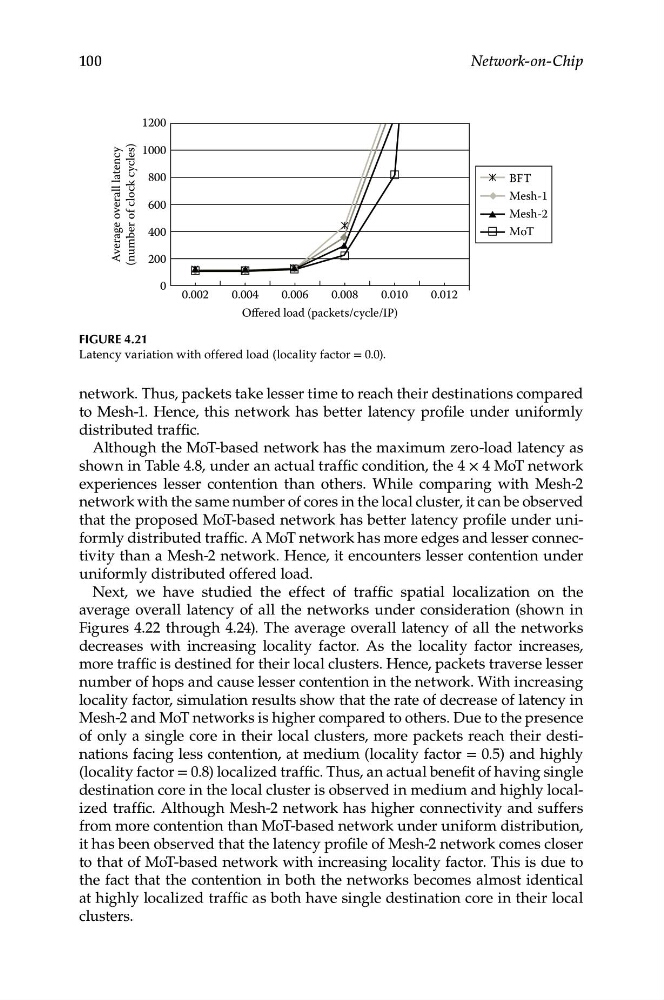
Figure 4.21
Latency variation with offered load (locality factor = 0.0).
network. Thus, packets take lesser time to reach their destinations compared
to Mesh-1. Hence, this network has better latency profile under uniformly
distributed traffic.
Although the MoT-based network has the maximum zero-load latency as
shown in Table 4.8, under an actual traffic condition, the 4 × 4 MoT network
experiences lesser contention than others. While comparing with Mesh-2
network with the same number of cores in the local cluster, it can be observed
that the proposed MoT-based network has better latency profile under uniformly distributed traffic. A MoT network has more edges and lesser connectivity than a Mesh-2 network. Hence, it encounters lesser contention under
uniformly distributed offered load.
Next, we have studied the effect of traffic spatial localization on the
average overall latency of all the networks under consideration (shown in
Figures 4.22 through 4.24). The average overall latency of all the networks
decreases with increasing locality factor. As the locality factor increases,
more traffic is destined for their local clusters. Hence, packets traverse lesser
number of hops and cause lesser contention in the network. With increasing
locality factor, simulation results show that the rate of decrease of latency in
Mesh-2 and MoT networks is higher compared to others. Due to the presence
of only a single core in their local clusters, more packets reach their destinations facing less contention, at medium (locality factor = 0.5) and highly
(locality factor = 0.8) localized traffic. Thus, an actual benefit of having single
destination core in the local cluster is observed in medium and highly localized traffic. Although Mesh-2 network has higher connectivity and suffers
from more contention than MoT-based network under uniform distribution,
it has been observed that the latency profile of Mesh-2 network comes closer
to that of MoT-based network with increasing locality factor. This is due to
the fact that the contention in both the networks becomes almost identical
at highly localized traffic as both have single destination core in their local
clusters.