

0.00
0.05
0.10
0.15
0.20
0.25
0.30
0.35
Accepted traffic
(flits/cycle/IP)
BFT
Mesh-1
Mesh-2
MoT
0.002 0.004 0.006 0.008 0.010 0.012 0.014 0.016 0.018 0.020
Offered load (packets/cycle/IP)
97
Evaluation of Network-on-Chip Architectures
Thus, it is difficult to comment on the superiority of any network based on
the values noted in Table 4.7 alone. It is necessary to perform a detailed simulation to compare the topologies.
4.6.3 Performance Comparison
4.6.3.1 Accepted Traffic versus Offered Load
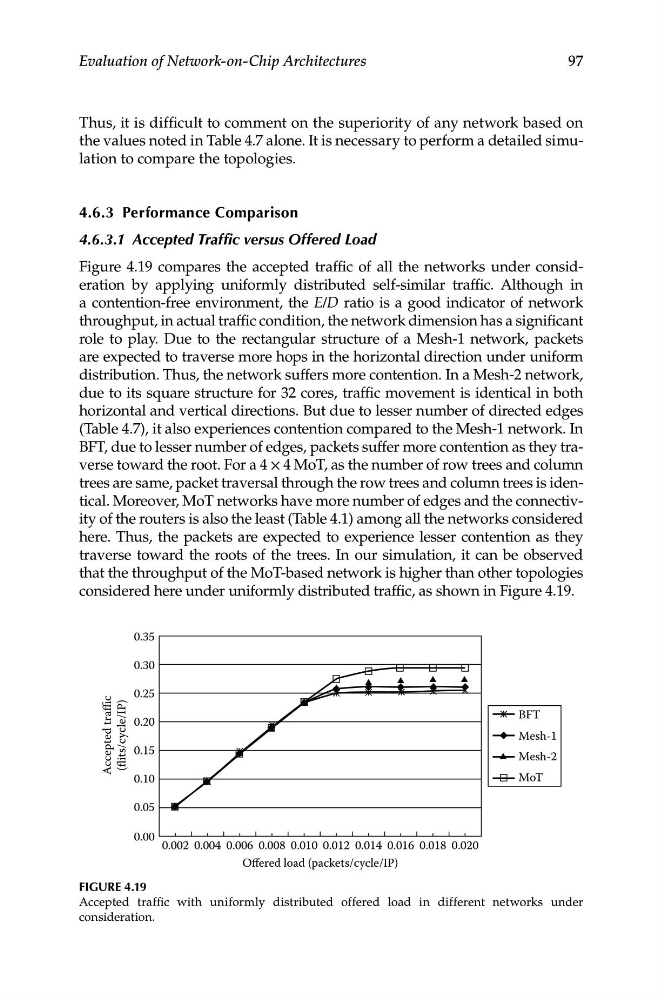
Figure 4.19 compares the accepted traffic of all the networks under consideration by applying uniformly distributed self-similar traffic. Although in
a contention-free environment, the E/D ratio is a good indicator of network
throughput, in actual traffic condition, the network dimension has a significant
role to play. Due to the rectangular structure of a Mesh-1 network, packets
are expected to traverse more hops in the horizontal direction under uniform
distribution. Thus, the network suffers more contention. In a Mesh-2 network,
due to its square structure for 32 cores, traffic movement is identical in both
horizontal and vertical directions. But due to lesser number of directed edges
(Table 4.7), it also experiences contention compared to the Mesh-1 network. In
BFT, due to lesser number of edges, packets suffer more contention as they traverse toward the root. For a 4 × 4 MoT, as the number of row trees and column
trees are same, packet traversal through the row trees and column trees is identical. Moreover, MoT networks have more number of edges and the connectivity of the routers is also the least (Table 4.1) among all the networks considered
here. Thus, the packets are expected to experience lesser contention as they
traverse toward the roots of the trees. In our simulation, it can be observed
that the throughput of the MoT-based network is higher than other topologies
considered here under uniformly distributed traffic, as shown in Figure 4.19.
Figure 4.19
Accepted traffic with uniformly distributed offered load in different networks under
consideration.