

95
Evaluation of Network-on-Chip Architectures
the breadth of the chip increases just because of the channel width. The length
of the chip will increase by the length of all center routers and two edge routers of a row. Thus, a better estimation of the chip dimension of a 4 × 8 Mesh-1
network considering unidirectional opposite links increases the area from
20 mm × 10 mm to 22.18 mm × 10.128 mm, and that of a 4 × 4 Mesh-2 network
becomes 21.24 mm × 10.128 mm. For the BFT-based network, the length of the
chip increases because of the leaf, stem, and root routers, whereas its breadth
increases just because of the channel width. The estimated dimension of the
BFT network becomes 22.33 mm × 10.128 mm. For the MoT-based network, all
routers and repeaters of a row tree can be placed between row-wise adjacent
tiles such that they do not increase the breadth of the chip. It can be noted
that only the stem routers of the column trees of each 2 × 2 MoT subnetwork
will increase the breadth of the chip. The length of the chip will be increased
because of the routers and repeaters of the row tree. Taking all these facts
into account, the estimated chip dimension of the 4 × 4 MoT increases to
21.5 mm × 10.4 mm. Assuming each router to be a perfect square, the length
of each side of the stem router is about 200 µm, which is almost 6 times wider
than the cross section of two opposite unidirectional 32-bit links. Thus, unlike
mesh and BFT networks, MoT network connects up to 16 cores in a single row
tree; the channel width will not increase the breadth of the chip.
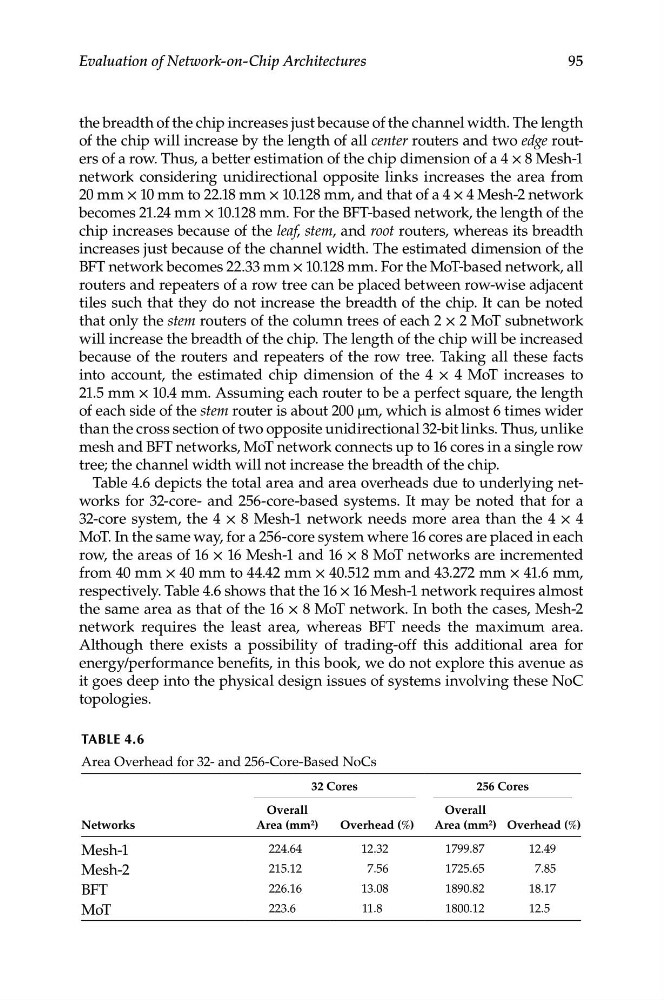
Table 4.6 depicts the total area and area overheads due to underlying networks for 32-core- and 256-core-based systems. It may be noted that for a
32-core system, the 4 × 8 Mesh-1 network needs more area than the 4 × 4
MoT. In the same way, for a 256-core system where 16 cores are placed in each
row, the areas of 16 × 16 Mesh-1 and 16 × 8 MoT networks are incremented
from 40 mm × 40 mm to 44.42 mm × 40.512 mm and 43.272 mm × 41.6 mm,
respectively. Table 4.6 shows that the 16 × 16 Mesh-1 network requires almost
the same area as that of the 16 × 8 MoT network. In both the cases, Mesh-2
network requires the least area, whereas BFT needs the maximum area.
Although there exists a possibility of trading-off this additional area for
energy/performance benefits, in this book, we do not explore this avenue as
it goes deep into the physical design issues of systems involving these NoC
topologies.
TABLe 4.6
Area Overhead for 32- and 256-Core-Based NoCs
32 Cores
256 Cores
Overall
Overall
Networks
Area (mm 2 )
Overhead (%)
Area (mm 2 ) Overhead (%)
Mesh-1
224.64
12.32
1799.87
12.49
Mesh-2
215.12
7.56
1725.65
7.85
BFT
226.16
13.08
1890.82
18.17
MoT
223.6
11.8
1800.12
12.5