

90
Network-on-Chip
and the number of accepted traffic increases with increasing locality factor,
the average energy consumption per packet also decreases.
4.5 Impact of FIFO Size and Placement in Energy
and Performance of a Network
In Section 4.4, we have seen that FIFO is the most energy-consuming element
in the network. The WH router uses both input and output buffering. There
are considerable amount of works in the literature (Pande et al. 2003; Wentzlaff
et al. 2007; Zhang et al. 2006) that follow similar methodology of placing
the FIFO buffers at both input and output channels of a router. Researchers
have also proposed alternative WH routers that use only input buffering
(Kumar et al. 2007; Zeferino and Susin 2003). Since both the schemes are
widely used in literature, this section evaluates and compares the two. We
will proceed with the better one in remaining analysis. Moreover, it has also
been reported in literature (Marculescu et al. 2009; Ogras et al. 2005) that
the performance and energy consumption of NoC are largely dependent on
the depth of the FIFO buffer. Experimentation has been carried out on this
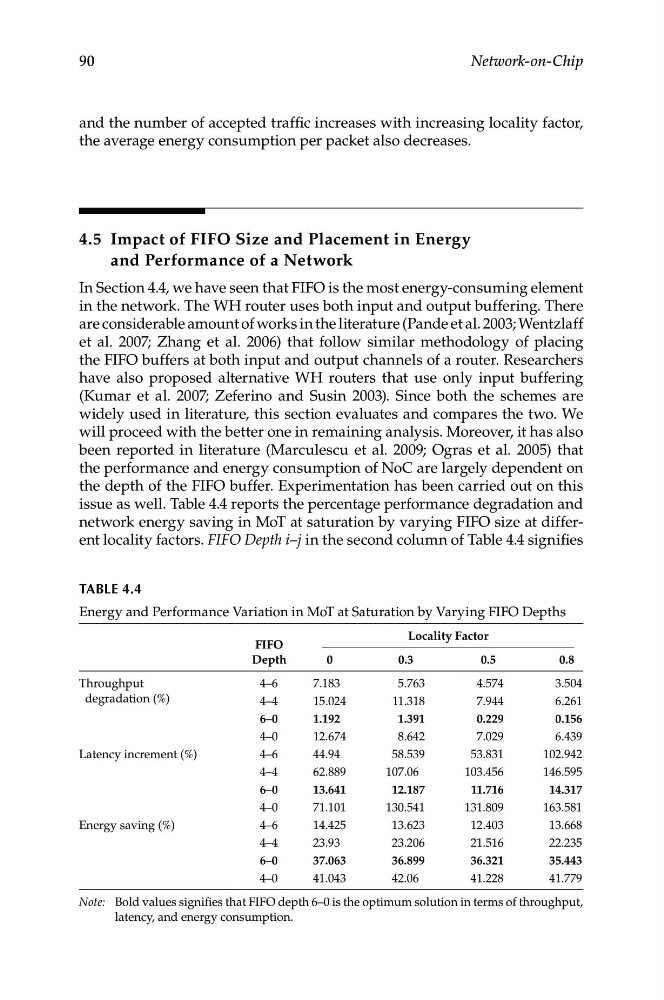
issue as well. Table 4.4 reports the percentage performance degradation and
network energy saving in MoT at saturation by varying FIFO size at different locality factors. FIFO Depth i–j in the second column of Table 4.4 signifies
TABLe 4.4
Energy and Performance Variation in MoT at Saturation by Varying FIFO Depths
FIFO
Depth
Locality Factor
0
0.3
0.5
0.8
Throughput
4–6
7.183
5.763
4.574
3.504
degradation (%)
4–4
15.024
11.318
7.944
6.261
6–0
1.192
1.391
0.229
0.156
4–0
12.674
8.642
7.029
6.439
Latency increment (%)
4–6
44.94
58.539
53.831
102.942
4–4
62.889
107.06
103.456
146.595
6–0
13.641
12.187
11.716
14.317
4–0
71.101
130.541
131.809
163.581
Energy saving (%)
4–6
14.425
13.623
12.403
13.668
4–4
23.93
23.206
21.516
22.235
6–0
37.063
36.899
36.321
35.443
4–0
41.043
42.06
41.228
41.779
Note: Bold values signifies that FIFO depth 6–0 is the optimum solution in terms of throughput,
latency, and energy consumption.