

64
S. Kakkar et al.
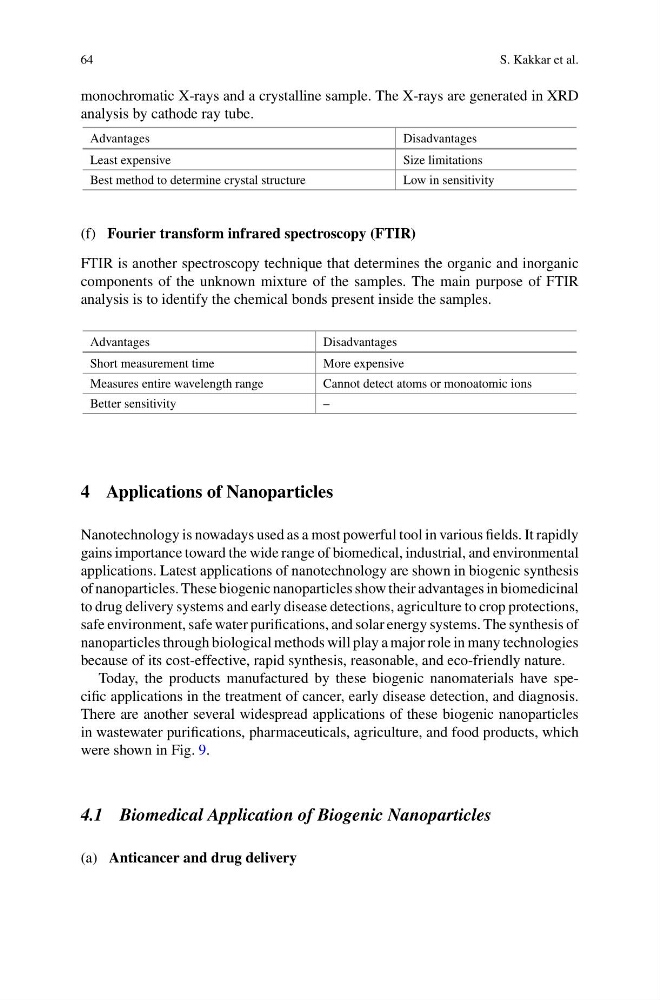
monochromatic X-rays and a crystalline sample. The X-rays are generated in XRD
analysis by cathode ray tube.
Advantages
Disadvantages
Least expensive
Size limitations
Best method to determine crystal structure
Low in sensitivity
(f) Fourier transform infrared spectroscopy (FTIR)
FTIR is another spectroscopy technique that determines the organic and inorganic
components of the unknown mixture of the samples. The main purpose of FTIR
analysis is to identify the chemical bonds present inside the samples.
Advantages
Disadvantages
Short measurement time
More expensive
Measures entire wavelength range
Cannot detect atoms or monoatomic ions
Better sensitivity
–
4 Applications of Nanoparticles
Nanotechnology is nowadays used as a most powerful tool in various fields. It rapidly
gains importance toward the wide range of biomedical, industrial, and environmental
applications. Latest applications of nanotechnology are shown in biogenic synthesis
of nanoparticles. These biogenic nanoparticles show their advantages in biomedicinal
to drug delivery systems and early disease detections, agriculture to crop protections,
safe environment, safe water purifications, and solar energy systems. The synthesis of
nanoparticles through biological methods will play a major role in many technologies
because of its cost-effective, rapid synthesis, reasonable, and eco-friendly nature.
Today, the products manufactured by these biogenic nanomaterials have specific applications in the treatment of cancer, early disease detection, and diagnosis.
There are another several widespread applications of these biogenic nanoparticles
in wastewater purifications, pharmaceuticals, agriculture, and food products, which
were shown in Fig. 9.
4.1 Biomedical Application of Biogenic Nanoparticles
(a) Anticancer and drug delivery
S. Kakkar et al.
monochromatic X-rays and a crystalline sample. The X-rays are generated in XRD
analysis by cathode ray tube.
Advantages
Disadvantages
Least expensive
Size limitations
Best method to determine crystal structure
Low in sensitivity
(f) Fourier transform infrared spectroscopy (FTIR)
FTIR is another spectroscopy technique that determines the organic and inorganic
components of the unknown mixture of the samples. The main purpose of FTIR
analysis is to identify the chemical bonds present inside the samples.
Advantages
Disadvantages
Short measurement time
More expensive
Measures entire wavelength range
Cannot detect atoms or monoatomic ions
Better sensitivity
–
4 Applications of Nanoparticles
Nanotechnology is nowadays used as a most powerful tool in various fields. It rapidly
gains importance toward the wide range of biomedical, industrial, and environmental
applications. Latest applications of nanotechnology are shown in biogenic synthesis
of nanoparticles. These biogenic nanoparticles show their advantages in biomedicinal
to drug delivery systems and early disease detections, agriculture to crop protections,
safe environment, safe water purifications, and solar energy systems. The synthesis of
nanoparticles through biological methods will play a major role in many technologies
because of its cost-effective, rapid synthesis, reasonable, and eco-friendly nature.
Today, the products manufactured by these biogenic nanomaterials have specific applications in the treatment of cancer, early disease detection, and diagnosis.
There are another several widespread applications of these biogenic nanoparticles
in wastewater purifications, pharmaceuticals, agriculture, and food products, which
were shown in Fig. 9.
4.1 Biomedical Application of Biogenic Nanoparticles
(a) Anticancer and drug delivery