

Nucleic Acid Based Nanoconstructs for Environmental Analysis …
581
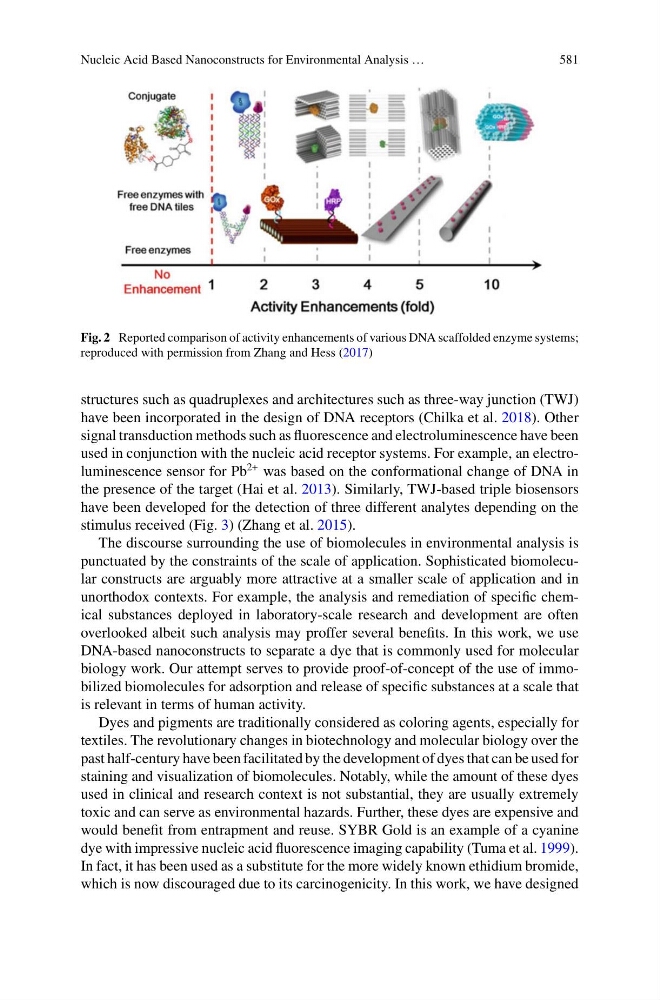
Fig. 2 Reported comparison of activity enhancements of various DNA scaffolded enzyme systems;
reproduced with permission from Zhang and Hess (2017)
structures such as quadruplexes and architectures such as three-way junction (TWJ)
have been incorporated in the design of DNA receptors (Chilka et al. 2018). Other
signal transduction methods such as fluorescence and electroluminescence have been
used in conjunction with the nucleic acid receptor systems. For example, an electroluminescence sensor for Pb
2+ was based on the conformational change of DNA in
the presence of the target (Hai et al. 2013). Similarly, TWJ-based triple biosensors
have been developed for the detection of three different analytes depending on the
stimulus received (Fig. 3) (Zhang et al. 2015).
The discourse surrounding the use of biomolecules in environmental analysis is
punctuated by the constraints of the scale of application. Sophisticated biomolecular constructs are arguably more attractive at a smaller scale of application and in
unorthodox contexts. For example, the analysis and remediation of specific chemical substances deployed in laboratory-scale research and development are often
overlooked albeit such analysis may proffer several benefits. In this work, we use
DNA-based nanoconstructs to separate a dye that is commonly used for molecular
biology work. Our attempt serves to provide proof-of-concept of the use of immobilized biomolecules for adsorption and release of specific substances at a scale that
is relevant in terms of human activity.
Dyes and pigments are traditionally considered as coloring agents, especially for
textiles. The revolutionary changes in biotechnology and molecular biology over the
past half-century have been facilitated by the development of dyes that can be used for
staining and visualization of biomolecules. Notably, while the amount of these dyes
used in clinical and research context is not substantial, they are usually extremely
toxic and can serve as environmental hazards. Further, these dyes are expensive and
would benefit from entrapment and reuse. SYBR Gold is an example of a cyanine
dye with impressive nucleic acid fluorescence imaging capability (Tuma et al. 1999).
In fact, it has been used as a substitute for the more widely known ethidium bromide,
which is now discouraged due to its carcinogenicity. In this work, we have designed