

Eco-friendly Surface Modification …
551
4.2 UV Treatment
With the growing environmental concern for the degradation of the ozone layer and
global warming, awareness has been created for protection against harmful UV rays,
one of the most prominent risk factors for the development of skin cancer. Fabrics
are the easiest and convenient UV protection source, but they do not completely
block the harmful UV rays. To determine the UV protection strength of the fabric,
UV protection factor (UPF) is commonly used. UPF allows an evaluation of UV
protection provided by textiles concerning the spectral composition of sunlight and
human skin sensitivities. The higher the value of UPF, the more is the UV blocking
capacity of the fabric. According to ASTM standards, range of UPF rating given to
fabrics is as follows (Shahidi and Ghoranneviss 2016):
UPF rating
Protection quality
%UV radiation blocked
15–24
Good UV protection
93–95
25–39
Very good UV protection
96–97
40–50+
Excellent UV protection
97.5–98+
The UPF values of textiles can be increased by treating them with metal nanoparticles like ZnO; however, excessive use of nanoparticles can lead to ecological problems as they are easily washed off and contaminate the water bodies. Physical adhesion of nanoparticles to the fabric surface can be enhanced by pretreatment of fabric
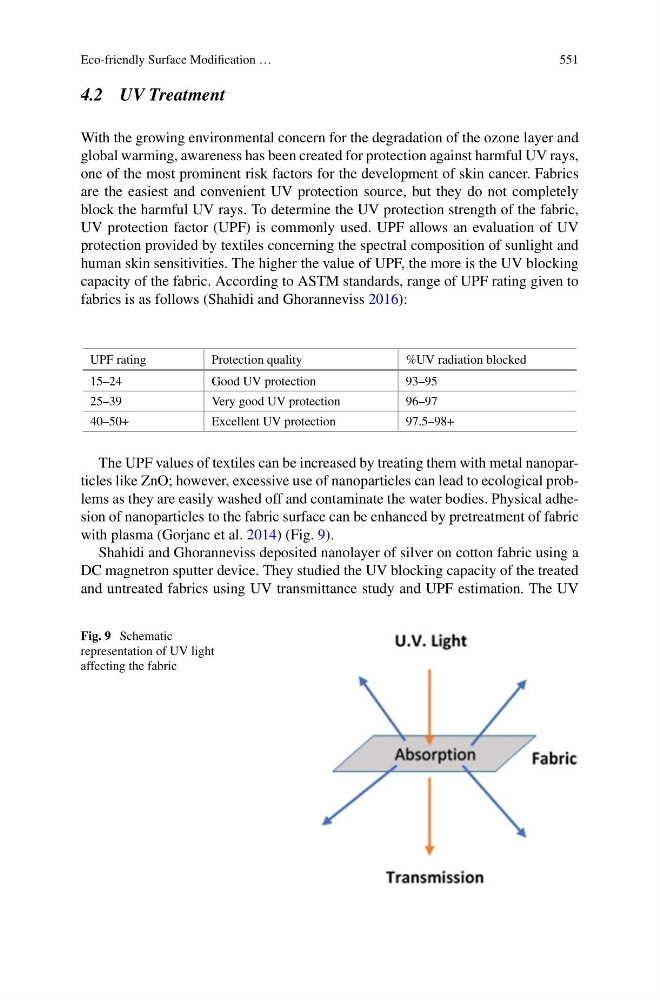
with plasma (Gorjanc et al. 2014) (Fig. 9).
Shahidi and Ghoranneviss deposited nanolayer of silver on cotton fabric using a
DC magnetron sputter device. They studied the UV blocking capacity of the treated
and untreated fabrics using UV transmittance study and UPF estimation. The UV
Fig. 9 Schematic
representation of UV light
affecting the fabric
551
4.2 UV Treatment
With the growing environmental concern for the degradation of the ozone layer and
global warming, awareness has been created for protection against harmful UV rays,
one of the most prominent risk factors for the development of skin cancer. Fabrics
are the easiest and convenient UV protection source, but they do not completely
block the harmful UV rays. To determine the UV protection strength of the fabric,
UV protection factor (UPF) is commonly used. UPF allows an evaluation of UV
protection provided by textiles concerning the spectral composition of sunlight and
human skin sensitivities. The higher the value of UPF, the more is the UV blocking
capacity of the fabric. According to ASTM standards, range of UPF rating given to
fabrics is as follows (Shahidi and Ghoranneviss 2016):
UPF rating
Protection quality
%UV radiation blocked
15–24
Good UV protection
93–95
25–39
Very good UV protection
96–97
40–50+
Excellent UV protection
97.5–98+
The UPF values of textiles can be increased by treating them with metal nanoparticles like ZnO; however, excessive use of nanoparticles can lead to ecological problems as they are easily washed off and contaminate the water bodies. Physical adhesion of nanoparticles to the fabric surface can be enhanced by pretreatment of fabric
with plasma (Gorjanc et al. 2014) (Fig. 9).
Shahidi and Ghoranneviss deposited nanolayer of silver on cotton fabric using a
DC magnetron sputter device. They studied the UV blocking capacity of the treated
and untreated fabrics using UV transmittance study and UPF estimation. The UV
Fig. 9 Schematic
representation of UV light
affecting the fabric