

Microstructurally Engineered Ceramics for Environmental …
523
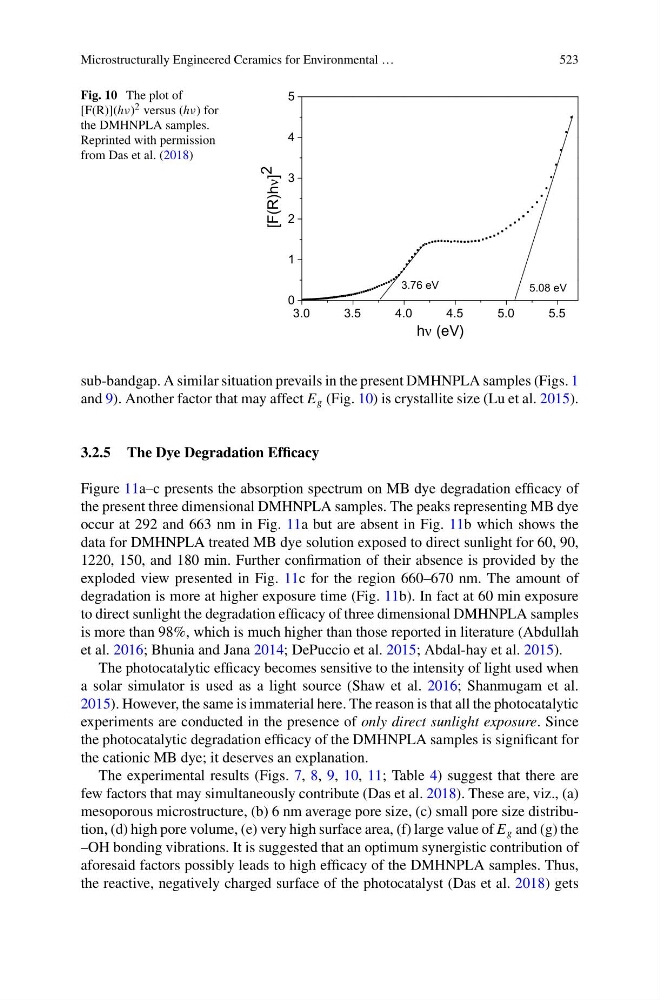
Fig. 10 The plot of
[F(R)](hν) 2 versus (hν) for
the DMHNPLA samples.
Reprinted with permission
from Das et al. (2018)
3.0
3.5
4.0
4.5
5.0
5.5
0
1
2
3
4
5
[F(R)hν] 2
5.08 eV
3.76 eV
hν (eV)
sub-bandgap. A similar situation prevails in the present DMHNPLA samples (Figs. 1
and 9). Another factor that may affect E g (Fig. 10) is crystallite size (Lu et al. 2015).
3.2.5 The Dye Degradation Efficacy
Figure 11a–c presents the absorption spectrum on MB dye degradation efficacy of
the present three dimensional DMHNPLA samples. The peaks representing MB dye
occur at 292 and 663 nm in Fig. 11a but are absent in Fig. 11b which shows the
data for DMHNPLA treated MB dye solution exposed to direct sunlight for 60, 90,
1220, 150, and 180 min. Further confirmation of their absence is provided by the
exploded view presented in Fig. 11c for the region 660–670 nm. The amount of
degradation is more at higher exposure time (Fig. 11b). In fact at 60 min exposure
to direct sunlight the degradation efficacy of three dimensional DMHNPLA samples
is more than 98%, which is much higher than those reported in literature (Abdullah
et al. 2016; Bhunia and Jana 2014; DePuccio et al. 2015; Abdal-hay et al. 2015).
The photocatalytic efficacy becomes sensitive to the intensity of light used when
a solar simulator is used as a light source (Shaw et al. 2016; Shanmugam et al.
2015). However, the same is immaterial here. The reason is that all the photocatalytic
experiments are conducted in the presence of only direct sunlight exposure. Since
the photocatalytic degradation efficacy of the DMHNPLA samples is significant for
the cationic MB dye; it deserves an explanation.
The experimental results (Figs. 7, 8, 9, 10, 11; Table 4) suggest that there are
few factors that may simultaneously contribute (Das et al. 2018). These are, viz., (a)
mesoporous microstructure, (b) 6 nm average pore size, (c) small pore size distribution, (d) high pore volume, (e) very high surface area, (f) large value of E g and (g) the
–OH bonding vibrations. It is suggested that an optimum synergistic contribution of
aforesaid factors possibly leads to high efficacy of the DMHNPLA samples. Thus,
the reactive, negatively charged surface of the photocatalyst (Das et al. 2018) gets
523
Fig. 10 The plot of
[F(R)](hν) 2 versus (hν) for
the DMHNPLA samples.
Reprinted with permission
from Das et al. (2018)
3.0
3.5
4.0
4.5
5.0
5.5
0
1
2
3
4
5
[F(R)hν] 2
5.08 eV
3.76 eV
hν (eV)
sub-bandgap. A similar situation prevails in the present DMHNPLA samples (Figs. 1
and 9). Another factor that may affect E g (Fig. 10) is crystallite size (Lu et al. 2015).
3.2.5 The Dye Degradation Efficacy
Figure 11a–c presents the absorption spectrum on MB dye degradation efficacy of
the present three dimensional DMHNPLA samples. The peaks representing MB dye
occur at 292 and 663 nm in Fig. 11a but are absent in Fig. 11b which shows the
data for DMHNPLA treated MB dye solution exposed to direct sunlight for 60, 90,
1220, 150, and 180 min. Further confirmation of their absence is provided by the
exploded view presented in Fig. 11c for the region 660–670 nm. The amount of
degradation is more at higher exposure time (Fig. 11b). In fact at 60 min exposure
to direct sunlight the degradation efficacy of three dimensional DMHNPLA samples
is more than 98%, which is much higher than those reported in literature (Abdullah
et al. 2016; Bhunia and Jana 2014; DePuccio et al. 2015; Abdal-hay et al. 2015).
The photocatalytic efficacy becomes sensitive to the intensity of light used when
a solar simulator is used as a light source (Shaw et al. 2016; Shanmugam et al.
2015). However, the same is immaterial here. The reason is that all the photocatalytic
experiments are conducted in the presence of only direct sunlight exposure. Since
the photocatalytic degradation efficacy of the DMHNPLA samples is significant for
the cationic MB dye; it deserves an explanation.
The experimental results (Figs. 7, 8, 9, 10, 11; Table 4) suggest that there are
few factors that may simultaneously contribute (Das et al. 2018). These are, viz., (a)
mesoporous microstructure, (b) 6 nm average pore size, (c) small pore size distribution, (d) high pore volume, (e) very high surface area, (f) large value of E g and (g) the
–OH bonding vibrations. It is suggested that an optimum synergistic contribution of
aforesaid factors possibly leads to high efficacy of the DMHNPLA samples. Thus,
the reactive, negatively charged surface of the photocatalyst (Das et al. 2018) gets