

520
P. S. Das et al.
Cu(II) ion concentrations dictates the relative variations in efficacies as a function of
solution number, Fig. 5b.
3.2 DMHNPLA for MB Dye Degradation
3.2.1 Synthesis of DMHNPLA Samples
The details of the synthesis procedure for DHNPLA are already reported (Das et al.
2018). The synthesis procedure is almost similar to that of MHNPL (Das et al. 2017).
However, with an aim to create more uniform and relatively narrower pore size
distribution as well as interconnected pores, Mg(NO 3 ) 2 solution of pH about 6.4 is
kept under a sonication bath. Now NaOH solution of pH ~ 12.8 is added dropwise at an
average rate of about 0.14 cc.s
−1 to the Mg(NO 3 ) 2 solution under ambient laboratory
condition (i.e., 30 °C). Next, by following the procedural steps as detailed in (Das
et al. 2017, 2018); the sample powders are obtained as a three dimensional (3D) selfassembly of MHNPL structures. These are designated as DMHNPLA which stands
for 3-D designed magnesium hydroxide nano-platelet assembly, as mentioned above.
3.2.2 Phase Purity and Surface Area Studies
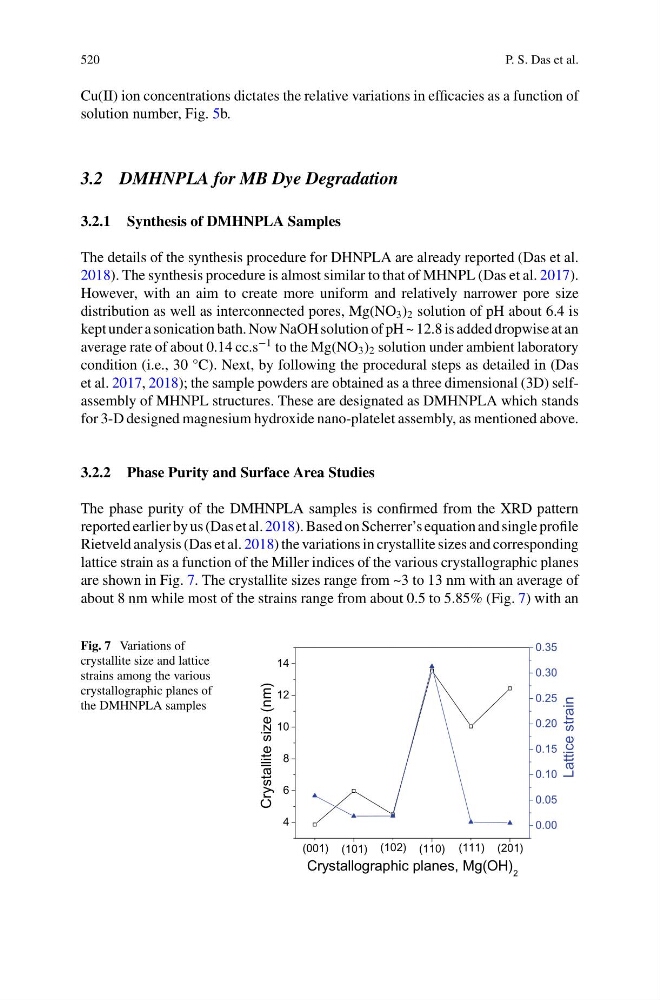
The phase purity of the DMHNPLA samples is confirmed from the XRD pattern
reported earlier by us (Das et al. 2018). Based on Scherrer’s equation and single profile
Rietveld analysis (Das et al. 2018) the variations in crystallite sizes and corresponding
lattice strain as a function of the Miller indices of the various crystallographic planes
are shown in Fig. 7. The crystallite sizes range from ~3 to 13 nm with an average of
about 8 nm while most of the strains range from about 0.5 to 5.85% (Fig. 7) with an
Fig. 7 Variations of
crystallite size and lattice
strains among the various
crystallographic planes of
the DMHNPLA samples
4
6
8
10
12
14
Crystallite size (nm)
Lattice strain
(001) (101) (102) (110) (111) (201)
Crystallographic planes, Mg(OH) 2
0.00
0.05
0.10
0.15
0.20
0.25
0.30
0.35
P. S. Das et al.
Cu(II) ion concentrations dictates the relative variations in efficacies as a function of
solution number, Fig. 5b.
3.2 DMHNPLA for MB Dye Degradation
3.2.1 Synthesis of DMHNPLA Samples
The details of the synthesis procedure for DHNPLA are already reported (Das et al.
2018). The synthesis procedure is almost similar to that of MHNPL (Das et al. 2017).
However, with an aim to create more uniform and relatively narrower pore size
distribution as well as interconnected pores, Mg(NO 3 ) 2 solution of pH about 6.4 is
kept under a sonication bath. Now NaOH solution of pH ~ 12.8 is added dropwise at an
average rate of about 0.14 cc.s
−1 to the Mg(NO 3 ) 2 solution under ambient laboratory
condition (i.e., 30 °C). Next, by following the procedural steps as detailed in (Das
et al. 2017, 2018); the sample powders are obtained as a three dimensional (3D) selfassembly of MHNPL structures. These are designated as DMHNPLA which stands
for 3-D designed magnesium hydroxide nano-platelet assembly, as mentioned above.
3.2.2 Phase Purity and Surface Area Studies
The phase purity of the DMHNPLA samples is confirmed from the XRD pattern
reported earlier by us (Das et al. 2018). Based on Scherrer’s equation and single profile
Rietveld analysis (Das et al. 2018) the variations in crystallite sizes and corresponding
lattice strain as a function of the Miller indices of the various crystallographic planes
are shown in Fig. 7. The crystallite sizes range from ~3 to 13 nm with an average of
about 8 nm while most of the strains range from about 0.5 to 5.85% (Fig. 7) with an
Fig. 7 Variations of
crystallite size and lattice
strains among the various
crystallographic planes of
the DMHNPLA samples
4
6
8
10
12
14
Crystallite size (nm)
Lattice strain
(001) (101) (102) (110) (111) (201)
Crystallographic planes, Mg(OH) 2
0.00
0.05
0.10
0.15
0.20
0.25
0.30
0.35