

Microstructurally Engineered Ceramics for Environmental …
513
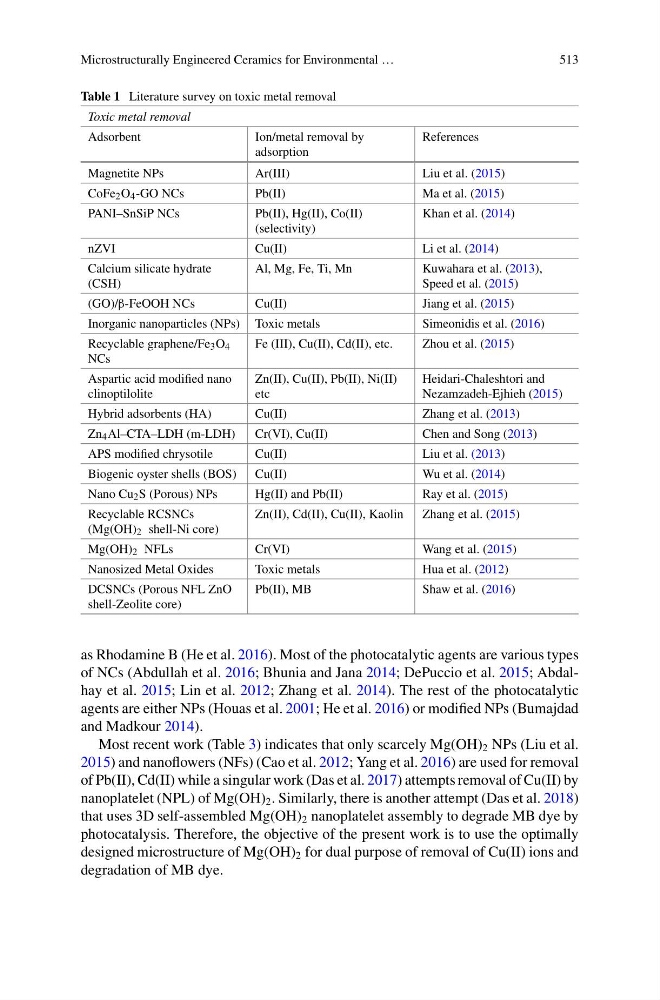
Table 1 Literature survey on toxic metal removal
Toxic metal removal
Adsorbent
Ion/metal removal by
adsorption
References
Magnetite NPs
Ar(III)
Liu et al. (2015)
CoFe 2 O 4 -GO NCs
Pb(II)
Ma et al. (2015)
PANI–SnSiP NCs
Pb(II), Hg(II), Co(II)
(selectivity)
Khan et al. (2014)
nZVI
Cu(II)
Li et al. (2014)
Calcium silicate hydrate
(CSH)
Al, Mg, Fe, Ti, Mn
Kuwahara et al. (2013),
Speed et al. (2015)
(GO)/β-FeOOH NCs
Cu(II)
Jiang et al. (2015)
Inorganic nanoparticles (NPs) Toxic metals
Simeonidis et al. (2016)
Recyclable graphene/Fe 3 O 4
NCs
Fe (III), Cu(II), Cd(II), etc.
Zhou et al. (2015)
Aspartic acid modified nano
clinoptilolite
Zn(II), Cu(II), Pb(II), Ni(II)
etc
Heidari-Chaleshtori and
Nezamzadeh-Ejhieh (2015)
Hybrid adsorbents (HA)
Cu(II)
Zhang et al. (2013)
Zn 4 Al–CTA–LDH (m-LDH)
Cr(VI), Cu(II)
Chen and Song (2013)
APS modified chrysotile
Cu(II)
Liu et al. (2013)
Biogenic oyster shells (BOS) Cu(II)
Wu et al. (2014)
Nano Cu 2 S (Porous) NPs
Hg(II) and Pb(II)
Ray et al. (2015)
Recyclable RCSNCs
(Mg(OH) 2 shell-Ni core)
Zn(II), Cd(II), Cu(II), Kaolin Zhang et al. (2015)
Mg(OH) 2 NFLs
Cr(VI)
Wang et al. (2015)
Nanosized Metal Oxides
Toxic metals
Hua et al. (2012)
DCSNCs (Porous NFL ZnO
shell-Zeolite core)
Pb(II), MB
Shaw et al. (2016)
as Rhodamine B (He et al. 2016). Most of the photocatalytic agents are various types
of NCs (Abdullah et al. 2016; Bhunia and Jana 2014; DePuccio et al. 2015; Abdalhay et al. 2015; Lin et al. 2012; Zhang et al. 2014). The rest of the photocatalytic
agents are either NPs (Houas et al. 2001; He et al. 2016) or modified NPs (Bumajdad
and Madkour 2014).
Most recent work (Table 3) indicates that only scarcely Mg(OH) 2 NPs (Liu et al.
2015) and nanoflowers (NFs) (Cao et al. 2012; Yang et al. 2016) are used for removal
of Pb(II), Cd(II) while a singular work (Das et al. 2017) attempts removal of Cu(II) by
nanoplatelet (NPL) of Mg(OH) 2 . Similarly, there is another attempt (Das et al. 2018)
that uses 3D self-assembled Mg(OH) 2 nanoplatelet assembly to degrade MB dye by
photocatalysis. Therefore, the objective of the present work is to use the optimally
designed microstructure of Mg(OH) 2 for dual purpose of removal of Cu(II) ions and
degradation of MB dye.
513
Table 1 Literature survey on toxic metal removal
Toxic metal removal
Adsorbent
Ion/metal removal by
adsorption
References
Magnetite NPs
Ar(III)
Liu et al. (2015)
CoFe 2 O 4 -GO NCs
Pb(II)
Ma et al. (2015)
PANI–SnSiP NCs
Pb(II), Hg(II), Co(II)
(selectivity)
Khan et al. (2014)
nZVI
Cu(II)
Li et al. (2014)
Calcium silicate hydrate
(CSH)
Al, Mg, Fe, Ti, Mn
Kuwahara et al. (2013),
Speed et al. (2015)
(GO)/β-FeOOH NCs
Cu(II)
Jiang et al. (2015)
Inorganic nanoparticles (NPs) Toxic metals
Simeonidis et al. (2016)
Recyclable graphene/Fe 3 O 4
NCs
Fe (III), Cu(II), Cd(II), etc.
Zhou et al. (2015)
Aspartic acid modified nano
clinoptilolite
Zn(II), Cu(II), Pb(II), Ni(II)
etc
Heidari-Chaleshtori and
Nezamzadeh-Ejhieh (2015)
Hybrid adsorbents (HA)
Cu(II)
Zhang et al. (2013)
Zn 4 Al–CTA–LDH (m-LDH)
Cr(VI), Cu(II)
Chen and Song (2013)
APS modified chrysotile
Cu(II)
Liu et al. (2013)
Biogenic oyster shells (BOS) Cu(II)
Wu et al. (2014)
Nano Cu 2 S (Porous) NPs
Hg(II) and Pb(II)
Ray et al. (2015)
Recyclable RCSNCs
(Mg(OH) 2 shell-Ni core)
Zn(II), Cd(II), Cu(II), Kaolin Zhang et al. (2015)
Mg(OH) 2 NFLs
Cr(VI)
Wang et al. (2015)
Nanosized Metal Oxides
Toxic metals
Hua et al. (2012)
DCSNCs (Porous NFL ZnO
shell-Zeolite core)
Pb(II), MB
Shaw et al. (2016)
as Rhodamine B (He et al. 2016). Most of the photocatalytic agents are various types
of NCs (Abdullah et al. 2016; Bhunia and Jana 2014; DePuccio et al. 2015; Abdalhay et al. 2015; Lin et al. 2012; Zhang et al. 2014). The rest of the photocatalytic
agents are either NPs (Houas et al. 2001; He et al. 2016) or modified NPs (Bumajdad
and Madkour 2014).
Most recent work (Table 3) indicates that only scarcely Mg(OH) 2 NPs (Liu et al.
2015) and nanoflowers (NFs) (Cao et al. 2012; Yang et al. 2016) are used for removal
of Pb(II), Cd(II) while a singular work (Das et al. 2017) attempts removal of Cu(II) by
nanoplatelet (NPL) of Mg(OH) 2 . Similarly, there is another attempt (Das et al. 2018)
that uses 3D self-assembled Mg(OH) 2 nanoplatelet assembly to degrade MB dye by
photocatalysis. Therefore, the objective of the present work is to use the optimally
designed microstructure of Mg(OH) 2 for dual purpose of removal of Cu(II) ions and
degradation of MB dye.