

Magnetic Nanoparticles: Green and Environment Friendly …
491
TEOS
APTES
NPs deposition
Fe 3 O 4
SiO 2
NH 2 group
Au
Cu
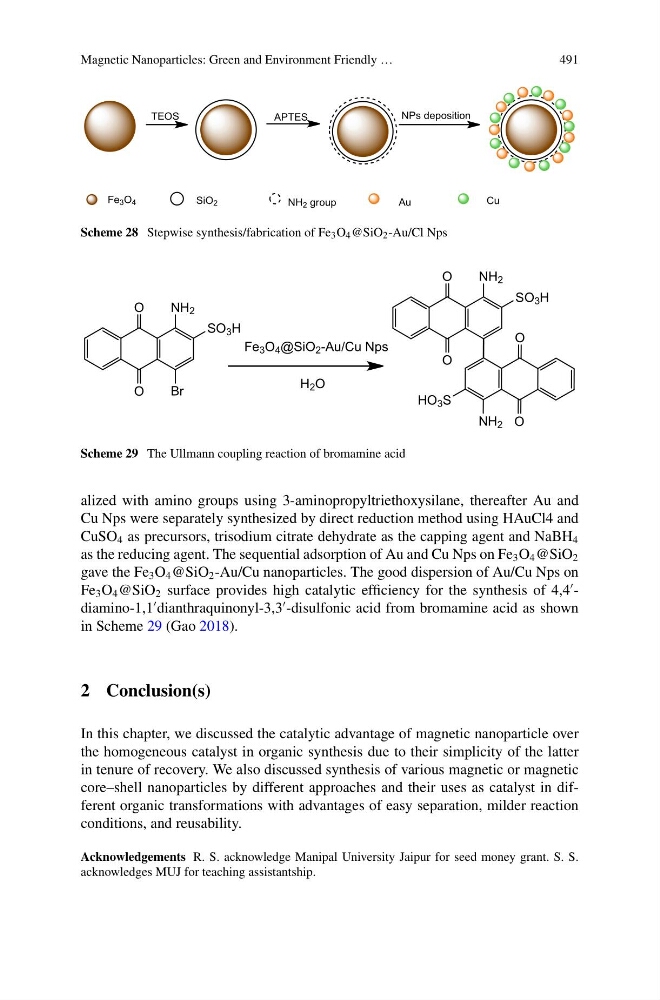
Scheme 28 Stepwise synthesis/fabrication of Fe 3 O 4 @SiO 2 -Au/Cl Nps
O
O
NH 2
SO 3 H
Br
O
O
NH 2
SO 3 H
O
O
NH 2
HO 3 S
Fe 3 O 4 @SiO 2 -Au/Cu Nps
H 2 O
Scheme 29 The Ullmann coupling reaction of bromamine acid
alized with amino groups using 3-aminopropyltriethoxysilane, thereafter Au and
Cu Nps were separately synthesized by direct reduction method using HAuCl4 and
CuSO 4 as precursors, trisodium citrate dehydrate as the capping agent and NaBH 4
as the reducing agent. The sequential adsorption of Au and Cu Nps on Fe 3 O 4 @SiO 2
gave the Fe 3 O 4 @SiO 2 -Au/Cu nanoparticles. The good dispersion of Au/Cu Nps on
Fe 3 O 4 @SiO 2 surface provides high catalytic efficiency for the synthesis of 4,4
-
diamino-1,1
dianthraquinonyl-3,3
-disulfonic acid from bromamine acid as shown
in Scheme 29 (Gao 2018).
2 Conclusion(s)
In this chapter, we discussed the catalytic advantage of magnetic nanoparticle over
the homogeneous catalyst in organic synthesis due to their simplicity of the latter
in tenure of recovery. We also discussed synthesis of various magnetic or magnetic
core–shell nanoparticles by different approaches and their uses as catalyst in different organic transformations with advantages of easy separation, milder reaction
conditions, and reusability.
Acknowledgements R. S. acknowledge Manipal University Jaipur for seed money grant. S. S.
acknowledges MUJ for teaching assistantship.
491
TEOS
APTES
NPs deposition
Fe 3 O 4
SiO 2
NH 2 group
Au
Cu
Scheme 28 Stepwise synthesis/fabrication of Fe 3 O 4 @SiO 2 -Au/Cl Nps
O
O
NH 2
SO 3 H
Br
O
O
NH 2
SO 3 H
O
O
NH 2
HO 3 S
Fe 3 O 4 @SiO 2 -Au/Cu Nps
H 2 O
Scheme 29 The Ullmann coupling reaction of bromamine acid
alized with amino groups using 3-aminopropyltriethoxysilane, thereafter Au and
Cu Nps were separately synthesized by direct reduction method using HAuCl4 and
CuSO 4 as precursors, trisodium citrate dehydrate as the capping agent and NaBH 4
as the reducing agent. The sequential adsorption of Au and Cu Nps on Fe 3 O 4 @SiO 2
gave the Fe 3 O 4 @SiO 2 -Au/Cu nanoparticles. The good dispersion of Au/Cu Nps on
Fe 3 O 4 @SiO 2 surface provides high catalytic efficiency for the synthesis of 4,4
-
diamino-1,1
dianthraquinonyl-3,3
-disulfonic acid from bromamine acid as shown
in Scheme 29 (Gao 2018).
2 Conclusion(s)
In this chapter, we discussed the catalytic advantage of magnetic nanoparticle over
the homogeneous catalyst in organic synthesis due to their simplicity of the latter
in tenure of recovery. We also discussed synthesis of various magnetic or magnetic
core–shell nanoparticles by different approaches and their uses as catalyst in different organic transformations with advantages of easy separation, milder reaction
conditions, and reusability.
Acknowledgements R. S. acknowledge Manipal University Jaipur for seed money grant. S. S.
acknowledges MUJ for teaching assistantship.