

490
S. Swami and R. Shrivastava
OH
HO
CN
NC
RCHO
O
R
CN
NH 2
HO
+
+
Fe 3 O 4 -Chitosan MNps
water/ ultrasound irradiation
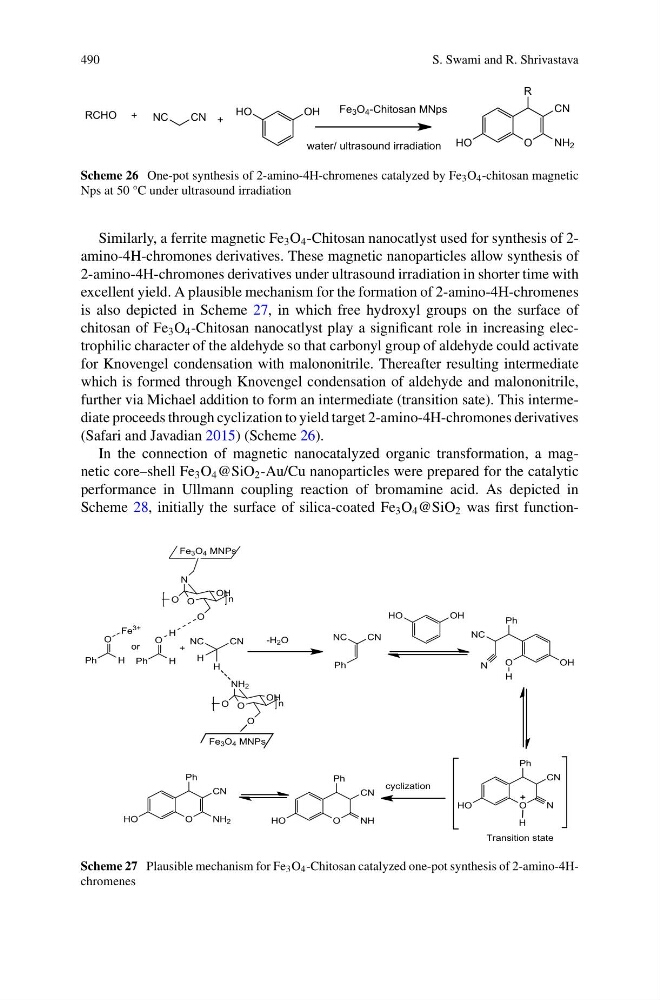
Scheme 26 One-pot synthesis of 2-amino-4H-chromenes catalyzed by Fe 3 O 4 -chitosan magnetic
Nps at 50 °C under ultrasound irradiation
Similarly, a ferrite magnetic Fe 3 O 4 -Chitosan nanocatlyst used for synthesis of 2amino-4H-chromones derivatives. These magnetic nanoparticles allow synthesis of
2-amino-4H-chromones derivatives under ultrasound irradiation in shorter time with
excellent yield. A plausible mechanism for the formation of 2-amino-4H-chromenes
is also depicted in Scheme 27, in which free hydroxyl groups on the surface of
chitosan of Fe 3 O 4 -Chitosan nanocatlyst play a significant role in increasing electrophilic character of the aldehyde so that carbonyl group of aldehyde could activate
for Knovengel condensation with malononitrile. Thereafter resulting intermediate
which is formed through Knovengel condensation of aldehyde and malononitrile,
further via Michael addition to form an intermediate (transition sate). This intermediate proceeds through cyclization to yield target 2-amino-4H-chromones derivatives
(Safari and Javadian 2015) (Scheme 26).
In the connection of magnetic nanocatalyzed organic transformation, a magnetic core–shell Fe 3 O 4 @SiO 2 -Au/Cu nanoparticles were prepared for the catalytic
performance in Ullmann coupling reaction of bromamine acid. As depicted in
Scheme 28, initially the surface of silica-coated Fe 3 O 4 @SiO 2 was first functionO
Ph
CN
NH 2
HO
O
Ph
CN
NH
HO
O
Ph
CN
N
HO
H
O
OH
NC
H
N
Ph
O
H
Ph
Fe
3+
O
H
Ph
H
O
OH
O
N
O
Fe 3 O 4 MNPs
n
or
NC
CN
H
H
O
OH
O
NH 2
O
n
Fe 3 O 4 MNPs
+
NC
CN
Ph
HO
OH
-H 2 O
Transition state
cyclization
Scheme 27 Plausible mechanism for Fe 3 O 4 -Chitosan catalyzed one-pot synthesis of 2-amino-4Hchromenes
S. Swami and R. Shrivastava
OH
HO
CN
NC
RCHO
O
R
CN
NH 2
HO
+
+
Fe 3 O 4 -Chitosan MNps
water/ ultrasound irradiation
Scheme 26 One-pot synthesis of 2-amino-4H-chromenes catalyzed by Fe 3 O 4 -chitosan magnetic
Nps at 50 °C under ultrasound irradiation
Similarly, a ferrite magnetic Fe 3 O 4 -Chitosan nanocatlyst used for synthesis of 2amino-4H-chromones derivatives. These magnetic nanoparticles allow synthesis of
2-amino-4H-chromones derivatives under ultrasound irradiation in shorter time with
excellent yield. A plausible mechanism for the formation of 2-amino-4H-chromenes
is also depicted in Scheme 27, in which free hydroxyl groups on the surface of
chitosan of Fe 3 O 4 -Chitosan nanocatlyst play a significant role in increasing electrophilic character of the aldehyde so that carbonyl group of aldehyde could activate
for Knovengel condensation with malononitrile. Thereafter resulting intermediate
which is formed through Knovengel condensation of aldehyde and malononitrile,
further via Michael addition to form an intermediate (transition sate). This intermediate proceeds through cyclization to yield target 2-amino-4H-chromones derivatives
(Safari and Javadian 2015) (Scheme 26).
In the connection of magnetic nanocatalyzed organic transformation, a magnetic core–shell Fe 3 O 4 @SiO 2 -Au/Cu nanoparticles were prepared for the catalytic
performance in Ullmann coupling reaction of bromamine acid. As depicted in
Scheme 28, initially the surface of silica-coated Fe 3 O 4 @SiO 2 was first functionO
Ph
CN
NH 2
HO
O
Ph
CN
NH
HO
O
Ph
CN
N
HO
H
O
OH
NC
H
N
Ph
O
H
Ph
Fe
3+
O
H
Ph
H
O
OH
O
N
O
Fe 3 O 4 MNPs
n
or
NC
CN
H
H
O
OH
O
NH 2
O
n
Fe 3 O 4 MNPs
+
NC
CN
Ph
HO
OH
-H 2 O
Transition state
cyclization
Scheme 27 Plausible mechanism for Fe 3 O 4 -Chitosan catalyzed one-pot synthesis of 2-amino-4Hchromenes