

Magnetic Nanoparticles: Green and Environment Friendly …
487
OH
OH
OH
OH
OH
HO
HO
HO
1,4-butanesultone
O
O
O
O
O
O
O
O
SO 3 H
SO 3 H
SO 3 H
HO 3 S
HO 3 S
HO 3 S
SO 3 H HO 3 S
O
O
O
O
O
O
O
O
SO 3 H
SO 3 H
SO 3 H
HO 3 S
HO 3 S
HO 3 S
SO 3 H
SO 3 H
OH
H 3 N
HO
NH 3
HO
NH 3
HO
NH 3
HO
NH 3
OH
H 3 N
OH
H 3 N
OH
H 3 N
Ethanolamine
= Fe 2 O 3
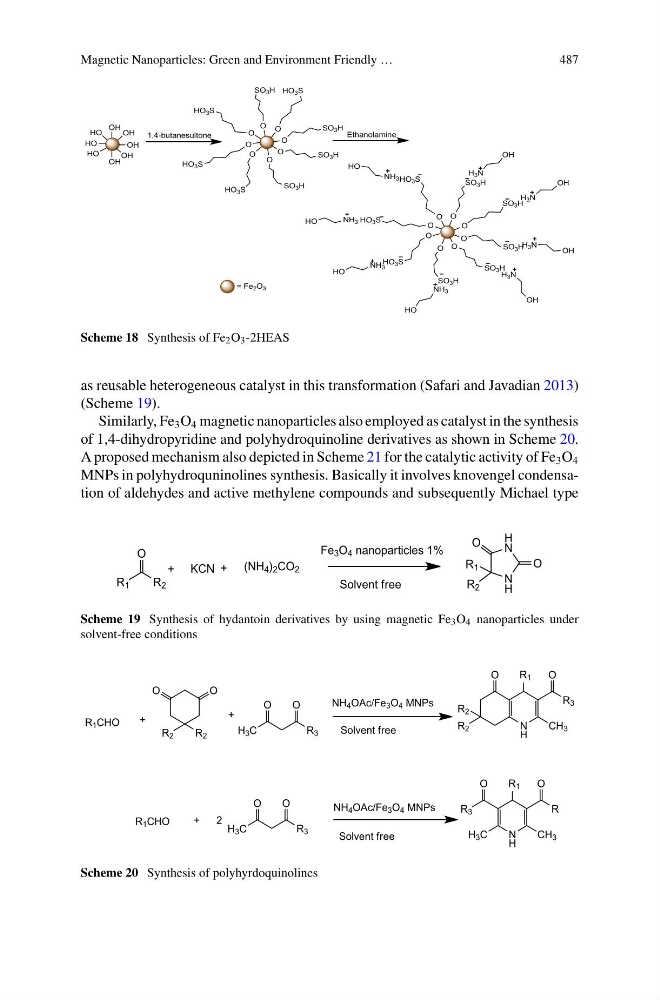
Scheme 18 Synthesis of Fe 2 O 3 -2HEAS
as reusable heterogeneous catalyst in this transformation (Safari and Javadian 2013)
(Scheme 19).
Similarly, Fe 3 O 4 magnetic nanoparticles also employed as catalyst in the synthesis
of 1,4-dihydropyridine and polyhydroquinoline derivatives as shown in Scheme 20.
A proposed mechanism also depicted in Scheme 21 for the catalytic activity of Fe 3 O 4
MNPs in polyhydroquninolines synthesis. Basically it involves knovengel condensation of aldehydes and active methylene compounds and subsequently Michael type
O
R 2
R 1
KCN
(NH 4 ) 2 CO 2
Fe 3 O 4 nanoparticles 1%
Solvent free
N
H
H
N
O
O
R 2
R 1
+
+
Scheme 19 Synthesis of hydantoin derivatives by using magnetic Fe 3 O 4 nanoparticles under
solvent-free conditions
O
O
H 3 C
R 3
O
O
H 3 C
R 3
O
O
N
H
N
H
O
R 1
R 3
O
CH 3
R 2
R 2
R 1
O
R 3
H 3 C
R
O
CH 3
R 2
R 2
NH 4 OAc/Fe 3 O 4 MNPs
Solvent free
R 1 CHO
R 1 CHO
NH 4 OAc/Fe 3 O 4 MNPs
Solvent free
+
+
+
2
Scheme 20 Synthesis of polyhyrdoquinolines
487
OH
OH
OH
OH
OH
HO
HO
HO
1,4-butanesultone
O
O
O
O
O
O
O
O
SO 3 H
SO 3 H
SO 3 H
HO 3 S
HO 3 S
HO 3 S
SO 3 H HO 3 S
O
O
O
O
O
O
O
O
SO 3 H
SO 3 H
SO 3 H
HO 3 S
HO 3 S
HO 3 S
SO 3 H
SO 3 H
OH
H 3 N
HO
NH 3
HO
NH 3
HO
NH 3
HO
NH 3
OH
H 3 N
OH
H 3 N
OH
H 3 N
Ethanolamine
= Fe 2 O 3
Scheme 18 Synthesis of Fe 2 O 3 -2HEAS
as reusable heterogeneous catalyst in this transformation (Safari and Javadian 2013)
(Scheme 19).
Similarly, Fe 3 O 4 magnetic nanoparticles also employed as catalyst in the synthesis
of 1,4-dihydropyridine and polyhydroquinoline derivatives as shown in Scheme 20.
A proposed mechanism also depicted in Scheme 21 for the catalytic activity of Fe 3 O 4
MNPs in polyhydroquninolines synthesis. Basically it involves knovengel condensation of aldehydes and active methylene compounds and subsequently Michael type
O
R 2
R 1
KCN
(NH 4 ) 2 CO 2
Fe 3 O 4 nanoparticles 1%
Solvent free
N
H
H
N
O
O
R 2
R 1
+
+
Scheme 19 Synthesis of hydantoin derivatives by using magnetic Fe 3 O 4 nanoparticles under
solvent-free conditions
O
O
H 3 C
R 3
O
O
H 3 C
R 3
O
O
N
H
N
H
O
R 1
R 3
O
CH 3
R 2
R 2
R 1
O
R 3
H 3 C
R
O
CH 3
R 2
R 2
NH 4 OAc/Fe 3 O 4 MNPs
Solvent free
R 1 CHO
R 1 CHO
NH 4 OAc/Fe 3 O 4 MNPs
Solvent free
+
+
+
2
Scheme 20 Synthesis of polyhyrdoquinolines