

482
S. Swami and R. Shrivastava
HO
O
O
O
H
N
O
N
H
O
NH
N
H
O
H
N
O
NH
O
Fe 3 O 4
SiO 2
O
R
H
O
O
R
OH
Calix-Pro-MN 10%
H 2 O, rt, 36h
Calix-Pro-MN
+
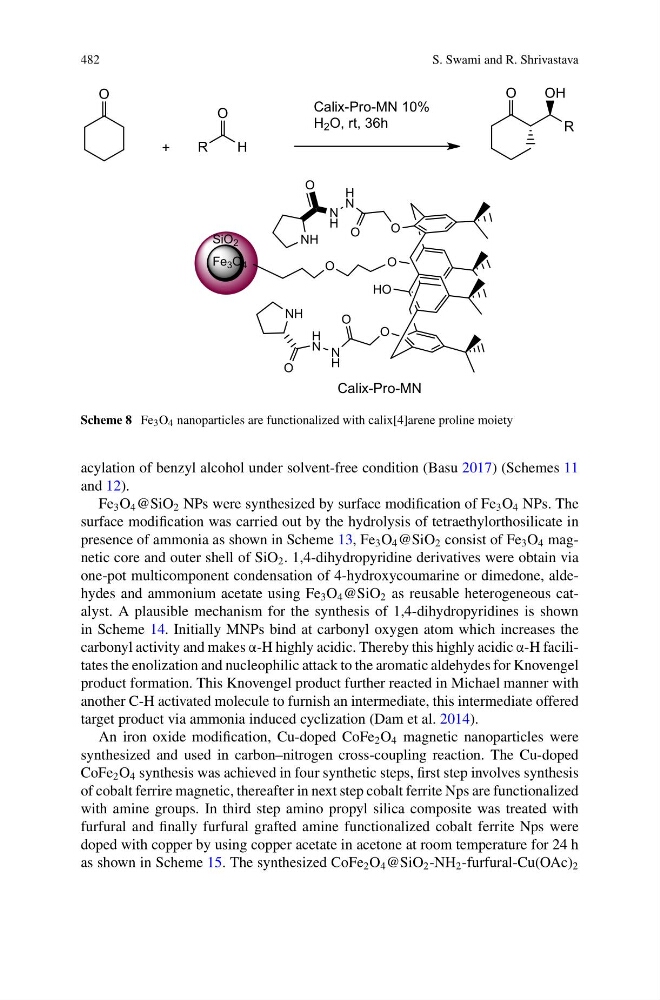
Scheme 8 Fe 3 O 4 nanoparticles are functionalized with calix[4]arene proline moiety
acylation of benzyl alcohol under solvent-free condition (Basu 2017) (Schemes 11
and 12).
Fe 3 O 4 @SiO 2 NPs were synthesized by surface modification of Fe 3 O 4 NPs. The
surface modification was carried out by the hydrolysis of tetraethylorthosilicate in
presence of ammonia as shown in Scheme 13, Fe 3 O 4 @SiO 2 consist of Fe 3 O 4 magnetic core and outer shell of SiO 2 . 1,4-dihydropyridine derivatives were obtain via
one-pot multicomponent condensation of 4-hydroxycoumarine or dimedone, aldehydes and ammonium acetate using Fe 3 O 4 @SiO 2 as reusable heterogeneous catalyst. A plausible mechanism for the synthesis of 1,4-dihydropyridines is shown
in Scheme 14. Initially MNPs bind at carbonyl oxygen atom which increases the
carbonyl activity and makes α-H highly acidic. Thereby this highly acidic α-H facilitates the enolization and nucleophilic attack to the aromatic aldehydes for Knovengel
product formation. This Knovengel product further reacted in Michael manner with
another C-H activated molecule to furnish an intermediate, this intermediate offered
target product via ammonia induced cyclization (Dam et al. 2014).
An iron oxide modification, Cu-doped CoFe 2 O 4 magnetic nanoparticles were
synthesized and used in carbon–nitrogen cross-coupling reaction. The Cu-doped
CoFe 2 O 4 synthesis was achieved in four synthetic steps, first step involves synthesis
of cobalt ferrire magnetic, thereafter in next step cobalt ferrite Nps are functionalized
with amine groups. In third step amino propyl silica composite was treated with
furfural and finally furfural grafted amine functionalized cobalt ferrite Nps were
doped with copper by using copper acetate in acetone at room temperature for 24 h
as shown in Scheme 15. The synthesized CoFe 2 O 4 @SiO 2 -NH 2 -furfural-Cu(OAc) 2
S. Swami and R. Shrivastava
HO
O
O
O
H
N
O
N
H
O
NH
N
H
O
H
N
O
NH
O
Fe 3 O 4
SiO 2
O
R
H
O
O
R
OH
Calix-Pro-MN 10%
H 2 O, rt, 36h
Calix-Pro-MN
+
Scheme 8 Fe 3 O 4 nanoparticles are functionalized with calix[4]arene proline moiety
acylation of benzyl alcohol under solvent-free condition (Basu 2017) (Schemes 11
and 12).
Fe 3 O 4 @SiO 2 NPs were synthesized by surface modification of Fe 3 O 4 NPs. The
surface modification was carried out by the hydrolysis of tetraethylorthosilicate in
presence of ammonia as shown in Scheme 13, Fe 3 O 4 @SiO 2 consist of Fe 3 O 4 magnetic core and outer shell of SiO 2 . 1,4-dihydropyridine derivatives were obtain via
one-pot multicomponent condensation of 4-hydroxycoumarine or dimedone, aldehydes and ammonium acetate using Fe 3 O 4 @SiO 2 as reusable heterogeneous catalyst. A plausible mechanism for the synthesis of 1,4-dihydropyridines is shown
in Scheme 14. Initially MNPs bind at carbonyl oxygen atom which increases the
carbonyl activity and makes α-H highly acidic. Thereby this highly acidic α-H facilitates the enolization and nucleophilic attack to the aromatic aldehydes for Knovengel
product formation. This Knovengel product further reacted in Michael manner with
another C-H activated molecule to furnish an intermediate, this intermediate offered
target product via ammonia induced cyclization (Dam et al. 2014).
An iron oxide modification, Cu-doped CoFe 2 O 4 magnetic nanoparticles were
synthesized and used in carbon–nitrogen cross-coupling reaction. The Cu-doped
CoFe 2 O 4 synthesis was achieved in four synthetic steps, first step involves synthesis
of cobalt ferrire magnetic, thereafter in next step cobalt ferrite Nps are functionalized
with amine groups. In third step amino propyl silica composite was treated with
furfural and finally furfural grafted amine functionalized cobalt ferrite Nps were
doped with copper by using copper acetate in acetone at room temperature for 24 h
as shown in Scheme 15. The synthesized CoFe 2 O 4 @SiO 2 -NH 2 -furfural-Cu(OAc) 2