

Functionalized Nano-porous Silicon Surfaces for Energy …
389
where E is the energy stored in Joules and V the voltage between the plate. The
stored energy in the capacitor can be increased by increasing the voltage stored on
the capacitor or the capacitance C. The capacitance C of a capacitor is given by the
equation:
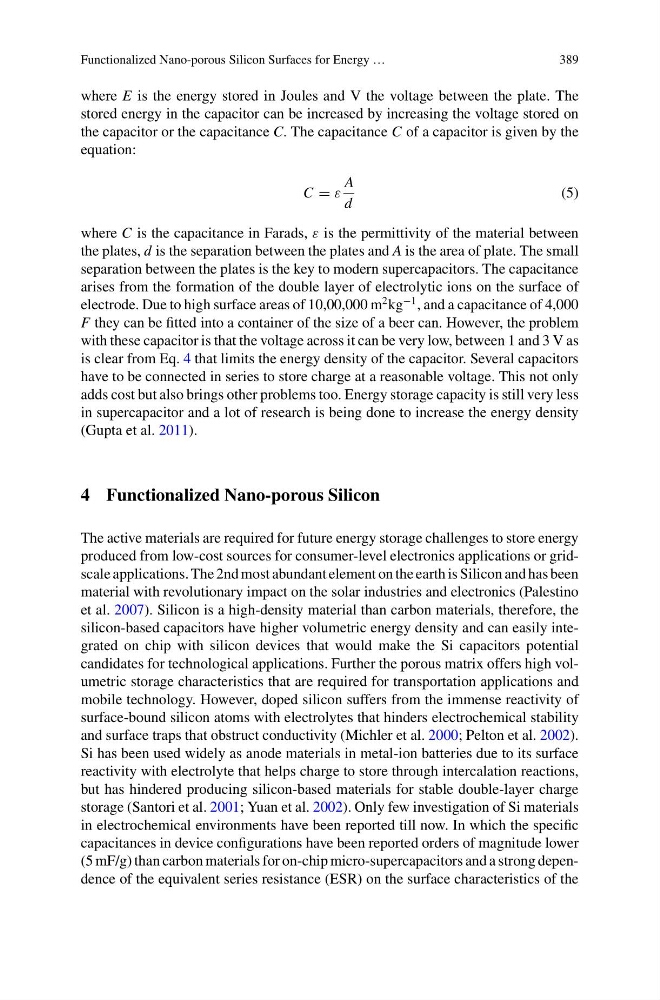
C = ε
A
d
(5)
where C is the capacitance in Farads, ε is the permittivity of the material between
the plates, d is the separation between the plates and A is the area of plate. The small
separation between the plates is the key to modern supercapacitors. The capacitance
arises from the formation of the double layer of electrolytic ions on the surface of
electrode. Due to high surface areas of 10,00,000 m
2 kg
−1 , and a capacitance of 4,000
F they can be fitted into a container of the size of a beer can. However, the problem
with these capacitor is that the voltage across it can be very low, between 1 and 3 V as
is clear from Eq. 4 that limits the energy density of the capacitor. Several capacitors
have to be connected in series to store charge at a reasonable voltage. This not only
adds cost but also brings other problems too. Energy storage capacity is still very less
in supercapacitor and a lot of research is being done to increase the energy density
(Gupta et al. 2011).
4 Functionalized Nano-porous Silicon
The active materials are required for future energy storage challenges to store energy
produced from low-cost sources for consumer-level electronics applications or gridscale applications. The 2nd most abundant element on the earth is Silicon and has been
material with revolutionary impact on the solar industries and electronics (Palestino
et al. 2007). Silicon is a high-density material than carbon materials, therefore, the
silicon-based capacitors have higher volumetric energy density and can easily integrated on chip with silicon devices that would make the Si capacitors potential
candidates for technological applications. Further the porous matrix offers high volumetric storage characteristics that are required for transportation applications and
mobile technology. However, doped silicon suffers from the immense reactivity of
surface-bound silicon atoms with electrolytes that hinders electrochemical stability
and surface traps that obstruct conductivity (Michler et al. 2000; Pelton et al. 2002).
Si has been used widely as anode materials in metal-ion batteries due to its surface
reactivity with electrolyte that helps charge to store through intercalation reactions,
but has hindered producing silicon-based materials for stable double-layer charge
storage (Santori et al. 2001; Yuan et al. 2002). Only few investigation of Si materials
in electrochemical environments have been reported till now. In which the specific
capacitances in device configurations have been reported orders of magnitude lower
(5 mF/g) than carbon materials for on-chip micro-supercapacitors and a strong dependence of the equivalent series resistance (ESR) on the surface characteristics of the
389
where E is the energy stored in Joules and V the voltage between the plate. The
stored energy in the capacitor can be increased by increasing the voltage stored on
the capacitor or the capacitance C. The capacitance C of a capacitor is given by the
equation:
C = ε
A
d
(5)
where C is the capacitance in Farads, ε is the permittivity of the material between
the plates, d is the separation between the plates and A is the area of plate. The small
separation between the plates is the key to modern supercapacitors. The capacitance
arises from the formation of the double layer of electrolytic ions on the surface of
electrode. Due to high surface areas of 10,00,000 m
2 kg
−1 , and a capacitance of 4,000
F they can be fitted into a container of the size of a beer can. However, the problem
with these capacitor is that the voltage across it can be very low, between 1 and 3 V as
is clear from Eq. 4 that limits the energy density of the capacitor. Several capacitors
have to be connected in series to store charge at a reasonable voltage. This not only
adds cost but also brings other problems too. Energy storage capacity is still very less
in supercapacitor and a lot of research is being done to increase the energy density
(Gupta et al. 2011).
4 Functionalized Nano-porous Silicon
The active materials are required for future energy storage challenges to store energy
produced from low-cost sources for consumer-level electronics applications or gridscale applications. The 2nd most abundant element on the earth is Silicon and has been
material with revolutionary impact on the solar industries and electronics (Palestino
et al. 2007). Silicon is a high-density material than carbon materials, therefore, the
silicon-based capacitors have higher volumetric energy density and can easily integrated on chip with silicon devices that would make the Si capacitors potential
candidates for technological applications. Further the porous matrix offers high volumetric storage characteristics that are required for transportation applications and
mobile technology. However, doped silicon suffers from the immense reactivity of
surface-bound silicon atoms with electrolytes that hinders electrochemical stability
and surface traps that obstruct conductivity (Michler et al. 2000; Pelton et al. 2002).
Si has been used widely as anode materials in metal-ion batteries due to its surface
reactivity with electrolyte that helps charge to store through intercalation reactions,
but has hindered producing silicon-based materials for stable double-layer charge
storage (Santori et al. 2001; Yuan et al. 2002). Only few investigation of Si materials
in electrochemical environments have been reported till now. In which the specific
capacitances in device configurations have been reported orders of magnitude lower
(5 mF/g) than carbon materials for on-chip micro-supercapacitors and a strong dependence of the equivalent series resistance (ESR) on the surface characteristics of the