

388
P. Kumar
or mass of the reactants per exchanged electron as small as possible; (3) electrolyte
should not be consumed in the chemistry of the battery. The Lithium-ion batteries
are widely used due to their high energy density in mobile technology and are considered to be one of the best choices as a power source for vehicles. However, an
effort is being made to increase the capacity of lithium-ion batteries by replacing
the traditional graphite as the anode material with the use of silicon (Si). Silicon has
a theoretical specific capacity of ~4200 mAh/g for lithium compare to traditional
graphite that has specific capacity of ~370 mAh/g. Even when taking into account
the volumetric expansion, simply by changing the graphitic anode by silicon, it has
been estimated that the cell energy density could be improved by 10–30% (Bogart
et al. 2014; Obrovac and Chevrier 2014). Silicon is commonly used in anodes today
and can hold 10 times more lithium ions than the graphite. But Si expands its volume
three times when completely lithiated. The swelling and shrinking on repeated cycle
causes silicon to quickly break down. To overcome these problems of stability due
to volumetric expansion, a functionalized mesoporous silicon is being used as an
anode material. It is reported that the pores between the Si material help to provide
the space for volumetric expansion results in better stability. Therefore an optimized
pore size of porous silicon has been studied for stability of battery electrode (Ikonen
et al. 2017).
3.2 Supercapacitor
Capacitors are devices in which two conducting plates are separated by an insulator
and a supercapacitors are capacitors, which can store large quantities of electricity. Energy storage capacity per unit volume or mass of supercapacitor is 10–100
times more than electrolytic capacitors. They can be charged and discharged much
quicker than batteries, and have many more charging and discharging life cycles
than rechargeable batteries. The electric energy in capacitors is stored by accumulating positive and negative charges often on parallel plates separated by an insulating
dielectric while batteries store electricity using electrochemical potential. Capacitors
have traditionally been used to provide very short bursts of energy usually less than
one second. The charge storage capacity of the capacitor is limited and is usually
much larger and heavier than a battery of equivalent power. Supercapacitors have
been projected as a potential replacement for traditional batteries due to rises in storage capacity. Capacitors are potential candidates for energy storage for regenerative
breaking due to its quick charge and discharge capacity. The capacitor storage capacity is decided by the surface area of its two charged plates. The higher surface area
of plates has larger capacitance. The surface area of capacitor plate can be increased
by the use of nanostructured surfaces results in the increase in charge capacity of
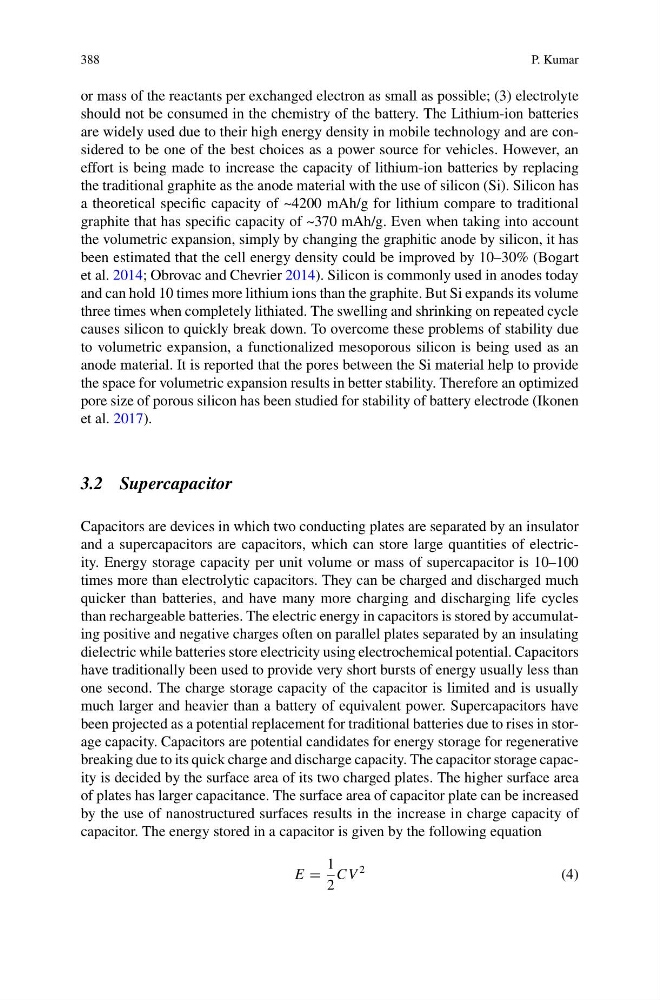
capacitor. The energy stored in a capacitor is given by the following equation
E =
1
2
C V
2
(4)
P. Kumar
or mass of the reactants per exchanged electron as small as possible; (3) electrolyte
should not be consumed in the chemistry of the battery. The Lithium-ion batteries
are widely used due to their high energy density in mobile technology and are considered to be one of the best choices as a power source for vehicles. However, an
effort is being made to increase the capacity of lithium-ion batteries by replacing
the traditional graphite as the anode material with the use of silicon (Si). Silicon has
a theoretical specific capacity of ~4200 mAh/g for lithium compare to traditional
graphite that has specific capacity of ~370 mAh/g. Even when taking into account
the volumetric expansion, simply by changing the graphitic anode by silicon, it has
been estimated that the cell energy density could be improved by 10–30% (Bogart
et al. 2014; Obrovac and Chevrier 2014). Silicon is commonly used in anodes today
and can hold 10 times more lithium ions than the graphite. But Si expands its volume
three times when completely lithiated. The swelling and shrinking on repeated cycle
causes silicon to quickly break down. To overcome these problems of stability due
to volumetric expansion, a functionalized mesoporous silicon is being used as an
anode material. It is reported that the pores between the Si material help to provide
the space for volumetric expansion results in better stability. Therefore an optimized
pore size of porous silicon has been studied for stability of battery electrode (Ikonen
et al. 2017).
3.2 Supercapacitor
Capacitors are devices in which two conducting plates are separated by an insulator
and a supercapacitors are capacitors, which can store large quantities of electricity. Energy storage capacity per unit volume or mass of supercapacitor is 10–100
times more than electrolytic capacitors. They can be charged and discharged much
quicker than batteries, and have many more charging and discharging life cycles
than rechargeable batteries. The electric energy in capacitors is stored by accumulating positive and negative charges often on parallel plates separated by an insulating
dielectric while batteries store electricity using electrochemical potential. Capacitors
have traditionally been used to provide very short bursts of energy usually less than
one second. The charge storage capacity of the capacitor is limited and is usually
much larger and heavier than a battery of equivalent power. Supercapacitors have
been projected as a potential replacement for traditional batteries due to rises in storage capacity. Capacitors are potential candidates for energy storage for regenerative
breaking due to its quick charge and discharge capacity. The capacitor storage capacity is decided by the surface area of its two charged plates. The higher surface area
of plates has larger capacitance. The surface area of capacitor plate can be increased
by the use of nanostructured surfaces results in the increase in charge capacity of
capacitor. The energy stored in a capacitor is given by the following equation
E =
1
2
C V
2
(4)