

Functionalized Nano-porous Silicon Surfaces for Energy …
381
hydrogen evolution on the surface of Si. Due to these reasons the concentration ration
of HF and ethanol or other surfactant is very important to vary the physical properties
of PS. Another factor in deciding the physical properties of PS is potentially applied
between the electrodes. Generally it is preferable to work with constant current
because it allows better control of physical properties and reproducibility of the PS
layer.
2.2 Change in Physical Properties of Porous Silicon
Several mechanisms have been proposed to explain the porous silicon formation.
In most the mechanism basic need is as follows: The holes are prerequisite for pore
formation in Si substrate and the Si wafer must be anodically biased. This corresponds
to reverse biasing for n-type doped silicon and forward biasing for p-type doped
silicon. For semi-insulating p-type doped and n-type doped silicon, light must be
supplied to have enough holes in the substrate. Optimized current density below the
critical value must be used. The holes are used up during the etching of silicon in first
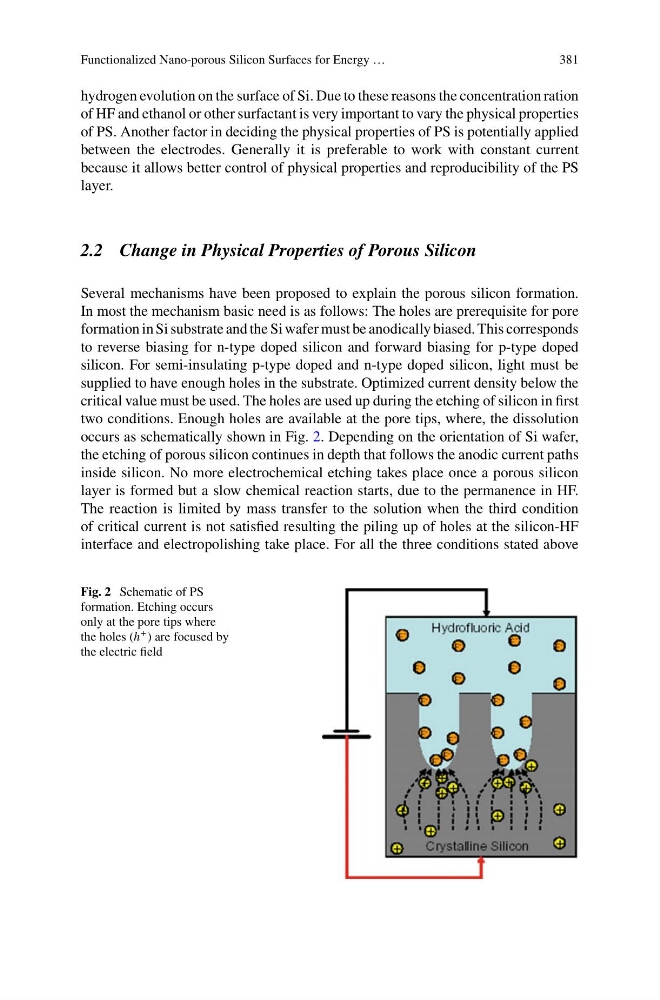
two conditions. Enough holes are available at the pore tips, where, the dissolution
occurs as schematically shown in Fig. 2. Depending on the orientation of Si wafer,
the etching of porous silicon continues in depth that follows the anodic current paths
inside silicon. No more electrochemical etching takes place once a porous silicon
layer is formed but a slow chemical reaction starts, due to the permanence in HF.
The reaction is limited by mass transfer to the solution when the third condition
of critical current is not satisfied resulting the piling up of holes at the silicon-HF
interface and electropolishing take place. For all the three conditions stated above
Fig. 2 Schematic of PS
formation. Etching occurs
only at the pore tips where
the holes (h + ) are focused by
the electric field
381
hydrogen evolution on the surface of Si. Due to these reasons the concentration ration
of HF and ethanol or other surfactant is very important to vary the physical properties
of PS. Another factor in deciding the physical properties of PS is potentially applied
between the electrodes. Generally it is preferable to work with constant current
because it allows better control of physical properties and reproducibility of the PS
layer.
2.2 Change in Physical Properties of Porous Silicon
Several mechanisms have been proposed to explain the porous silicon formation.
In most the mechanism basic need is as follows: The holes are prerequisite for pore
formation in Si substrate and the Si wafer must be anodically biased. This corresponds
to reverse biasing for n-type doped silicon and forward biasing for p-type doped
silicon. For semi-insulating p-type doped and n-type doped silicon, light must be
supplied to have enough holes in the substrate. Optimized current density below the
critical value must be used. The holes are used up during the etching of silicon in first
two conditions. Enough holes are available at the pore tips, where, the dissolution
occurs as schematically shown in Fig. 2. Depending on the orientation of Si wafer,
the etching of porous silicon continues in depth that follows the anodic current paths
inside silicon. No more electrochemical etching takes place once a porous silicon
layer is formed but a slow chemical reaction starts, due to the permanence in HF.
The reaction is limited by mass transfer to the solution when the third condition
of critical current is not satisfied resulting the piling up of holes at the silicon-HF
interface and electropolishing take place. For all the three conditions stated above
Fig. 2 Schematic of PS
formation. Etching occurs
only at the pore tips where
the holes (h + ) are focused by
the electric field