

380
P. Kumar
equations:
Si + 2HF + 2h
+
→ SiF 2 + 2H
+
,
(1)
SiF 2 + 4HF → H 2 + H 2 SiF 6
(2)
The etching rate is determined by the holes (h
+ ) accumulation in the adjacent
regions of the HF electrolyte and Si atoms.
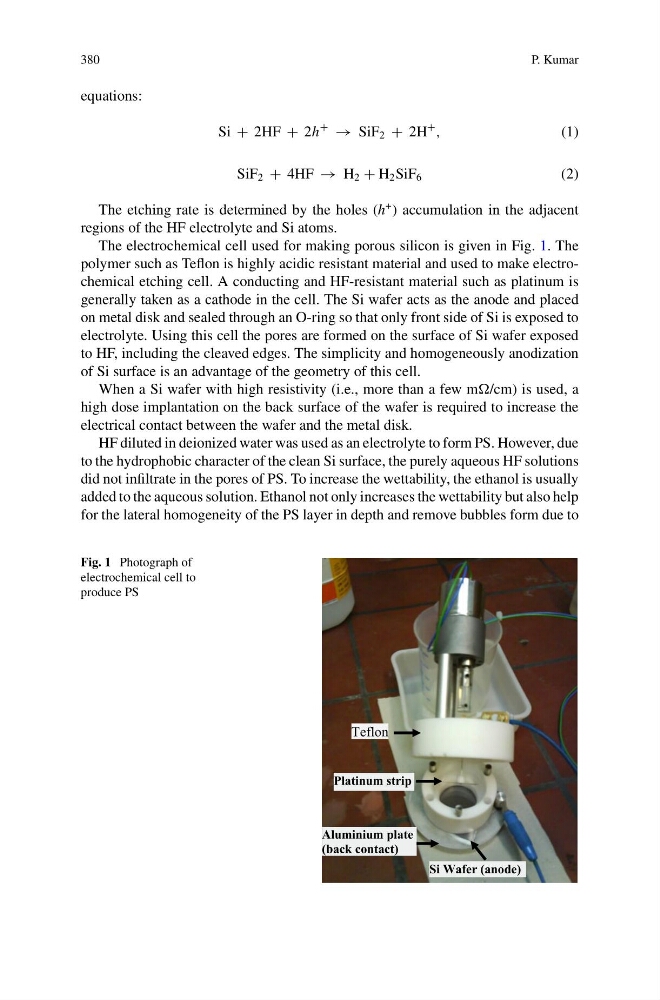
The electrochemical cell used for making porous silicon is given in Fig. 1. The
polymer such as Teflon is highly acidic resistant material and used to make electrochemical etching cell. A conducting and HF-resistant material such as platinum is
generally taken as a cathode in the cell. The Si wafer acts as the anode and placed
on metal disk and sealed through an O-ring so that only front side of Si is exposed to
electrolyte. Using this cell the pores are formed on the surface of Si wafer exposed
to HF, including the cleaved edges. The simplicity and homogeneously anodization
of Si surface is an advantage of the geometry of this cell.
When a Si wafer with high resistivity (i.e., more than a few m/cm) is used, a
high dose implantation on the back surface of the wafer is required to increase the
electrical contact between the wafer and the metal disk.
HF diluted in deionized water was used as an electrolyte to form PS. However, due
to the hydrophobic character of the clean Si surface, the purely aqueous HF solutions
did not infiltrate in the pores of PS. To increase the wettability, the ethanol is usually
added to the aqueous solution. Ethanol not only increases the wettability but also help
for the lateral homogeneity of the PS layer in depth and remove bubbles form due to
Fig. 1 Photograph of
electrochemical cell to
produce PS
Platinum strip
Si Wafer (anode)
Aluminium plate
(back contact)
Teflon
P. Kumar
equations:
Si + 2HF + 2h
+
→ SiF 2 + 2H
+
,
(1)
SiF 2 + 4HF → H 2 + H 2 SiF 6
(2)
The etching rate is determined by the holes (h
+ ) accumulation in the adjacent
regions of the HF electrolyte and Si atoms.
The electrochemical cell used for making porous silicon is given in Fig. 1. The
polymer such as Teflon is highly acidic resistant material and used to make electrochemical etching cell. A conducting and HF-resistant material such as platinum is
generally taken as a cathode in the cell. The Si wafer acts as the anode and placed
on metal disk and sealed through an O-ring so that only front side of Si is exposed to
electrolyte. Using this cell the pores are formed on the surface of Si wafer exposed
to HF, including the cleaved edges. The simplicity and homogeneously anodization
of Si surface is an advantage of the geometry of this cell.
When a Si wafer with high resistivity (i.e., more than a few m/cm) is used, a
high dose implantation on the back surface of the wafer is required to increase the
electrical contact between the wafer and the metal disk.
HF diluted in deionized water was used as an electrolyte to form PS. However, due
to the hydrophobic character of the clean Si surface, the purely aqueous HF solutions
did not infiltrate in the pores of PS. To increase the wettability, the ethanol is usually
added to the aqueous solution. Ethanol not only increases the wettability but also help
for the lateral homogeneity of the PS layer in depth and remove bubbles form due to
Fig. 1 Photograph of
electrochemical cell to
produce PS
Platinum strip
Si Wafer (anode)
Aluminium plate
(back contact)
Teflon