

Synthesis and Characterization of Nanofluids …
19
k eff = k f
k p (1 + 2α B ) + 2k m + 2∅
k p (1 − α B ) − k m
k p (1 + 2α B ) + 2k m − ∅
k p (1 − α B ) − k m
1 + A eco Re
M eco
B
Pr
0.33
f ∅
(11)
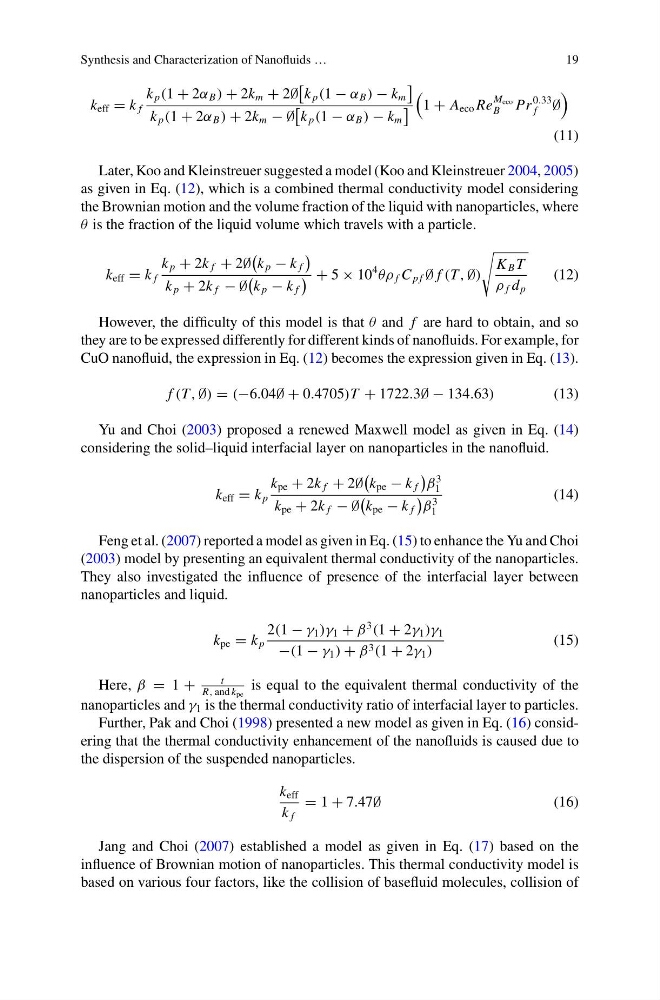
Later, Koo and Kleinstreuer suggested a model (Koo and Kleinstreuer 2004, 2005)
as given in Eq. (12), which is a combined thermal conductivity model considering
the Brownian motion and the volume fraction of the liquid with nanoparticles, where
θ is the fraction of the liquid volume which travels with a particle.
k eff = k f
k p + 2k f + 2∅
k p − k f
k p + 2k f − ∅
k p − k f
+ 5 × 10
4
θρ f C p f ∅ f (T, ∅)
K B T
ρ f d p
(12)
However, the difficulty of this model is that θ and f are hard to obtain, and so
they are to be expressed differently for different kinds of nanofluids. For example, for
CuO nanofluid, the expression in Eq. (12) becomes the expression given in Eq. (13).
f (T, ∅) = (−6.04∅ + 0.4705)T + 1722.3∅ − 134.63)
(13)
Yu and Choi (2003) proposed a renewed Maxwell model as given in Eq. (14)
considering the solid–liquid interfacial layer on nanoparticles in the nanofluid.
k eff = k p
k pe + 2k f + 2∅
k pe − k f
β
3
1
k pe + 2k f − ∅
k pe − k f
β
3
1
(14)
Feng et al. (2007) reported a model as given in Eq. (15) to enhance the Yu and Choi
(2003) model by presenting an equivalent thermal conductivity of the nanoparticles.
They also investigated the influence of presence of the interfacial layer between
nanoparticles and liquid.
k pe = k p
2(1 − γ 1 )γ 1 + β
3
(1 + 2γ 1 )γ 1
−(1 − γ 1 ) + β 3 (1 + 2γ 1 )
(15)
Here, β = 1 +
t
R, and k pe
is equal to the equivalent thermal conductivity of the
nanoparticles and γ 1 is the thermal conductivity ratio of interfacial layer to particles.
Further, Pak and Choi (1998) presented a new model as given in Eq. (16) considering that the thermal conductivity enhancement of the nanofluids is caused due to
the dispersion of the suspended nanoparticles.
k eff
k f
= 1 + 7.47∅
(16)
Jang and Choi (2007) established a model as given in Eq. (17) based on the
influence of Brownian motion of nanoparticles. This thermal conductivity model is
based on various four factors, like the collision of basefluid molecules, collision of
19
k eff = k f
k p (1 + 2α B ) + 2k m + 2∅
k p (1 − α B ) − k m
k p (1 + 2α B ) + 2k m − ∅
k p (1 − α B ) − k m
1 + A eco Re
M eco
B
Pr
0.33
f ∅
(11)
Later, Koo and Kleinstreuer suggested a model (Koo and Kleinstreuer 2004, 2005)
as given in Eq. (12), which is a combined thermal conductivity model considering
the Brownian motion and the volume fraction of the liquid with nanoparticles, where
θ is the fraction of the liquid volume which travels with a particle.
k eff = k f
k p + 2k f + 2∅
k p − k f
k p + 2k f − ∅
k p − k f
+ 5 × 10
4
θρ f C p f ∅ f (T, ∅)
K B T
ρ f d p
(12)
However, the difficulty of this model is that θ and f are hard to obtain, and so
they are to be expressed differently for different kinds of nanofluids. For example, for
CuO nanofluid, the expression in Eq. (12) becomes the expression given in Eq. (13).
f (T, ∅) = (−6.04∅ + 0.4705)T + 1722.3∅ − 134.63)
(13)
Yu and Choi (2003) proposed a renewed Maxwell model as given in Eq. (14)
considering the solid–liquid interfacial layer on nanoparticles in the nanofluid.
k eff = k p
k pe + 2k f + 2∅
k pe − k f
β
3
1
k pe + 2k f − ∅
k pe − k f
β
3
1
(14)
Feng et al. (2007) reported a model as given in Eq. (15) to enhance the Yu and Choi
(2003) model by presenting an equivalent thermal conductivity of the nanoparticles.
They also investigated the influence of presence of the interfacial layer between
nanoparticles and liquid.
k pe = k p
2(1 − γ 1 )γ 1 + β
3
(1 + 2γ 1 )γ 1
−(1 − γ 1 ) + β 3 (1 + 2γ 1 )
(15)
Here, β = 1 +
t
R, and k pe
is equal to the equivalent thermal conductivity of the
nanoparticles and γ 1 is the thermal conductivity ratio of interfacial layer to particles.
Further, Pak and Choi (1998) presented a new model as given in Eq. (16) considering that the thermal conductivity enhancement of the nanofluids is caused due to
the dispersion of the suspended nanoparticles.
k eff
k f
= 1 + 7.47∅
(16)
Jang and Choi (2007) established a model as given in Eq. (17) based on the
influence of Brownian motion of nanoparticles. This thermal conductivity model is
based on various four factors, like the collision of basefluid molecules, collision of