

18
D. P. Barai et al.
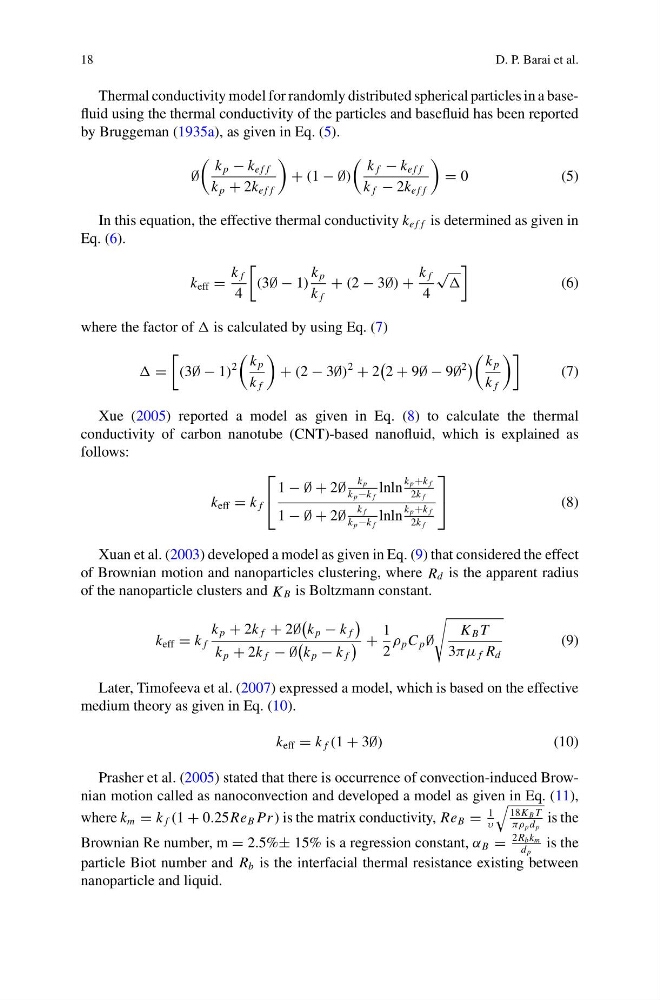
Thermal conductivity model for randomly distributed spherical particles in a basefluid using the thermal conductivity of the particles and basefluid has been reported
by Bruggeman (1935a), as given in Eq. (5).
∅
k p − k e f f
k p + 2k e f f
+ (1 − ∅)
k f − k e f f
k f − 2k e f f
= 0
( 5 )
In this equation, the effective thermal conductivity k e f f is determined as given in
Eq. (6).
k eff =
k f
4
(3∅ − 1)
k p
k f
+ (2 − 3∅) +
k f
4
√
(6)
where the factor of is calculated by using Eq. (7)
=
(3∅ − 1)
2
k p
k f
+ (2 − 3∅)
2
+ 2
2 + 9∅ − 9∅
2
k p
k f
(7)
Xue (2005) reported a model as given in Eq. (8) to calculate the thermal
conductivity of carbon nanotube (CNT)-based nanofluid, which is explained as
follows:
k eff = k f
⎡
⎣
1 − ∅ + 2∅
k p
k p −k f
lnln
k p +k f
2k f
1 − ∅ + 2∅
k f
k p −k f
lnln
k p +k f
2k f
⎤
⎦
(8)
Xuan et al. (2003) developed a model as given in Eq. (9) that considered the effect
of Brownian motion and nanoparticles clustering, where Rd is the apparent radius
of the nanoparticle clusters and K B is Boltzmann constant.
k eff = k f
k p + 2k f + 2∅
k p − k f
k p + 2k f − ∅
k p − k f
+
1
2
ρ p C p ∅
K B T
3πμ f R d
(9)
Later, Timofeeva et al. (2007) expressed a model, which is based on the effective
medium theory as given in Eq. (10).
k eff = k f (1 + 3∅)
(10)
Prasher et al. (2005) stated that there is occurrence of convection-induced Brownian motion called as nanoconvection and developed a model as given in Eq. (11),
where k m = k f (1 + 0.25Re B Pr) is the matrix conductivity, Re B =
1
υ
18K B T
πρ p d p
is the
Brownian Re number, m = 2.5%± 15% is a regression constant, α B =
2R b k m
d p
is the
particle Biot number and R b is the interfacial thermal resistance existing between
nanoparticle and liquid.
D. P. Barai et al.
Thermal conductivity model for randomly distributed spherical particles in a basefluid using the thermal conductivity of the particles and basefluid has been reported
by Bruggeman (1935a), as given in Eq. (5).
∅
k p − k e f f
k p + 2k e f f
+ (1 − ∅)
k f − k e f f
k f − 2k e f f
= 0
( 5 )
In this equation, the effective thermal conductivity k e f f is determined as given in
Eq. (6).
k eff =
k f
4
(3∅ − 1)
k p
k f
+ (2 − 3∅) +
k f
4
√
(6)
where the factor of is calculated by using Eq. (7)
=
(3∅ − 1)
2
k p
k f
+ (2 − 3∅)
2
+ 2
2 + 9∅ − 9∅
2
k p
k f
(7)
Xue (2005) reported a model as given in Eq. (8) to calculate the thermal
conductivity of carbon nanotube (CNT)-based nanofluid, which is explained as
follows:
k eff = k f
⎡
⎣
1 − ∅ + 2∅
k p
k p −k f
lnln
k p +k f
2k f
1 − ∅ + 2∅
k f
k p −k f
lnln
k p +k f
2k f
⎤
⎦
(8)
Xuan et al. (2003) developed a model as given in Eq. (9) that considered the effect
of Brownian motion and nanoparticles clustering, where Rd is the apparent radius
of the nanoparticle clusters and K B is Boltzmann constant.
k eff = k f
k p + 2k f + 2∅
k p − k f
k p + 2k f − ∅
k p − k f
+
1
2
ρ p C p ∅
K B T
3πμ f R d
(9)
Later, Timofeeva et al. (2007) expressed a model, which is based on the effective
medium theory as given in Eq. (10).
k eff = k f (1 + 3∅)
(10)
Prasher et al. (2005) stated that there is occurrence of convection-induced Brownian motion called as nanoconvection and developed a model as given in Eq. (11),
where k m = k f (1 + 0.25Re B Pr) is the matrix conductivity, Re B =
1
υ
18K B T
πρ p d p
is the
Brownian Re number, m = 2.5%± 15% is a regression constant, α B =
2R b k m
d p
is the
particle Biot number and R b is the interfacial thermal resistance existing between
nanoparticle and liquid.