

Nanoporous Polymeric Membranes for Hydrogen Separation
369
a substrate, and there are many pores of size ranging from 0.2 to 10 μm, Pd nanoparticles were used for depositing on the substrate. These membranes also expended
for purification due to their higher permeability and selectivity, chemical compatibility for gas separation. Such types of membranes prepared in a composite form
containing Pd in a different form for example nanoparticle, alloy, etc. These nanocomposite membranes provide high hydrogen perm-selectivity (David and Kopac 2011;
Hatlevik et al. 2010).
PET porous membranes were modified with the carboxylic group and an amino
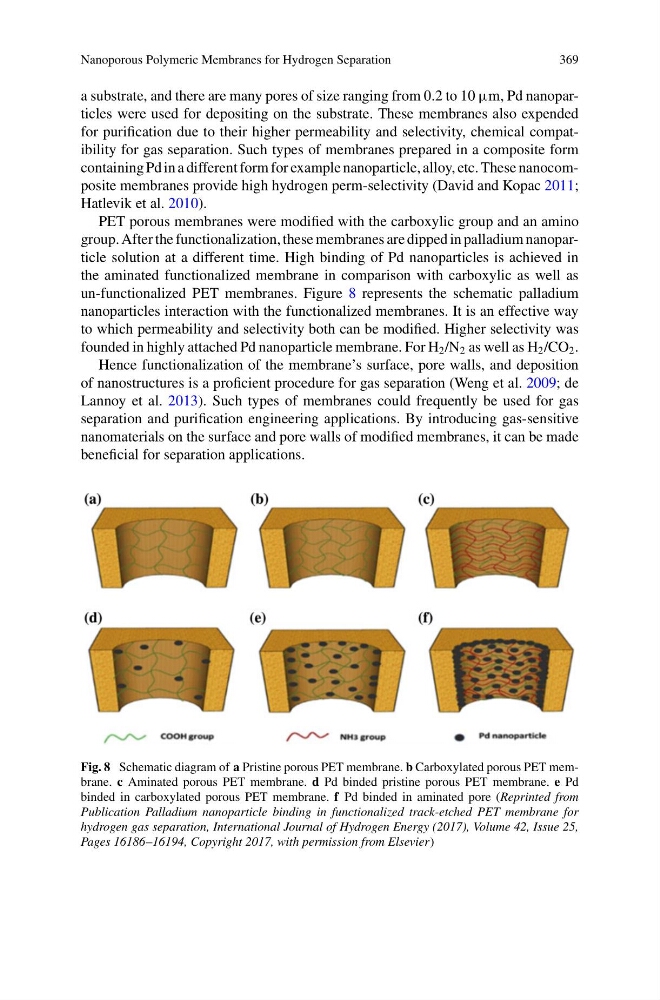
group. After the functionalization, these membranes are dipped in palladium nanoparticle solution at a different time. High binding of Pd nanoparticles is achieved in
the aminated functionalized membrane in comparison with carboxylic as well as
un-functionalized PET membranes. Figure 8 represents the schematic palladium
nanoparticles interaction with the functionalized membranes. It is an effective way
to which permeability and selectivity both can be modified. Higher selectivity was
founded in highly attached Pd nanoparticle membrane. For H 2 /N 2 as well as H 2 /CO 2 .
Hence functionalization of the membrane’s surface, pore walls, and deposition
of nanostructures is a proficient procedure for gas separation (Weng et al. 2009; de
Lannoy et al. 2013). Such types of membranes could frequently be used for gas
separation and purification engineering applications. By introducing gas-sensitive
nanomaterials on the surface and pore walls of modified membranes, it can be made
beneficial for separation applications.
Fig. 8 Schematic diagram of a Pristine porous PET membrane. b Carboxylated porous PET membrane. c Aminated porous PET membrane. d Pd binded pristine porous PET membrane. e Pd
binded in carboxylated porous PET membrane. f Pd binded in aminated pore (Reprinted from
Publication Palladium nanoparticle binding in functionalized track-etched PET membrane for
hydrogen gas separation, International Journal of Hydrogen Energy (2017), Volume 42, Issue 25,
Pages 16186–16194, Copyright 2017, with permission from Elsevier)
369
a substrate, and there are many pores of size ranging from 0.2 to 10 μm, Pd nanoparticles were used for depositing on the substrate. These membranes also expended
for purification due to their higher permeability and selectivity, chemical compatibility for gas separation. Such types of membranes prepared in a composite form
containing Pd in a different form for example nanoparticle, alloy, etc. These nanocomposite membranes provide high hydrogen perm-selectivity (David and Kopac 2011;
Hatlevik et al. 2010).
PET porous membranes were modified with the carboxylic group and an amino
group. After the functionalization, these membranes are dipped in palladium nanoparticle solution at a different time. High binding of Pd nanoparticles is achieved in
the aminated functionalized membrane in comparison with carboxylic as well as
un-functionalized PET membranes. Figure 8 represents the schematic palladium
nanoparticles interaction with the functionalized membranes. It is an effective way
to which permeability and selectivity both can be modified. Higher selectivity was
founded in highly attached Pd nanoparticle membrane. For H 2 /N 2 as well as H 2 /CO 2 .
Hence functionalization of the membrane’s surface, pore walls, and deposition
of nanostructures is a proficient procedure for gas separation (Weng et al. 2009; de
Lannoy et al. 2013). Such types of membranes could frequently be used for gas
separation and purification engineering applications. By introducing gas-sensitive
nanomaterials on the surface and pore walls of modified membranes, it can be made
beneficial for separation applications.
Fig. 8 Schematic diagram of a Pristine porous PET membrane. b Carboxylated porous PET membrane. c Aminated porous PET membrane. d Pd binded pristine porous PET membrane. e Pd
binded in carboxylated porous PET membrane. f Pd binded in aminated pore (Reprinted from
Publication Palladium nanoparticle binding in functionalized track-etched PET membrane for
hydrogen gas separation, International Journal of Hydrogen Energy (2017), Volume 42, Issue 25,
Pages 16186–16194, Copyright 2017, with permission from Elsevier)