

368
R. Kumar et al.
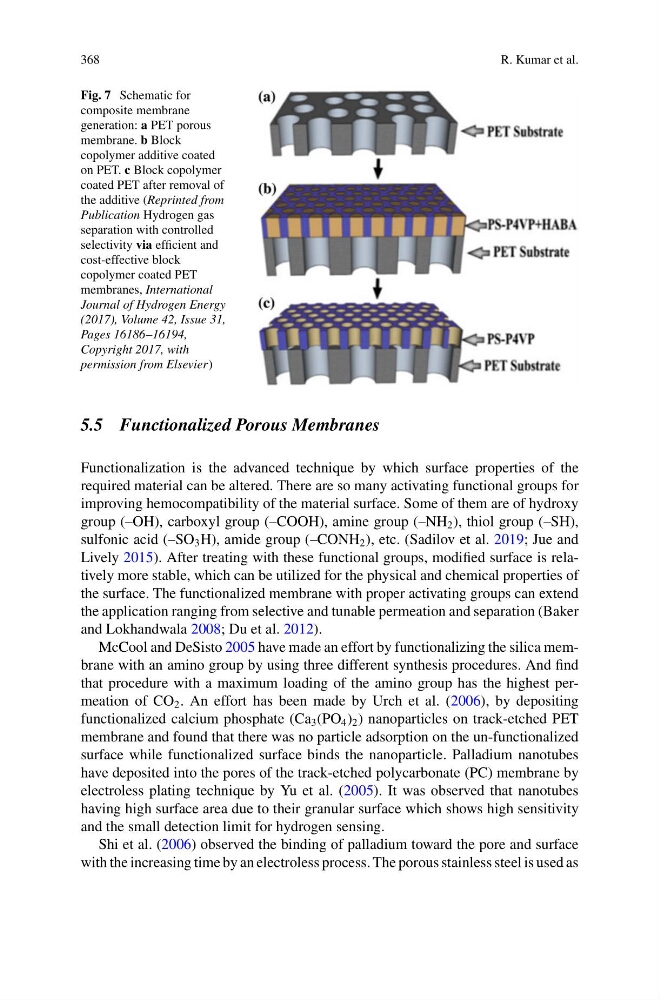
Fig. 7 Schematic for
composite membrane
generation: a PET porous
membrane. b Block
copolymer additive coated
on PET. c Block copolymer
coated PET after removal of
the additive (Reprinted from
Publication Hydrogen gas
separation with controlled
selectivity via efficient and
cost-effective block
copolymer coated PET
membranes, International
Journal of Hydrogen Energy
(2017), Volume 42, Issue 31,
Pages 16186–16194,
Copyright 2017, with
permission from Elsevier)
5.5 Functionalized Porous Membranes
Functionalization is the advanced technique by which surface properties of the
required material can be altered. There are so many activating functional groups for
improving hemocompatibility of the material surface. Some of them are of hydroxy
group (–OH), carboxyl group (–COOH), amine group (–NH 2 ), thiol group (–SH),
sulfonic acid (–SO 3 H), amide group (–CONH 2 ), etc. (Sadilov et al. 2019; Jue and
Lively 2015). After treating with these functional groups, modified surface is relatively more stable, which can be utilized for the physical and chemical properties of
the surface. The functionalized membrane with proper activating groups can extend
the application ranging from selective and tunable permeation and separation (Baker
and Lokhandwala 2008; Du et al. 2012).
McCool and DeSisto 2005 have made an effort by functionalizing the silica membrane with an amino group by using three different synthesis procedures. And find
that procedure with a maximum loading of the amino group has the highest permeation of CO 2 . An effort has been made by Urch et al. (2006), by depositing
functionalized calcium phosphate (Ca 3 (PO 4 ) 2 ) nanoparticles on track-etched PET
membrane and found that there was no particle adsorption on the un-functionalized
surface while functionalized surface binds the nanoparticle. Palladium nanotubes
have deposited into the pores of the track-etched polycarbonate (PC) membrane by
electroless plating technique by Yu et al. (2005). It was observed that nanotubes
having high surface area due to their granular surface which shows high sensitivity
and the small detection limit for hydrogen sensing.
Shi et al. (2006) observed the binding of palladium toward the pore and surface
with the increasing time by an electroless process. The porous stainless steel is used as
R. Kumar et al.
Fig. 7 Schematic for
composite membrane
generation: a PET porous
membrane. b Block
copolymer additive coated
on PET. c Block copolymer
coated PET after removal of
the additive (Reprinted from
Publication Hydrogen gas
separation with controlled
selectivity via efficient and
cost-effective block
copolymer coated PET
membranes, International
Journal of Hydrogen Energy
(2017), Volume 42, Issue 31,
Pages 16186–16194,
Copyright 2017, with
permission from Elsevier)
5.5 Functionalized Porous Membranes
Functionalization is the advanced technique by which surface properties of the
required material can be altered. There are so many activating functional groups for
improving hemocompatibility of the material surface. Some of them are of hydroxy
group (–OH), carboxyl group (–COOH), amine group (–NH 2 ), thiol group (–SH),
sulfonic acid (–SO 3 H), amide group (–CONH 2 ), etc. (Sadilov et al. 2019; Jue and
Lively 2015). After treating with these functional groups, modified surface is relatively more stable, which can be utilized for the physical and chemical properties of
the surface. The functionalized membrane with proper activating groups can extend
the application ranging from selective and tunable permeation and separation (Baker
and Lokhandwala 2008; Du et al. 2012).
McCool and DeSisto 2005 have made an effort by functionalizing the silica membrane with an amino group by using three different synthesis procedures. And find
that procedure with a maximum loading of the amino group has the highest permeation of CO 2 . An effort has been made by Urch et al. (2006), by depositing
functionalized calcium phosphate (Ca 3 (PO 4 ) 2 ) nanoparticles on track-etched PET
membrane and found that there was no particle adsorption on the un-functionalized
surface while functionalized surface binds the nanoparticle. Palladium nanotubes
have deposited into the pores of the track-etched polycarbonate (PC) membrane by
electroless plating technique by Yu et al. (2005). It was observed that nanotubes
having high surface area due to their granular surface which shows high sensitivity
and the small detection limit for hydrogen sensing.
Shi et al. (2006) observed the binding of palladium toward the pore and surface
with the increasing time by an electroless process. The porous stainless steel is used as