

Nanoporous Polymeric Membranes for Hydrogen Separation
365
channels. Such an approach is useful for the high permeability with high selectivity
of H 2 .
5.3 Track-Etched Membranes
Now these days, track-etched membranes are a new class of the gas separation/purification applications. Track-etched polymeric membranes have received
considerable attention in gas separation applications due to tunable pore shape and
size due to chemical etching and choice of the ion (Chakarvarti 2009; Gómez ÁlvarezArenas et al. 2009; Sudowe et al. 1999; Yamazaki et al. 1996). Swift Heavy Ion (SHI)
irradiation process is used to create the tracks, and subsequently, the tracks are converted into nanopores by selective chemical etching. Basically the ions beam having
the heavy energy in the range of 100 MeV were bombarded on the membranes.
Due to heavy energy, this ion passed throughout the membrane, and local damaged
zones (latent tracks) were created along the ion path. In detail, the passing ion interacts
with the loosely bound electrons of the polymer and transfers its energy to them. Such
electrons of the polymer gradually transfer this energy in the outward direction of
the ion path. Due to this phenomena, a cylindrical zone is created, which is called
the latent tracks.
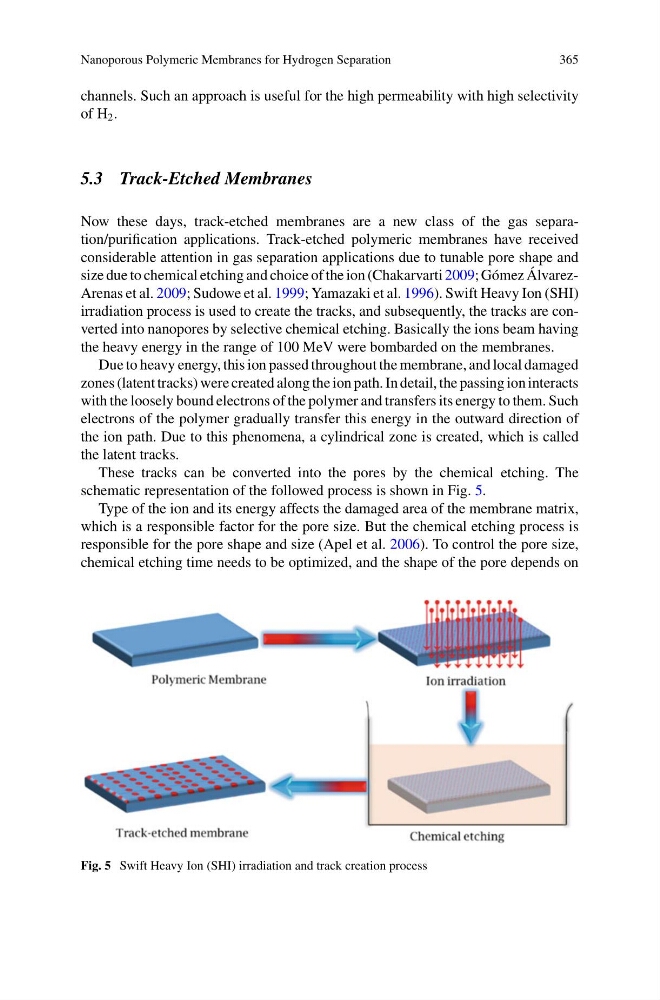
These tracks can be converted into the pores by the chemical etching. The
schematic representation of the followed process is shown in Fig. 5.
Type of the ion and its energy affects the damaged area of the membrane matrix,
which is a responsible factor for the pore size. But the chemical etching process is
responsible for the pore shape and size (Apel et al. 2006). To control the pore size,
chemical etching time needs to be optimized, and the shape of the pore depends on
Fig. 5 Swift Heavy Ion (SHI) irradiation and track creation process
365
channels. Such an approach is useful for the high permeability with high selectivity
of H 2 .
5.3 Track-Etched Membranes
Now these days, track-etched membranes are a new class of the gas separation/purification applications. Track-etched polymeric membranes have received
considerable attention in gas separation applications due to tunable pore shape and
size due to chemical etching and choice of the ion (Chakarvarti 2009; Gómez ÁlvarezArenas et al. 2009; Sudowe et al. 1999; Yamazaki et al. 1996). Swift Heavy Ion (SHI)
irradiation process is used to create the tracks, and subsequently, the tracks are converted into nanopores by selective chemical etching. Basically the ions beam having
the heavy energy in the range of 100 MeV were bombarded on the membranes.
Due to heavy energy, this ion passed throughout the membrane, and local damaged
zones (latent tracks) were created along the ion path. In detail, the passing ion interacts
with the loosely bound electrons of the polymer and transfers its energy to them. Such
electrons of the polymer gradually transfer this energy in the outward direction of
the ion path. Due to this phenomena, a cylindrical zone is created, which is called
the latent tracks.
These tracks can be converted into the pores by the chemical etching. The
schematic representation of the followed process is shown in Fig. 5.
Type of the ion and its energy affects the damaged area of the membrane matrix,
which is a responsible factor for the pore size. But the chemical etching process is
responsible for the pore shape and size (Apel et al. 2006). To control the pore size,
chemical etching time needs to be optimized, and the shape of the pore depends on
Fig. 5 Swift Heavy Ion (SHI) irradiation and track creation process