

Interaction of Nanoparticles with Reservoir Fluids and Rocks …
317
Table 3 Effect of temperature on viscosity of various nanofluids (Sharma et al. 2016)
NPs + Polymer (NP)
NPs + Surfactant +
Polymer (NSP)
Surfactant + Polymer
(SP)
Polymer (P)
Viscosity Temperature Viscosity Temperature Viscosity Temperature Viscosity Temperature
(Pa.s)
(°C)
(Pa.s)
(°C)
(Pa.s)
(°C)
(Pa.s)
(°C)
7.6
30
7.1
30
3.1
30
5.05
30
7.4
50
6.2
50
1.4
50
3.58
50
7.1
70
6.07
70
0.63
70
2.44
70
6.7
90
5.6
90
0.49
90
1.79
90
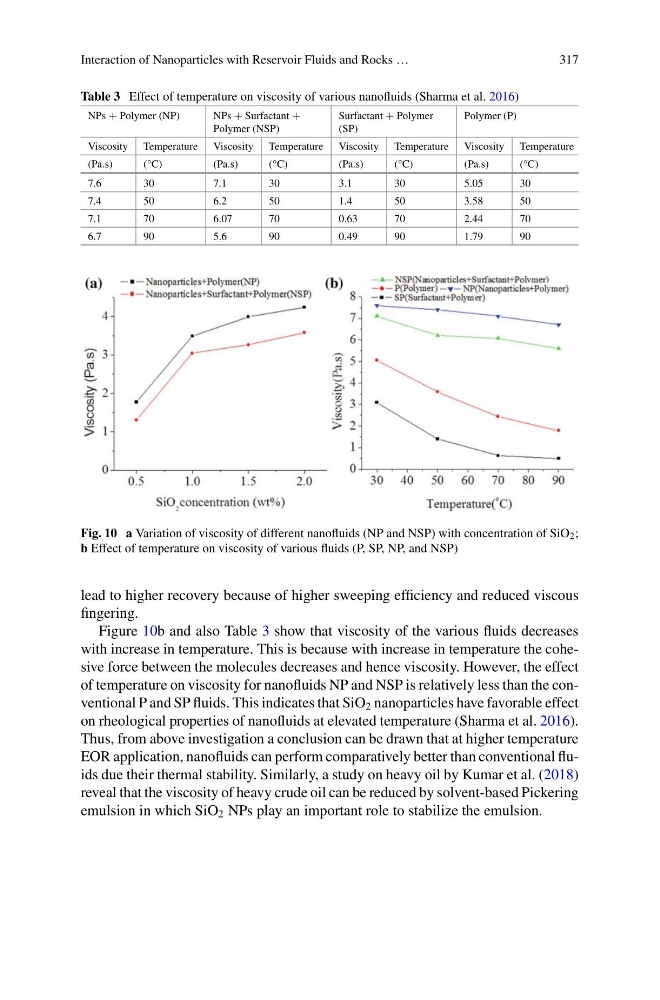
Fig. 10 a Variation of viscosity of different nanofluids (NP and NSP) with concentration of SiO 2 ;
b Effect of temperature on viscosity of various fluids (P, SP, NP, and NSP)
lead to higher recovery because of higher sweeping efficiency and reduced viscous
fingering.
Figure 10b and also Table 3 show that viscosity of the various fluids decreases
with increase in temperature. This is because with increase in temperature the cohesive force between the molecules decreases and hence viscosity. However, the effect
of temperature on viscosity for nanofluids NP and NSP is relatively less than the conventional P and SP fluids. This indicates that SiO 2 nanoparticles have favorable effect
on rheological properties of nanofluids at elevated temperature (Sharma et al. 2016).
Thus, from above investigation a conclusion can be drawn that at higher temperature
EOR application, nanofluids can perform comparatively better than conventional fluids due their thermal stability. Similarly, a study on heavy oil by Kumar et al. (2018)
reveal that the viscosity of heavy crude oil can be reduced by solvent-based Pickering
emulsion in which SiO 2 NPs play an important role to stabilize the emulsion.
317
Table 3 Effect of temperature on viscosity of various nanofluids (Sharma et al. 2016)
NPs + Polymer (NP)
NPs + Surfactant +
Polymer (NSP)
Surfactant + Polymer
(SP)
Polymer (P)
Viscosity Temperature Viscosity Temperature Viscosity Temperature Viscosity Temperature
(Pa.s)
(°C)
(Pa.s)
(°C)
(Pa.s)
(°C)
(Pa.s)
(°C)
7.6
30
7.1
30
3.1
30
5.05
30
7.4
50
6.2
50
1.4
50
3.58
50
7.1
70
6.07
70
0.63
70
2.44
70
6.7
90
5.6
90
0.49
90
1.79
90
Fig. 10 a Variation of viscosity of different nanofluids (NP and NSP) with concentration of SiO 2 ;
b Effect of temperature on viscosity of various fluids (P, SP, NP, and NSP)
lead to higher recovery because of higher sweeping efficiency and reduced viscous
fingering.
Figure 10b and also Table 3 show that viscosity of the various fluids decreases
with increase in temperature. This is because with increase in temperature the cohesive force between the molecules decreases and hence viscosity. However, the effect
of temperature on viscosity for nanofluids NP and NSP is relatively less than the conventional P and SP fluids. This indicates that SiO 2 nanoparticles have favorable effect
on rheological properties of nanofluids at elevated temperature (Sharma et al. 2016).
Thus, from above investigation a conclusion can be drawn that at higher temperature
EOR application, nanofluids can perform comparatively better than conventional fluids due their thermal stability. Similarly, a study on heavy oil by Kumar et al. (2018)
reveal that the viscosity of heavy crude oil can be reduced by solvent-based Pickering
emulsion in which SiO 2 NPs play an important role to stabilize the emulsion.