

Interaction of Nanoparticles with Reservoir Fluids and Rocks …
311
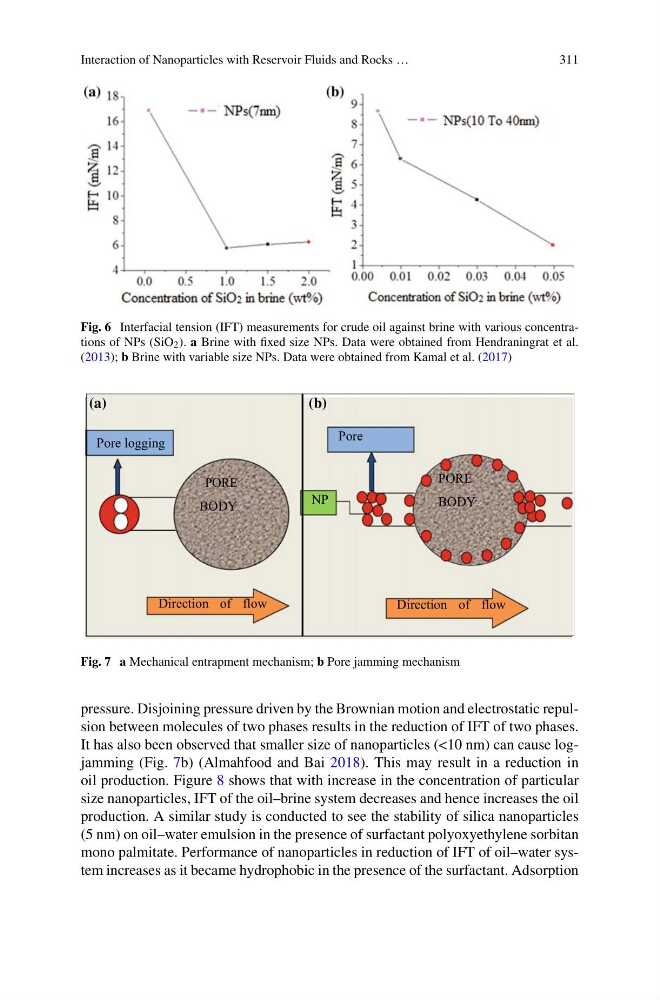
Fig. 6 Interfacial tension (IFT) measurements for crude oil against brine with various concentrations of NPs (SiO 2 ). a Brine with fixed size NPs. Data were obtained from Hendraningrat et al.
(2013); b Brine with variable size NPs. Data were obtained from Kamal et al. (2017)
(a)
NP
Pore
(b)
PORE
BODY
Direction of flow
Pore logging
PORE
BODY
Direction of flow
Fig. 7 a Mechanical entrapment mechanism; b Pore jamming mechanism
pressure. Disjoining pressure driven by the Brownian motion and electrostatic repulsion between molecules of two phases results in the reduction of IFT of two phases.
It has also been observed that smaller size of nanoparticles (<10 nm) can cause logjamming (Fig. 7b) (Almahfood and Bai 2018). This may result in a reduction in
oil production. Figure 8 shows that with increase in the concentration of particular
size nanoparticles, IFT of the oil–brine system decreases and hence increases the oil
production. A similar study is conducted to see the stability of silica nanoparticles
(5 nm) on oil–water emulsion in the presence of surfactant polyoxyethylene sorbitan
mono palmitate. Performance of nanoparticles in reduction of IFT of oil–water system increases as it became hydrophobic in the presence of the surfactant. Adsorption
311
Fig. 6 Interfacial tension (IFT) measurements for crude oil against brine with various concentrations of NPs (SiO 2 ). a Brine with fixed size NPs. Data were obtained from Hendraningrat et al.
(2013); b Brine with variable size NPs. Data were obtained from Kamal et al. (2017)
(a)
NP
Pore
(b)
PORE
BODY
Direction of flow
Pore logging
PORE
BODY
Direction of flow
Fig. 7 a Mechanical entrapment mechanism; b Pore jamming mechanism
pressure. Disjoining pressure driven by the Brownian motion and electrostatic repulsion between molecules of two phases results in the reduction of IFT of two phases.
It has also been observed that smaller size of nanoparticles (<10 nm) can cause logjamming (Fig. 7b) (Almahfood and Bai 2018). This may result in a reduction in
oil production. Figure 8 shows that with increase in the concentration of particular
size nanoparticles, IFT of the oil–brine system decreases and hence increases the oil
production. A similar study is conducted to see the stability of silica nanoparticles
(5 nm) on oil–water emulsion in the presence of surfactant polyoxyethylene sorbitan
mono palmitate. Performance of nanoparticles in reduction of IFT of oil–water system increases as it became hydrophobic in the presence of the surfactant. Adsorption