

308
U. S. Behera and J. S. Sangwai
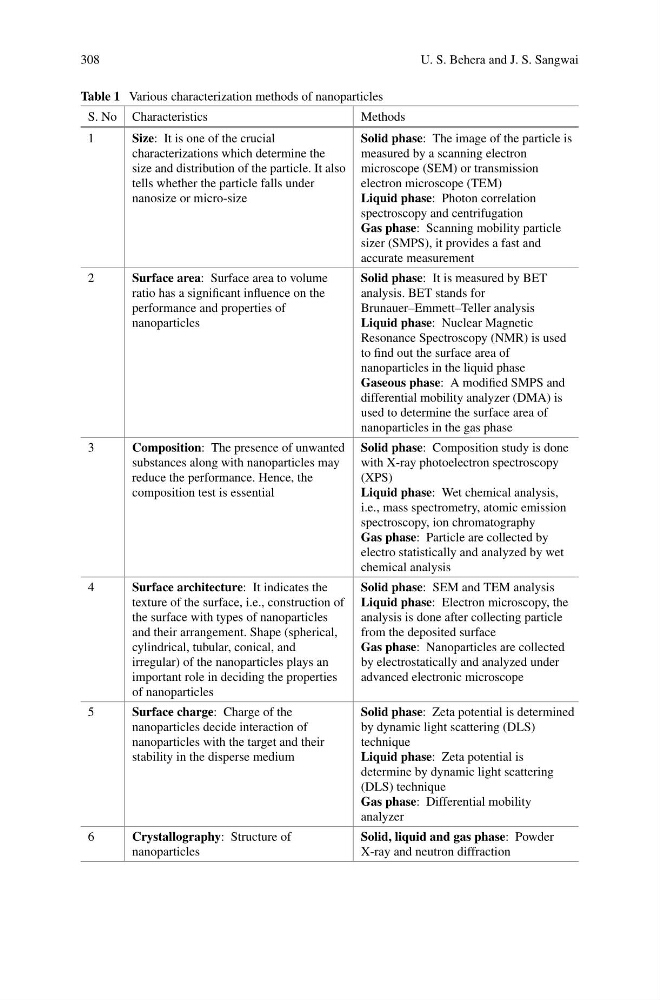
Table 1 Various characterization methods of nanoparticles
S. No Characteristics
Methods
1
Size: It is one of the crucial
characterizations which determine the
size and distribution of the particle. It also
tells whether the particle falls under
nanosize or micro-size
Solid phase: The image of the particle is
measured by a scanning electron
microscope (SEM) or transmission
electron microscope (TEM)
Liquid phase: Photon correlation
spectroscopy and centrifugation
Gas phase: Scanning mobility particle
sizer (SMPS), it provides a fast and
accurate measurement
2
Surface area: Surface area to volume
ratio has a significant influence on the
performance and properties of
nanoparticles
Solid phase: It is measured by BET
analysis. BET stands for
Brunauer–Emmett–Teller analysis
Liquid phase: Nuclear Magnetic
Resonance Spectroscopy (NMR) is used
to find out the surface area of
nanoparticles in the liquid phase
Gaseous phase: A modified SMPS and
differential mobility analyzer (DMA) is
used to determine the surface area of
nanoparticles in the gas phase
3
Composition: The presence of unwanted
substances along with nanoparticles may
reduce the performance. Hence, the
composition test is essential
Solid phase: Composition study is done
with X-ray photoelectron spectroscopy
(XPS)
Liquid phase: Wet chemical analysis,
i.e., mass spectrometry, atomic emission
spectroscopy, ion chromatography
Gas phase: Particle are collected by
electro statistically and analyzed by wet
chemical analysis
4
Surface architecture: It indicates the
texture of the surface, i.e., construction of
the surface with types of nanoparticles
and their arrangement. Shape (spherical,
cylindrical, tubular, conical, and
irregular) of the nanoparticles plays an
important role in deciding the properties
of nanoparticles
Solid phase: SEM and TEM analysis
Liquid phase: Electron microscopy, the
analysis is done after collecting particle
from the deposited surface
Gas phase: Nanoparticles are collected
by electrostatically and analyzed under
advanced electronic microscope
5
Surface charge: Charge of the
nanoparticles decide interaction of
nanoparticles with the target and their
stability in the disperse medium
Solid phase: Zeta potential is determined
by dynamic light scattering (DLS)
technique
Liquid phase: Zeta potential is
determine by dynamic light scattering
(DLS) technique
Gas phase: Differential mobility
analyzer
6
Crystallography: Structure of
nanoparticles
Solid, liquid and gas phase: Powder
X-ray and neutron diffraction
U. S. Behera and J. S. Sangwai
Table 1 Various characterization methods of nanoparticles
S. No Characteristics
Methods
1
Size: It is one of the crucial
characterizations which determine the
size and distribution of the particle. It also
tells whether the particle falls under
nanosize or micro-size
Solid phase: The image of the particle is
measured by a scanning electron
microscope (SEM) or transmission
electron microscope (TEM)
Liquid phase: Photon correlation
spectroscopy and centrifugation
Gas phase: Scanning mobility particle
sizer (SMPS), it provides a fast and
accurate measurement
2
Surface area: Surface area to volume
ratio has a significant influence on the
performance and properties of
nanoparticles
Solid phase: It is measured by BET
analysis. BET stands for
Brunauer–Emmett–Teller analysis
Liquid phase: Nuclear Magnetic
Resonance Spectroscopy (NMR) is used
to find out the surface area of
nanoparticles in the liquid phase
Gaseous phase: A modified SMPS and
differential mobility analyzer (DMA) is
used to determine the surface area of
nanoparticles in the gas phase
3
Composition: The presence of unwanted
substances along with nanoparticles may
reduce the performance. Hence, the
composition test is essential
Solid phase: Composition study is done
with X-ray photoelectron spectroscopy
(XPS)
Liquid phase: Wet chemical analysis,
i.e., mass spectrometry, atomic emission
spectroscopy, ion chromatography
Gas phase: Particle are collected by
electro statistically and analyzed by wet
chemical analysis
4
Surface architecture: It indicates the
texture of the surface, i.e., construction of
the surface with types of nanoparticles
and their arrangement. Shape (spherical,
cylindrical, tubular, conical, and
irregular) of the nanoparticles plays an
important role in deciding the properties
of nanoparticles
Solid phase: SEM and TEM analysis
Liquid phase: Electron microscopy, the
analysis is done after collecting particle
from the deposited surface
Gas phase: Nanoparticles are collected
by electrostatically and analyzed under
advanced electronic microscope
5
Surface charge: Charge of the
nanoparticles decide interaction of
nanoparticles with the target and their
stability in the disperse medium
Solid phase: Zeta potential is determined
by dynamic light scattering (DLS)
technique
Liquid phase: Zeta potential is
determine by dynamic light scattering
(DLS) technique
Gas phase: Differential mobility
analyzer
6
Crystallography: Structure of
nanoparticles
Solid, liquid and gas phase: Powder
X-ray and neutron diffraction