

300
U. S. Behera and J. S. Sangwai
1 Introduction
The existence of natural resources indicates the strength of the country and the adoption of newer technologies in their production magnifies its economy. When we
talk about natural resources, it includes minerals, hydrocarbon, soil, forest, wellconnected rivers, etc. World energy consumption is increasing day by day. The main
reason for the high utilization of energy is due to the increase in human population
all over the world. Most of the developed and developing nation of the world utilizes
more than 90% of the total energy produced in the world. Though there are various sources exist for the production of energy such as nuclear power, hydropower,
geothermal power, solar power, and hydrocarbon fuel, the importance of the use of
hydrocarbon fuel has grown due to its wide occurrences and ease of applications. In
most cases, at least 50% (approximate) of energy requirement of a country is being
fulfilled by hydrocarbon fuel (IEA report 2016). According to the BP world energy
data, the petroleum reserves are limited (BP statistical review of world energy, June
2018). Hence more attention has been paid to recover crude oil from depleted or
matured reservoirs. As the world reservoirs are growing older and older day by day,
it is difficult to extract more hydrocarbons using conventional methods. The existing
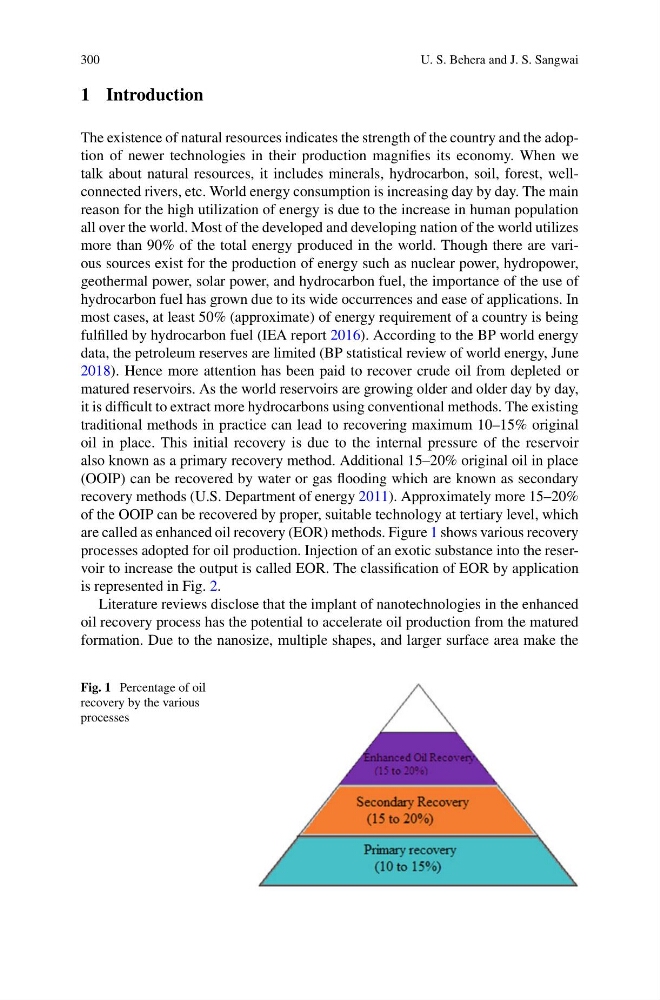
traditional methods in practice can lead to recovering maximum 10–15% original
oil in place. This initial recovery is due to the internal pressure of the reservoir
also known as a primary recovery method. Additional 15–20% original oil in place
(OOIP) can be recovered by water or gas flooding which are known as secondary
recovery methods (U.S. Department of energy 2011). Approximately more 15–20%
of the OOIP can be recovered by proper, suitable technology at tertiary level, which
are called as enhanced oil recovery (EOR) methods. Figure 1 shows various recovery
processes adopted for oil production. Injection of an exotic substance into the reservoir to increase the output is called EOR. The classification of EOR by application
is represented in Fig. 2.
Literature reviews disclose that the implant of nanotechnologies in the enhanced
oil recovery process has the potential to accelerate oil production from the matured
formation. Due to the nanosize, multiple shapes, and larger surface area make the
Fig. 1 Percentage of oil
recovery by the various
processes
U. S. Behera and J. S. Sangwai
1 Introduction
The existence of natural resources indicates the strength of the country and the adoption of newer technologies in their production magnifies its economy. When we
talk about natural resources, it includes minerals, hydrocarbon, soil, forest, wellconnected rivers, etc. World energy consumption is increasing day by day. The main
reason for the high utilization of energy is due to the increase in human population
all over the world. Most of the developed and developing nation of the world utilizes
more than 90% of the total energy produced in the world. Though there are various sources exist for the production of energy such as nuclear power, hydropower,
geothermal power, solar power, and hydrocarbon fuel, the importance of the use of
hydrocarbon fuel has grown due to its wide occurrences and ease of applications. In
most cases, at least 50% (approximate) of energy requirement of a country is being
fulfilled by hydrocarbon fuel (IEA report 2016). According to the BP world energy
data, the petroleum reserves are limited (BP statistical review of world energy, June
2018). Hence more attention has been paid to recover crude oil from depleted or
matured reservoirs. As the world reservoirs are growing older and older day by day,
it is difficult to extract more hydrocarbons using conventional methods. The existing
traditional methods in practice can lead to recovering maximum 10–15% original
oil in place. This initial recovery is due to the internal pressure of the reservoir
also known as a primary recovery method. Additional 15–20% original oil in place
(OOIP) can be recovered by water or gas flooding which are known as secondary
recovery methods (U.S. Department of energy 2011). Approximately more 15–20%
of the OOIP can be recovered by proper, suitable technology at tertiary level, which
are called as enhanced oil recovery (EOR) methods. Figure 1 shows various recovery
processes adopted for oil production. Injection of an exotic substance into the reservoir to increase the output is called EOR. The classification of EOR by application
is represented in Fig. 2.
Literature reviews disclose that the implant of nanotechnologies in the enhanced
oil recovery process has the potential to accelerate oil production from the matured
formation. Due to the nanosize, multiple shapes, and larger surface area make the
Fig. 1 Percentage of oil
recovery by the various
processes