

284
G. R. Seetharaman and J. S. Sangwai
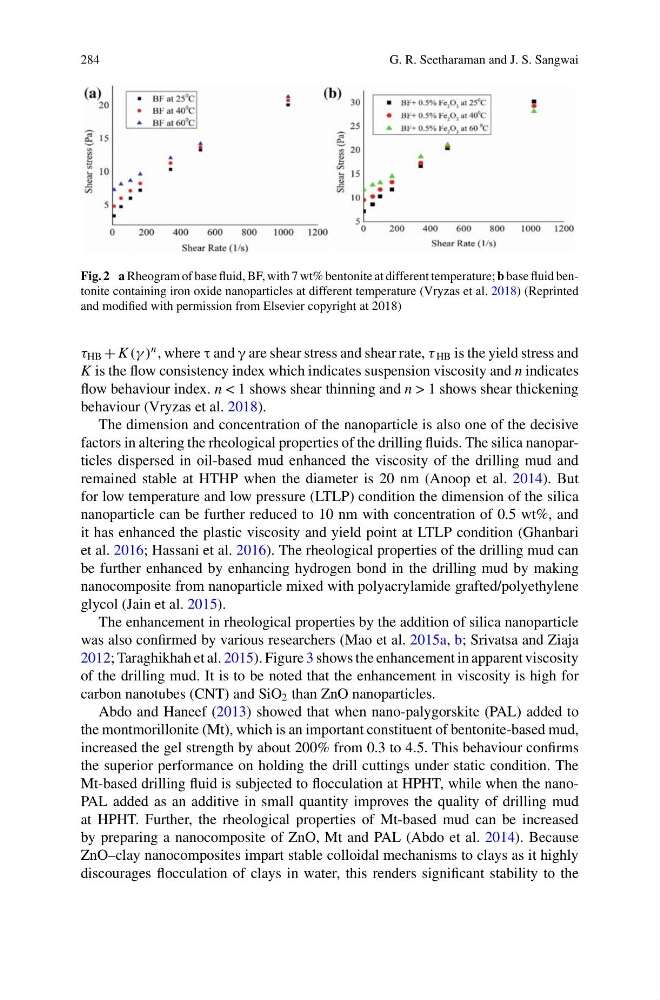
Fig. 2 a Rheogram of base fluid, BF, with 7 wt% bentonite at different temperature; b base fluid bentonite containing iron oxide nanoparticles at different temperature (Vryzas et al. 2018) (Reprinted
and modified with permission from Elsevier copyright at 2018)
τ HB + K (γ )
n , where τ and γ are shear stress and shear rate, τ HB is the yield stress and
K is the flow consistency index which indicates suspension viscosity and n indicates
flow behaviour index. n < 1 shows shear thinning and n > 1 shows shear thickening
behaviour (Vryzas et al. 2018).
The dimension and concentration of the nanoparticle is also one of the decisive
factors in altering the rheological properties of the drilling fluids. The silica nanoparticles dispersed in oil-based mud enhanced the viscosity of the drilling mud and
remained stable at HTHP when the diameter is 20 nm (Anoop et al. 2014). But
for low temperature and low pressure (LTLP) condition the dimension of the silica
nanoparticle can be further reduced to 10 nm with concentration of 0.5 wt%, and
it has enhanced the plastic viscosity and yield point at LTLP condition (Ghanbari
et al. 2016; Hassani et al. 2016). The rheological properties of the drilling mud can
be further enhanced by enhancing hydrogen bond in the drilling mud by making
nanocomposite from nanoparticle mixed with polyacrylamide grafted/polyethylene
glycol (Jain et al. 2015).
The enhancement in rheological properties by the addition of silica nanoparticle
was also confirmed by various researchers (Mao et al. 2015a, b; Srivatsa and Ziaja
2012; Taraghikhah et al. 2015). Figure 3 shows the enhancement in apparent viscosity
of the drilling mud. It is to be noted that the enhancement in viscosity is high for
carbon nanotubes (CNT) and SiO 2 than ZnO nanoparticles.
Abdo and Haneef (2013) showed that when nano-palygorskite (PAL) added to
the montmorillonite (Mt), which is an important constituent of bentonite-based mud,
increased the gel strength by about 200% from 0.3 to 4.5. This behaviour confirms
the superior performance on holding the drill cuttings under static condition. The
Mt-based drilling fluid is subjected to flocculation at HPHT, while when the nanoPAL added as an additive in small quantity improves the quality of drilling mud
at HPHT. Further, the rheological properties of Mt-based mud can be increased
by preparing a nanocomposite of ZnO, Mt and PAL (Abdo et al. 2014). Because
ZnO–clay nanocomposites impart stable colloidal mechanisms to clays as it highly
discourages flocculation of clays in water, this renders significant stability to the
G. R. Seetharaman and J. S. Sangwai
Fig. 2 a Rheogram of base fluid, BF, with 7 wt% bentonite at different temperature; b base fluid bentonite containing iron oxide nanoparticles at different temperature (Vryzas et al. 2018) (Reprinted
and modified with permission from Elsevier copyright at 2018)
τ HB + K (γ )
n , where τ and γ are shear stress and shear rate, τ HB is the yield stress and
K is the flow consistency index which indicates suspension viscosity and n indicates
flow behaviour index. n < 1 shows shear thinning and n > 1 shows shear thickening
behaviour (Vryzas et al. 2018).
The dimension and concentration of the nanoparticle is also one of the decisive
factors in altering the rheological properties of the drilling fluids. The silica nanoparticles dispersed in oil-based mud enhanced the viscosity of the drilling mud and
remained stable at HTHP when the diameter is 20 nm (Anoop et al. 2014). But
for low temperature and low pressure (LTLP) condition the dimension of the silica
nanoparticle can be further reduced to 10 nm with concentration of 0.5 wt%, and
it has enhanced the plastic viscosity and yield point at LTLP condition (Ghanbari
et al. 2016; Hassani et al. 2016). The rheological properties of the drilling mud can
be further enhanced by enhancing hydrogen bond in the drilling mud by making
nanocomposite from nanoparticle mixed with polyacrylamide grafted/polyethylene
glycol (Jain et al. 2015).
The enhancement in rheological properties by the addition of silica nanoparticle
was also confirmed by various researchers (Mao et al. 2015a, b; Srivatsa and Ziaja
2012; Taraghikhah et al. 2015). Figure 3 shows the enhancement in apparent viscosity
of the drilling mud. It is to be noted that the enhancement in viscosity is high for
carbon nanotubes (CNT) and SiO 2 than ZnO nanoparticles.
Abdo and Haneef (2013) showed that when nano-palygorskite (PAL) added to
the montmorillonite (Mt), which is an important constituent of bentonite-based mud,
increased the gel strength by about 200% from 0.3 to 4.5. This behaviour confirms
the superior performance on holding the drill cuttings under static condition. The
Mt-based drilling fluid is subjected to flocculation at HPHT, while when the nanoPAL added as an additive in small quantity improves the quality of drilling mud
at HPHT. Further, the rheological properties of Mt-based mud can be increased
by preparing a nanocomposite of ZnO, Mt and PAL (Abdo et al. 2014). Because
ZnO–clay nanocomposites impart stable colloidal mechanisms to clays as it highly
discourages flocculation of clays in water, this renders significant stability to the