

Effect of Nanoparticles on the Performance of Drilling Fluids
281
1.2 Classification of drilling fluids
1.2.1 Water based drilling fluids
Water, brine or formate salt is used as the continuous phase in water-based mud.
Since this mud is inexpensive and environmental-friendly, this is most commonly
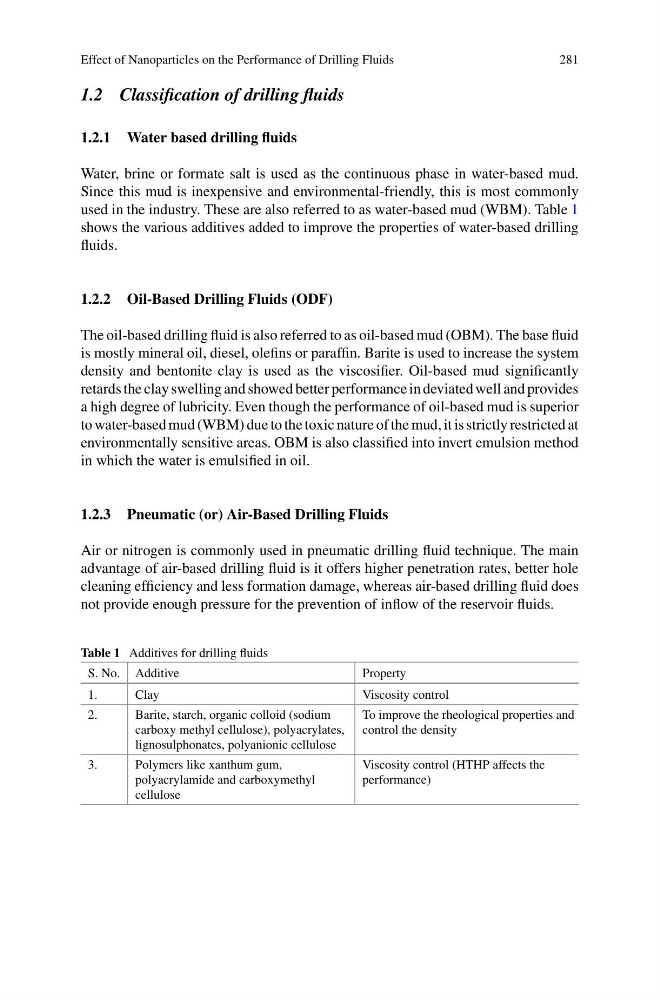
used in the industry. These are also referred to as water-based mud (WBM). Table 1
shows the various additives added to improve the properties of water-based drilling
fluids.
1.2.2 Oil-Based Drilling Fluids (ODF)
The oil-based drilling fluid is also referred to as oil-based mud (OBM). The base fluid
is mostly mineral oil, diesel, olefins or paraffin. Barite is used to increase the system
density and bentonite clay is used as the viscosifier. Oil-based mud significantly
retards the clay swelling and showed better performance in deviated well and provides
a high degree of lubricity. Even though the performance of oil-based mud is superior
to water-based mud (WBM) due to the toxic nature of the mud, it is strictly restricted at
environmentally sensitive areas. OBM is also classified into invert emulsion method
in which the water is emulsified in oil.
1.2.3 Pneumatic (or) Air-Based Drilling Fluids
Air or nitrogen is commonly used in pneumatic drilling fluid technique. The main
advantage of air-based drilling fluid is it offers higher penetration rates, better hole
cleaning efficiency and less formation damage, whereas air-based drilling fluid does
not provide enough pressure for the prevention of inflow of the reservoir fluids.
Table 1 Additives for drilling fluids
S. No. Additive
Property
1.
Clay
Viscosity control
2.
Barite, starch, organic colloid (sodium
carboxy methyl cellulose), polyacrylates,
lignosulphonates, polyanionic cellulose
To improve the rheological properties and
control the density
3.
Polymers like xanthum gum,
polyacrylamide and carboxymethyl
cellulose
Viscosity control (HTHP affects the
performance)
281
1.2 Classification of drilling fluids
1.2.1 Water based drilling fluids
Water, brine or formate salt is used as the continuous phase in water-based mud.
Since this mud is inexpensive and environmental-friendly, this is most commonly
used in the industry. These are also referred to as water-based mud (WBM). Table 1
shows the various additives added to improve the properties of water-based drilling
fluids.
1.2.2 Oil-Based Drilling Fluids (ODF)
The oil-based drilling fluid is also referred to as oil-based mud (OBM). The base fluid
is mostly mineral oil, diesel, olefins or paraffin. Barite is used to increase the system
density and bentonite clay is used as the viscosifier. Oil-based mud significantly
retards the clay swelling and showed better performance in deviated well and provides
a high degree of lubricity. Even though the performance of oil-based mud is superior
to water-based mud (WBM) due to the toxic nature of the mud, it is strictly restricted at
environmentally sensitive areas. OBM is also classified into invert emulsion method
in which the water is emulsified in oil.
1.2.3 Pneumatic (or) Air-Based Drilling Fluids
Air or nitrogen is commonly used in pneumatic drilling fluid technique. The main
advantage of air-based drilling fluid is it offers higher penetration rates, better hole
cleaning efficiency and less formation damage, whereas air-based drilling fluid does
not provide enough pressure for the prevention of inflow of the reservoir fluids.
Table 1 Additives for drilling fluids
S. No. Additive
Property
1.
Clay
Viscosity control
2.
Barite, starch, organic colloid (sodium
carboxy methyl cellulose), polyacrylates,
lignosulphonates, polyanionic cellulose
To improve the rheological properties and
control the density
3.
Polymers like xanthum gum,
polyacrylamide and carboxymethyl
cellulose
Viscosity control (HTHP affects the
performance)