

280
G. R. Seetharaman and J. S. Sangwai
1 Introduction
1.1 Drilling Fluids
A well-organized reservoir operation consists of many important stages, starting
from finding the presence of crude oil to extracting the oil from the reservoir. An
important parameter in-between these two stages that decides the fate of drilling is
the drilling fluids. A successful drilling operation depends upon the effectiveness
of the drilling fluid. Drilling a long hole from surface till deep inside the earth
produces a huge amount of heat, which reduce the performance of drilling bit. A
drilling fluid (or) mud, which is a combination of various chemicals, solids and
liquids, is generally used to cool down the drilling bit. The drilling fluid also needs to
perform other functions such as to carry the cuttings from the subsurface, minimize
formation damage by producing a filter cake and to maintain the wellbore stability.
The drilling fluids are classified into water-based drilling mud or fluids (WDM), oilbased drilling mud or fluids (OBM) and pneumatic drilling fluid. Since drilling fluids
encounter high temperature high pressure (HPHT) environment, maintaining the
viscosity of drilling fluid is the crucial part for effective functioning. Any deviation
in the rheological, physical and chemical properties of the drilling fluids severely
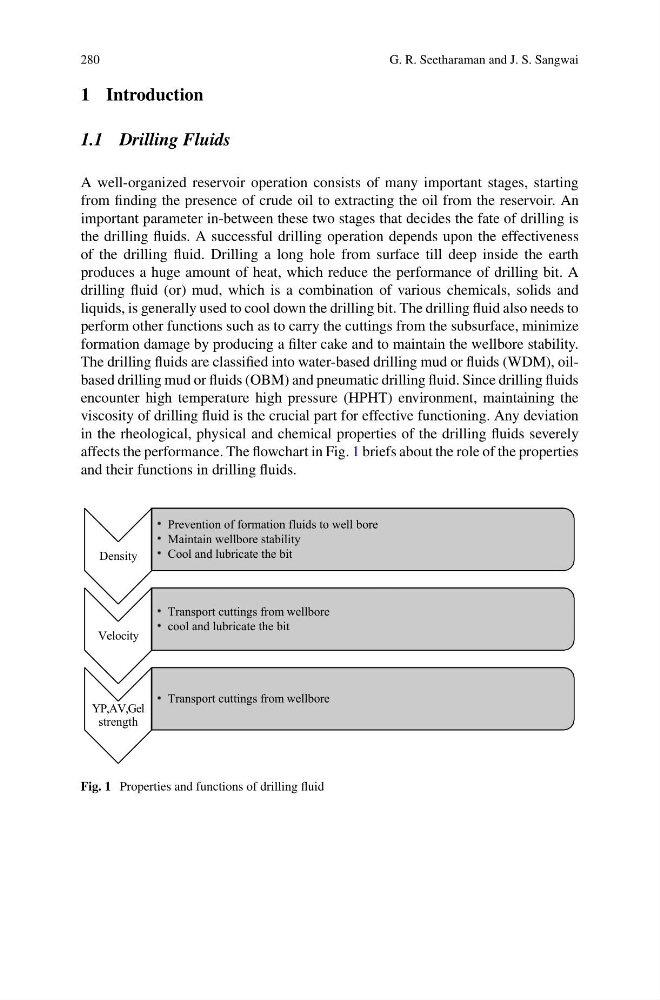
affects the performance. The flowchart in Fig. 1 briefs about the role of the properties
and their functions in drilling fluids.
Density
Prevention of formation fluids to well bore
Maintain wellbore stability
Cool and lubricate the bit
Velocity
Transport cuttings from wellbore
cool and lubricate the bit
YP,AV,Gel
strength
Transport cuttings from wellbore
Fig. 1 Properties and functions of drilling fluid
G. R. Seetharaman and J. S. Sangwai
1 Introduction
1.1 Drilling Fluids
A well-organized reservoir operation consists of many important stages, starting
from finding the presence of crude oil to extracting the oil from the reservoir. An
important parameter in-between these two stages that decides the fate of drilling is
the drilling fluids. A successful drilling operation depends upon the effectiveness
of the drilling fluid. Drilling a long hole from surface till deep inside the earth
produces a huge amount of heat, which reduce the performance of drilling bit. A
drilling fluid (or) mud, which is a combination of various chemicals, solids and
liquids, is generally used to cool down the drilling bit. The drilling fluid also needs to
perform other functions such as to carry the cuttings from the subsurface, minimize
formation damage by producing a filter cake and to maintain the wellbore stability.
The drilling fluids are classified into water-based drilling mud or fluids (WDM), oilbased drilling mud or fluids (OBM) and pneumatic drilling fluid. Since drilling fluids
encounter high temperature high pressure (HPHT) environment, maintaining the
viscosity of drilling fluid is the crucial part for effective functioning. Any deviation
in the rheological, physical and chemical properties of the drilling fluids severely
affects the performance. The flowchart in Fig. 1 briefs about the role of the properties
and their functions in drilling fluids.
Density
Prevention of formation fluids to well bore
Maintain wellbore stability
Cool and lubricate the bit
Velocity
Transport cuttings from wellbore
cool and lubricate the bit
YP,AV,Gel
strength
Transport cuttings from wellbore
Fig. 1 Properties and functions of drilling fluid