

246
R. M. Jadhav and J. S. Sangwai
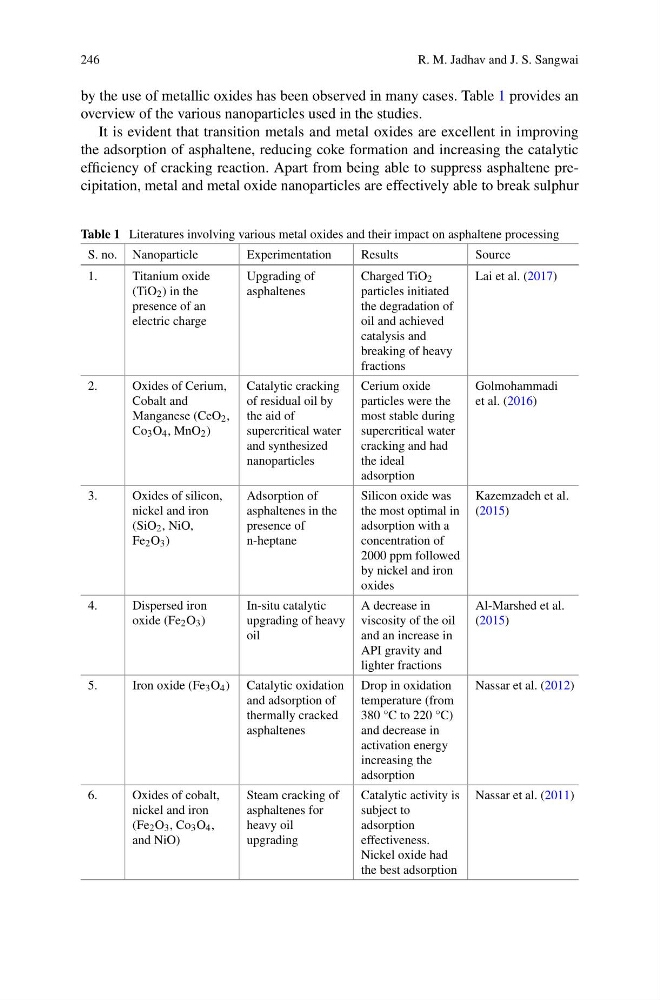
by the use of metallic oxides has been observed in many cases. Table 1 provides an
overview of the various nanoparticles used in the studies.
It is evident that transition metals and metal oxides are excellent in improving
the adsorption of asphaltene, reducing coke formation and increasing the catalytic
efficiency of cracking reaction. Apart from being able to suppress asphaltene precipitation, metal and metal oxide nanoparticles are effectively able to break sulphur
Table 1 Literatures involving various metal oxides and their impact on asphaltene processing
S. no. Nanoparticle
Experimentation
Results
Source
1.
Titanium oxide
(TiO 2 ) in the
presence of an
electric charge
Upgrading of
asphaltenes
Charged TiO 2
particles initiated
the degradation of
oil and achieved
catalysis and
breaking of heavy
fractions
Lai et al. (2017)
2.
Oxides of Cerium,
Cobalt and
Manganese (CeO 2 ,
Co 3 O 4 , MnO 2 )
Catalytic cracking
of residual oil by
the aid of
supercritical water
and synthesized
nanoparticles
Cerium oxide
particles were the
most stable during
supercritical water
cracking and had
the ideal
adsorption
Golmohammadi
et al. (2016)
3.
Oxides of silicon,
nickel and iron
(SiO 2 , NiO,
Fe 2 O 3 )
Adsorption of
asphaltenes in the
presence of
n-heptane
Silicon oxide was
the most optimal in
adsorption with a
concentration of
2000 ppm followed
by nickel and iron
oxides
Kazemzadeh et al.
(2015)
4.
Dispersed iron
oxide (Fe 2 O 3 )
In-situ catalytic
upgrading of heavy
oil
A decrease in
viscosity of the oil
and an increase in
API gravity and
lighter fractions
Al-Marshed et al.
(2015)
5.
Iron oxide (Fe 3 O 4 ) Catalytic oxidation
and adsorption of
thermally cracked
asphaltenes
Drop in oxidation
temperature (from
380 °C to 220 °C)
and decrease in
activation energy
increasing the
adsorption
Nassar et al. (2012)
6.
Oxides of cobalt,
nickel and iron
(Fe 2 O 3 , Co 3 O 4 ,
and NiO)
Steam cracking of
asphaltenes for
heavy oil
upgrading
Catalytic activity is
subject to
adsorption
effectiveness.
Nickel oxide had
the best adsorption
Nassar et al. (2011)
R. M. Jadhav and J. S. Sangwai
by the use of metallic oxides has been observed in many cases. Table 1 provides an
overview of the various nanoparticles used in the studies.
It is evident that transition metals and metal oxides are excellent in improving
the adsorption of asphaltene, reducing coke formation and increasing the catalytic
efficiency of cracking reaction. Apart from being able to suppress asphaltene precipitation, metal and metal oxide nanoparticles are effectively able to break sulphur
Table 1 Literatures involving various metal oxides and their impact on asphaltene processing
S. no. Nanoparticle
Experimentation
Results
Source
1.
Titanium oxide
(TiO 2 ) in the
presence of an
electric charge
Upgrading of
asphaltenes
Charged TiO 2
particles initiated
the degradation of
oil and achieved
catalysis and
breaking of heavy
fractions
Lai et al. (2017)
2.
Oxides of Cerium,
Cobalt and
Manganese (CeO 2 ,
Co 3 O 4 , MnO 2 )
Catalytic cracking
of residual oil by
the aid of
supercritical water
and synthesized
nanoparticles
Cerium oxide
particles were the
most stable during
supercritical water
cracking and had
the ideal
adsorption
Golmohammadi
et al. (2016)
3.
Oxides of silicon,
nickel and iron
(SiO 2 , NiO,
Fe 2 O 3 )
Adsorption of
asphaltenes in the
presence of
n-heptane
Silicon oxide was
the most optimal in
adsorption with a
concentration of
2000 ppm followed
by nickel and iron
oxides
Kazemzadeh et al.
(2015)
4.
Dispersed iron
oxide (Fe 2 O 3 )
In-situ catalytic
upgrading of heavy
oil
A decrease in
viscosity of the oil
and an increase in
API gravity and
lighter fractions
Al-Marshed et al.
(2015)
5.
Iron oxide (Fe 3 O 4 ) Catalytic oxidation
and adsorption of
thermally cracked
asphaltenes
Drop in oxidation
temperature (from
380 °C to 220 °C)
and decrease in
activation energy
increasing the
adsorption
Nassar et al. (2012)
6.
Oxides of cobalt,
nickel and iron
(Fe 2 O 3 , Co 3 O 4 ,
and NiO)
Steam cracking of
asphaltenes for
heavy oil
upgrading
Catalytic activity is
subject to
adsorption
effectiveness.
Nickel oxide had
the best adsorption
Nassar et al. (2011)