

242
R. M. Jadhav and J. S. Sangwai
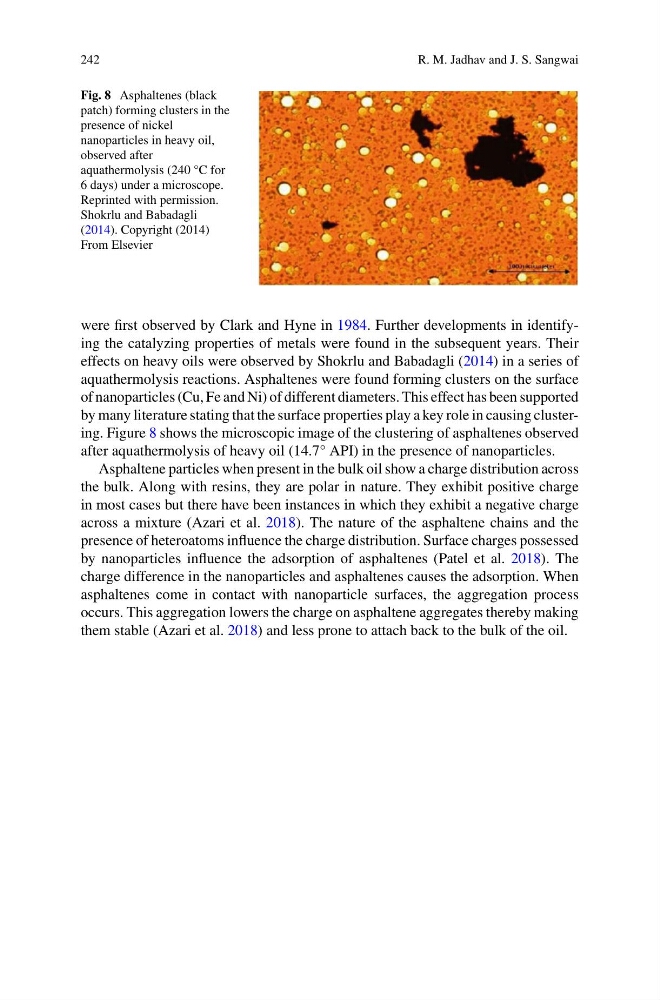
Fig. 8 Asphaltenes (black
patch) forming clusters in the
presence of nickel
nanoparticles in heavy oil,
observed after
aquathermolysis (240 °C for
6 days) under a microscope.
Reprinted with permission.
Shokrlu and Babadagli
(2014). Copyright (2014)
From Elsevier
were first observed by Clark and Hyne in 1984. Further developments in identifying the catalyzing properties of metals were found in the subsequent years. Their
effects on heavy oils were observed by Shokrlu and Babadagli (2014) in a series of
aquathermolysis reactions. Asphaltenes were found forming clusters on the surface
of nanoparticles (Cu, Fe and Ni) of different diameters. This effect has been supported
by many literature stating that the surface properties play a key role in causing clustering. Figure 8 shows the microscopic image of the clustering of asphaltenes observed
after aquathermolysis of heavy oil (14.7° API) in the presence of nanoparticles.
Asphaltene particles when present in the bulk oil show a charge distribution across
the bulk. Along with resins, they are polar in nature. They exhibit positive charge
in most cases but there have been instances in which they exhibit a negative charge
across a mixture (Azari et al. 2018). The nature of the asphaltene chains and the
presence of heteroatoms influence the charge distribution. Surface charges possessed
by nanoparticles influence the adsorption of asphaltenes (Patel et al. 2018). The
charge difference in the nanoparticles and asphaltenes causes the adsorption. When
asphaltenes come in contact with nanoparticle surfaces, the aggregation process
occurs. This aggregation lowers the charge on asphaltene aggregates thereby making
them stable (Azari et al. 2018) and less prone to attach back to the bulk of the oil.
R. M. Jadhav and J. S. Sangwai
Fig. 8 Asphaltenes (black
patch) forming clusters in the
presence of nickel
nanoparticles in heavy oil,
observed after
aquathermolysis (240 °C for
6 days) under a microscope.
Reprinted with permission.
Shokrlu and Babadagli
(2014). Copyright (2014)
From Elsevier
were first observed by Clark and Hyne in 1984. Further developments in identifying the catalyzing properties of metals were found in the subsequent years. Their
effects on heavy oils were observed by Shokrlu and Babadagli (2014) in a series of
aquathermolysis reactions. Asphaltenes were found forming clusters on the surface
of nanoparticles (Cu, Fe and Ni) of different diameters. This effect has been supported
by many literature stating that the surface properties play a key role in causing clustering. Figure 8 shows the microscopic image of the clustering of asphaltenes observed
after aquathermolysis of heavy oil (14.7° API) in the presence of nanoparticles.
Asphaltene particles when present in the bulk oil show a charge distribution across
the bulk. Along with resins, they are polar in nature. They exhibit positive charge
in most cases but there have been instances in which they exhibit a negative charge
across a mixture (Azari et al. 2018). The nature of the asphaltene chains and the
presence of heteroatoms influence the charge distribution. Surface charges possessed
by nanoparticles influence the adsorption of asphaltenes (Patel et al. 2018). The
charge difference in the nanoparticles and asphaltenes causes the adsorption. When
asphaltenes come in contact with nanoparticle surfaces, the aggregation process
occurs. This aggregation lowers the charge on asphaltene aggregates thereby making
them stable (Azari et al. 2018) and less prone to attach back to the bulk of the oil.