

Interaction of Heavy Crude Oil and Nanoparticles …
235
3. Steam-assisted gravity drainage (SAGD).
4. Cold heavy oil production by sand (CHOPS).
The methods mentioned above are used, some more than others, and are important
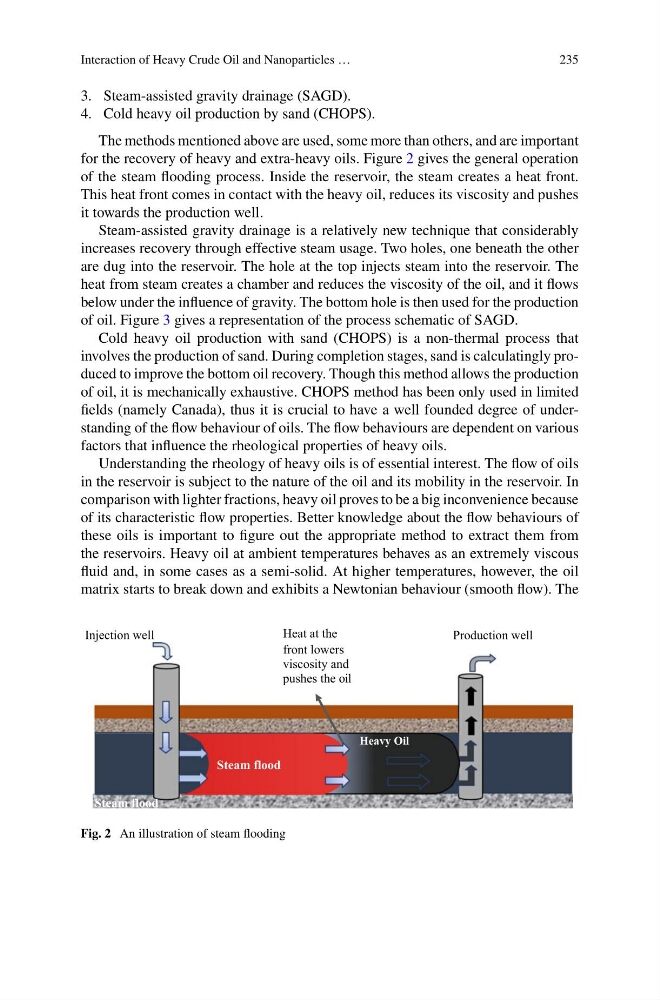
for the recovery of heavy and extra-heavy oils. Figure 2 gives the general operation
of the steam flooding process. Inside the reservoir, the steam creates a heat front.
This heat front comes in contact with the heavy oil, reduces its viscosity and pushes
it towards the production well.
Steam-assisted gravity drainage is a relatively new technique that considerably
increases recovery through effective steam usage. Two holes, one beneath the other
are dug into the reservoir. The hole at the top injects steam into the reservoir. The
heat from steam creates a chamber and reduces the viscosity of the oil, and it flows
below under the influence of gravity. The bottom hole is then used for the production
of oil. Figure 3 gives a representation of the process schematic of SAGD.
Cold heavy oil production with sand (CHOPS) is a non-thermal process that
involves the production of sand. During completion stages, sand is calculatingly produced to improve the bottom oil recovery. Though this method allows the production
of oil, it is mechanically exhaustive. CHOPS method has been only used in limited
fields (namely Canada), thus it is crucial to have a well founded degree of understanding of the flow behaviour of oils. The flow behaviours are dependent on various
factors that influence the rheological properties of heavy oils.
Understanding the rheology of heavy oils is of essential interest. The flow of oils
in the reservoir is subject to the nature of the oil and its mobility in the reservoir. In
comparison with lighter fractions, heavy oil proves to be a big inconvenience because
of its characteristic flow properties. Better knowledge about the flow behaviours of
these oils is important to figure out the appropriate method to extract them from
the reservoirs. Heavy oil at ambient temperatures behaves as an extremely viscous
fluid and, in some cases as a semi-solid. At higher temperatures, however, the oil
matrix starts to break down and exhibits a Newtonian behaviour (smooth flow). The
Heavy Oil
Injection well
Heat at the
front lowers
viscosity and
pushes the oil
Production well
Steam flood
Steam flood
Fig. 2 An illustration of steam flooding
235
3. Steam-assisted gravity drainage (SAGD).
4. Cold heavy oil production by sand (CHOPS).
The methods mentioned above are used, some more than others, and are important
for the recovery of heavy and extra-heavy oils. Figure 2 gives the general operation
of the steam flooding process. Inside the reservoir, the steam creates a heat front.
This heat front comes in contact with the heavy oil, reduces its viscosity and pushes
it towards the production well.
Steam-assisted gravity drainage is a relatively new technique that considerably
increases recovery through effective steam usage. Two holes, one beneath the other
are dug into the reservoir. The hole at the top injects steam into the reservoir. The
heat from steam creates a chamber and reduces the viscosity of the oil, and it flows
below under the influence of gravity. The bottom hole is then used for the production
of oil. Figure 3 gives a representation of the process schematic of SAGD.
Cold heavy oil production with sand (CHOPS) is a non-thermal process that
involves the production of sand. During completion stages, sand is calculatingly produced to improve the bottom oil recovery. Though this method allows the production
of oil, it is mechanically exhaustive. CHOPS method has been only used in limited
fields (namely Canada), thus it is crucial to have a well founded degree of understanding of the flow behaviour of oils. The flow behaviours are dependent on various
factors that influence the rheological properties of heavy oils.
Understanding the rheology of heavy oils is of essential interest. The flow of oils
in the reservoir is subject to the nature of the oil and its mobility in the reservoir. In
comparison with lighter fractions, heavy oil proves to be a big inconvenience because
of its characteristic flow properties. Better knowledge about the flow behaviours of
these oils is important to figure out the appropriate method to extract them from
the reservoirs. Heavy oil at ambient temperatures behaves as an extremely viscous
fluid and, in some cases as a semi-solid. At higher temperatures, however, the oil
matrix starts to break down and exhibits a Newtonian behaviour (smooth flow). The
Heavy Oil
Injection well
Heat at the
front lowers
viscosity and
pushes the oil
Production well
Steam flood
Steam flood
Fig. 2 An illustration of steam flooding