

A Review on Contemporary Hole Transport Materials …
153
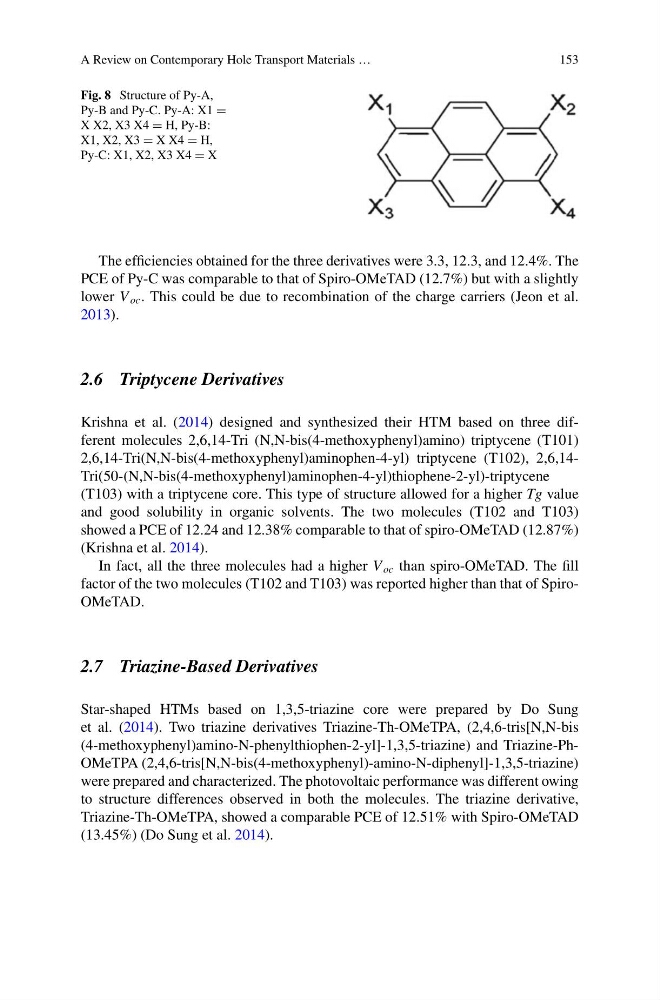
Fig. 8 Structure of Py-A,
Py-B and Py-C. Py-A: X1 =
X X2, X3 X4 = H, Py-B:
X1, X2, X3 = X X4 = H,
Py-C: X1, X2, X3 X4 = X
The efficiencies obtained for the three derivatives were 3.3, 12.3, and 12.4%. The
PCE of Py-C was comparable to that of Spiro-OMeTAD (12.7%) but with a slightly
lower V oc . This could be due to recombination of the charge carriers (Jeon et al.
2013).
2.6 Triptycene Derivatives
Krishna et al. (2014) designed and synthesized their HTM based on three different molecules 2,6,14-Tri (N,N-bis(4-methoxyphenyl)amino) triptycene (T101)
2,6,14-Tri(N,N-bis(4-methoxyphenyl)aminophen-4-yl) triptycene (T102), 2,6,14Tri(50-(N,N-bis(4-methoxyphenyl)aminophen-4-yl)thiophene-2-yl)-triptycene
(T103) with a triptycene core. This type of structure allowed for a higher Tg value
and good solubility in organic solvents. The two molecules (T102 and T103)
showed a PCE of 12.24 and 12.38% comparable to that of spiro-OMeTAD (12.87%)
(Krishna et al. 2014).
In fact, all the three molecules had a higher V oc than spiro-OMeTAD. The fill
factor of the two molecules (T102 and T103) was reported higher than that of SpiroOMeTAD.
2.7 Triazine-Based Derivatives
Star-shaped HTMs based on 1,3,5-triazine core were prepared by Do Sung
et al. (2014). Two triazine derivatives Triazine-Th-OMeTPA, (2,4,6-tris[N,N-bis
(4-methoxyphenyl)amino-N-phenylthiophen-2-yl]-1,3,5-triazine) and Triazine-PhOMeTPA (2,4,6-tris[N,N-bis(4-methoxyphenyl)-amino-N-diphenyl]-1,3,5-triazine)
were prepared and characterized. The photovoltaic performance was different owing
to structure differences observed in both the molecules. The triazine derivative,
Triazine-Th-OMeTPA, showed a comparable PCE of 12.51% with Spiro-OMeTAD
(13.45%) (Do Sung et al. 2014).
153
Fig. 8 Structure of Py-A,
Py-B and Py-C. Py-A: X1 =
X X2, X3 X4 = H, Py-B:
X1, X2, X3 = X X4 = H,
Py-C: X1, X2, X3 X4 = X
The efficiencies obtained for the three derivatives were 3.3, 12.3, and 12.4%. The
PCE of Py-C was comparable to that of Spiro-OMeTAD (12.7%) but with a slightly
lower V oc . This could be due to recombination of the charge carriers (Jeon et al.
2013).
2.6 Triptycene Derivatives
Krishna et al. (2014) designed and synthesized their HTM based on three different molecules 2,6,14-Tri (N,N-bis(4-methoxyphenyl)amino) triptycene (T101)
2,6,14-Tri(N,N-bis(4-methoxyphenyl)aminophen-4-yl) triptycene (T102), 2,6,14Tri(50-(N,N-bis(4-methoxyphenyl)aminophen-4-yl)thiophene-2-yl)-triptycene
(T103) with a triptycene core. This type of structure allowed for a higher Tg value
and good solubility in organic solvents. The two molecules (T102 and T103)
showed a PCE of 12.24 and 12.38% comparable to that of spiro-OMeTAD (12.87%)
(Krishna et al. 2014).
In fact, all the three molecules had a higher V oc than spiro-OMeTAD. The fill
factor of the two molecules (T102 and T103) was reported higher than that of SpiroOMeTAD.
2.7 Triazine-Based Derivatives
Star-shaped HTMs based on 1,3,5-triazine core were prepared by Do Sung
et al. (2014). Two triazine derivatives Triazine-Th-OMeTPA, (2,4,6-tris[N,N-bis
(4-methoxyphenyl)amino-N-phenylthiophen-2-yl]-1,3,5-triazine) and Triazine-PhOMeTPA (2,4,6-tris[N,N-bis(4-methoxyphenyl)-amino-N-diphenyl]-1,3,5-triazine)
were prepared and characterized. The photovoltaic performance was different owing
to structure differences observed in both the molecules. The triazine derivative,
Triazine-Th-OMeTPA, showed a comparable PCE of 12.51% with Spiro-OMeTAD
(13.45%) (Do Sung et al. 2014).