

152
S. Nair and J. V. Gohel
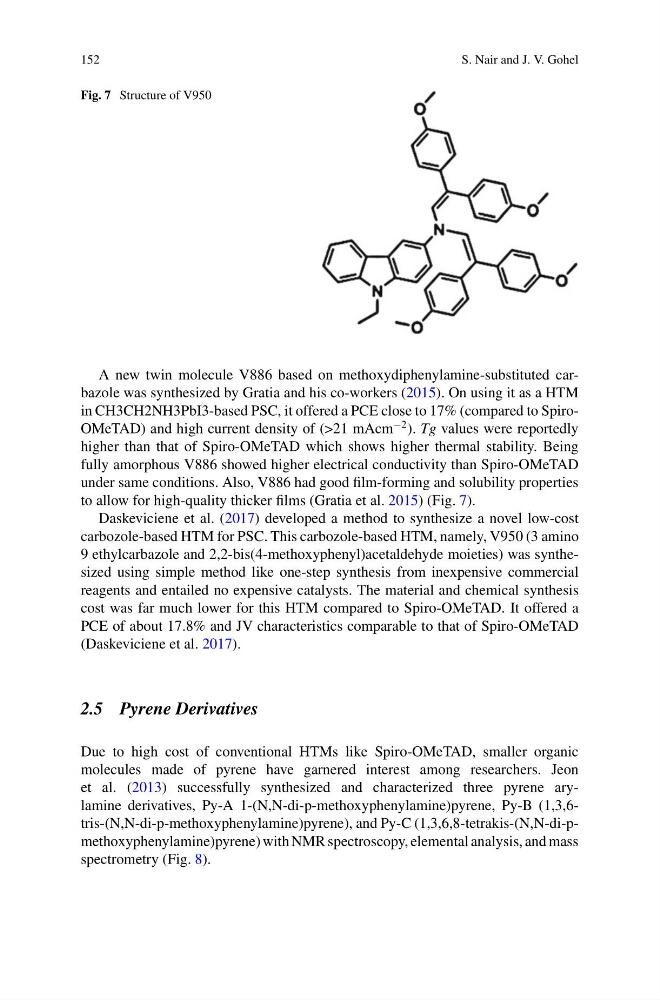
Fig. 7 Structure of V950
A new twin molecule V886 based on methoxydiphenylamine-substituted carbazole was synthesized by Gratia and his co-workers (2015). On using it as a HTM
in CH3CH2NH3PbI3-based PSC, it offered a PCE close to 17% (compared to SpiroOMeTAD) and high current density of (>21 mAcm
−2 ). Tg values were reportedly
higher than that of Spiro-OMeTAD which shows higher thermal stability. Being
fully amorphous V886 showed higher electrical conductivity than Spiro-OMeTAD
under same conditions. Also, V886 had good film-forming and solubility properties
to allow for high-quality thicker films (Gratia et al. 2015) (Fig. 7).
Daskeviciene et al. (2017) developed a method to synthesize a novel low-cost
carbozole-based HTM for PSC. This carbozole-based HTM, namely, V950 (3 amino
9 ethylcarbazole and 2,2-bis(4-methoxyphenyl)acetaldehyde moieties) was synthesized using simple method like one-step synthesis from inexpensive commercial
reagents and entailed no expensive catalysts. The material and chemical synthesis
cost was far much lower for this HTM compared to Spiro-OMeTAD. It offered a
PCE of about 17.8% and JV characteristics comparable to that of Spiro-OMeTAD
(Daskeviciene et al. 2017).
2.5 Pyrene Derivatives
Due to high cost of conventional HTMs like Spiro-OMeTAD, smaller organic
molecules made of pyrene have garnered interest among researchers. Jeon
et al. (2013) successfully synthesized and characterized three pyrene arylamine derivatives, Py-A 1-(N,N-di-p-methoxyphenylamine)pyrene, Py-B (1,3,6tris-(N,N-di-p-methoxyphenylamine)pyrene), and Py-C (1,3,6,8-tetrakis-(N,N-di-pmethoxyphenylamine)pyrene) with NMR spectroscopy, elemental analysis, and mass
spectrometry (Fig. 8).
S. Nair and J. V. Gohel
Fig. 7 Structure of V950
A new twin molecule V886 based on methoxydiphenylamine-substituted carbazole was synthesized by Gratia and his co-workers (2015). On using it as a HTM
in CH3CH2NH3PbI3-based PSC, it offered a PCE close to 17% (compared to SpiroOMeTAD) and high current density of (>21 mAcm
−2 ). Tg values were reportedly
higher than that of Spiro-OMeTAD which shows higher thermal stability. Being
fully amorphous V886 showed higher electrical conductivity than Spiro-OMeTAD
under same conditions. Also, V886 had good film-forming and solubility properties
to allow for high-quality thicker films (Gratia et al. 2015) (Fig. 7).
Daskeviciene et al. (2017) developed a method to synthesize a novel low-cost
carbozole-based HTM for PSC. This carbozole-based HTM, namely, V950 (3 amino
9 ethylcarbazole and 2,2-bis(4-methoxyphenyl)acetaldehyde moieties) was synthesized using simple method like one-step synthesis from inexpensive commercial
reagents and entailed no expensive catalysts. The material and chemical synthesis
cost was far much lower for this HTM compared to Spiro-OMeTAD. It offered a
PCE of about 17.8% and JV characteristics comparable to that of Spiro-OMeTAD
(Daskeviciene et al. 2017).
2.5 Pyrene Derivatives
Due to high cost of conventional HTMs like Spiro-OMeTAD, smaller organic
molecules made of pyrene have garnered interest among researchers. Jeon
et al. (2013) successfully synthesized and characterized three pyrene arylamine derivatives, Py-A 1-(N,N-di-p-methoxyphenylamine)pyrene, Py-B (1,3,6tris-(N,N-di-p-methoxyphenylamine)pyrene), and Py-C (1,3,6,8-tetrakis-(N,N-di-pmethoxyphenylamine)pyrene) with NMR spectroscopy, elemental analysis, and mass
spectrometry (Fig. 8).