

114
A. Bagaria and S. Ramakumar
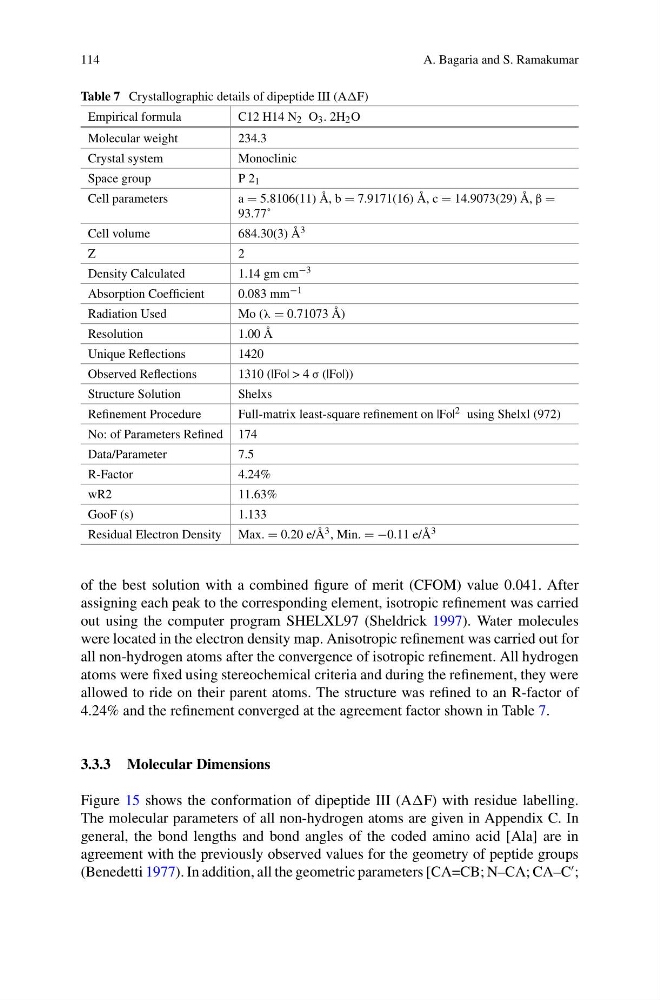
Table 7 Crystallographic details of dipeptide III (AF)
Empirical formula
C12 H14 N 2 O 3 . 2H 2 O
Molecular weight
234.3
Crystal system
Monoclinic
Space group
P 2 1
Cell parameters
a = 5.8106(11) Å, b = 7.9171(16) Å, c = 14.9073(29) Å, β =
93.77˚
Cell volume
684.30(3) Å 3
Z
2
Density Calculated
1.14 gm cm −3
Absorption Coefficient
0.083 mm −1
Radiation Used
Mo (λ = 0.71073 Å)
Resolution
1.00 Å
Unique Reflections
1420
Observed Reflections
1310 (|Fo| > 4 σ (|Fo|))
Structure Solution
Shelxs
Refinement Procedure
Full-matrix least-square refinement on |Fo| 2 using Shelxl (972)
No: of Parameters Refined 174
Data/Parameter
7.5
R-Factor
4.24%
wR2
11.63%
GooF (s)
1.133
Residual Electron Density Max. = 0.20 e/Å 3 , Min. = −0.11 e/Å 3
of the best solution with a combined figure of merit (CFOM) value 0.041. After
assigning each peak to the corresponding element, isotropic refinement was carried
out using the computer program SHELXL97 (Sheldrick 1997). Water molecules
were located in the electron density map. Anisotropic refinement was carried out for
all non-hydrogen atoms after the convergence of isotropic refinement. All hydrogen
atoms were fixed using stereochemical criteria and during the refinement, they were
allowed to ride on their parent atoms. The structure was refined to an R-factor of
4.24% and the refinement converged at the agreement factor shown in Table 7.
3.3.3 Molecular Dimensions
Figure 15 shows the conformation of dipeptide III (AF) with residue labelling.
The molecular parameters of all non-hydrogen atoms are given in Appendix C. In
general, the bond lengths and bond angles of the coded amino acid [Ala] are in
agreement with the previously observed values for the geometry of peptide groups
(Benedetti 1977). In addition, all the geometric parameters [CA=CB; N–CA; CA–C
;
A. Bagaria and S. Ramakumar
Table 7 Crystallographic details of dipeptide III (AF)
Empirical formula
C12 H14 N 2 O 3 . 2H 2 O
Molecular weight
234.3
Crystal system
Monoclinic
Space group
P 2 1
Cell parameters
a = 5.8106(11) Å, b = 7.9171(16) Å, c = 14.9073(29) Å, β =
93.77˚
Cell volume
684.30(3) Å 3
Z
2
Density Calculated
1.14 gm cm −3
Absorption Coefficient
0.083 mm −1
Radiation Used
Mo (λ = 0.71073 Å)
Resolution
1.00 Å
Unique Reflections
1420
Observed Reflections
1310 (|Fo| > 4 σ (|Fo|))
Structure Solution
Shelxs
Refinement Procedure
Full-matrix least-square refinement on |Fo| 2 using Shelxl (972)
No: of Parameters Refined 174
Data/Parameter
7.5
R-Factor
4.24%
wR2
11.63%
GooF (s)
1.133
Residual Electron Density Max. = 0.20 e/Å 3 , Min. = −0.11 e/Å 3
of the best solution with a combined figure of merit (CFOM) value 0.041. After
assigning each peak to the corresponding element, isotropic refinement was carried
out using the computer program SHELXL97 (Sheldrick 1997). Water molecules
were located in the electron density map. Anisotropic refinement was carried out for
all non-hydrogen atoms after the convergence of isotropic refinement. All hydrogen
atoms were fixed using stereochemical criteria and during the refinement, they were
allowed to ride on their parent atoms. The structure was refined to an R-factor of
4.24% and the refinement converged at the agreement factor shown in Table 7.
3.3.3 Molecular Dimensions
Figure 15 shows the conformation of dipeptide III (AF) with residue labelling.
The molecular parameters of all non-hydrogen atoms are given in Appendix C. In
general, the bond lengths and bond angles of the coded amino acid [Ala] are in
agreement with the previously observed values for the geometry of peptide groups
(Benedetti 1977). In addition, all the geometric parameters [CA=CB; N–CA; CA–C
;